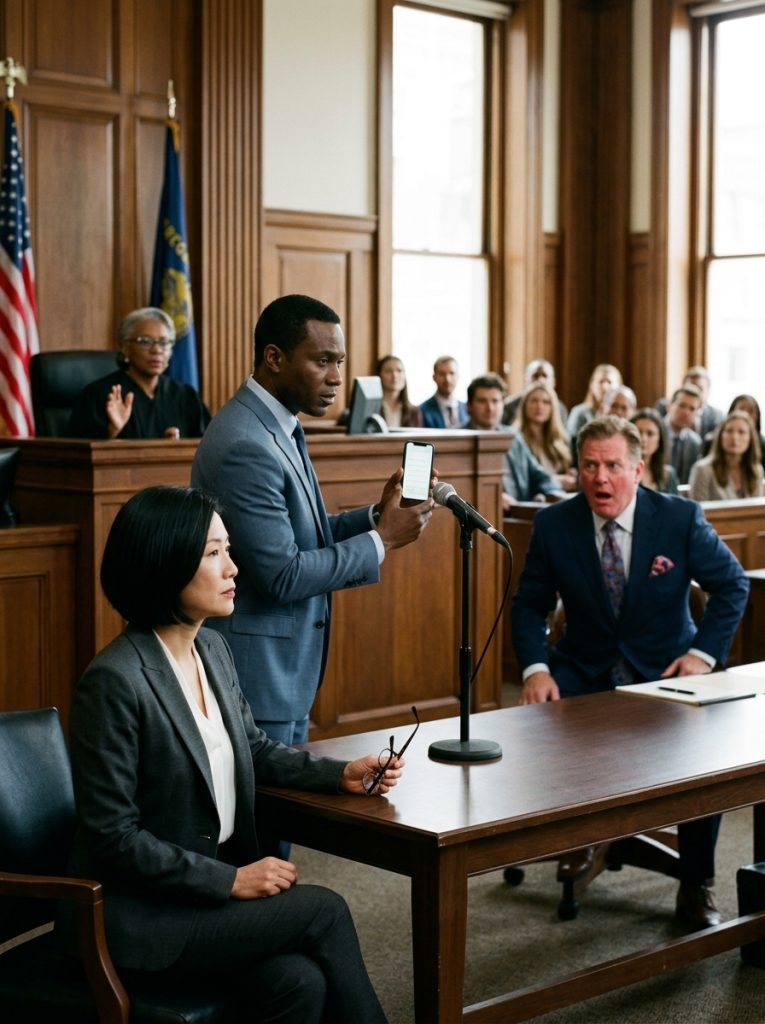
The voicemail played in a silent courtroom, and Greg Dunn’s own voice convicted him in forty-one seconds.
I’d heard it a hundred times by then, preparing. It still made the hair on my arms stand up to hear it fill that wood-paneled room.
It opened with him laughing. Slurring. A bar in the background. “Viv — Vivian, hey, it’s Greg.” A pause to find the thread. “Listen, the Hartwell thing. Don’t — don’t kill yourself on it, okay? It’s handled. I handled it.” Another laugh, ugly and pleased with itself. “Between us? It was never gonna close. I made sure. Couple calls to the right people, a little birdie tells Hartwell our lead time’s a fantasy — boom, deal’s dead, and guess whose fault it is? Not mine.” Then the part that ended him: “She’ll be gone by spring. Board’ll hand me the whole thing for a song. Anyway. Delivery date’s the fourteenth, write it down. Night.”
Click.
In 2019, he’d meant to brag to a friend and dialed me by mistake — or dialed me drunk and forgot I existed by the time it beeped. I’d saved it for the delivery date and never listened past the boring part. For two years the confession of the man trying to destroy me sat in my own phone, three taps away, while I lay awake wondering if maybe he was right, maybe I really couldn’t run a business.
He wasn’t bragging about my incompetence. He was bragging about his sabotage. On a date that proved he’d planned my removal years before he ever filed the lawsuit “for cause.”
I keep thinking about the afternoon Daniel first heard it, three weeks before trial. We were drowning, honestly. Greg’s filing was thick and confident and full of half-truths dressed as fact, and I’d spent a month feeling like I was trying to prove I was a good mother to a child I supposedly drowned. I’d played him the voicemail almost as gallows humor — see what I put up with — and Daniel had made me play it three more times, and then he’d sat back and gone quiet for a full minute. “Vivian,” he finally said, “do you understand what you’ve been carrying around in your pocket?” I didn’t, not really. I’d been so busy believing the smaller story about myself that I’d stopped hearing the larger one in my own phone.
After that, the work was relentless. Daniel and I spent nights at my kitchen table with the company’s records spread everywhere, and the more we pulled, the worse it looked for Greg and the better it looked for the truth.
When it finished, nobody in the courtroom moved. Then Greg’s attorney started talking very fast about authenticity and foundation and admissibility, and my lawyer, Daniel, calmly handed up everything that answered him before he could finish.
Because a drunk voicemail is a grenade, but it isn’t a case by itself. Daniel had spent three weeks building the case around it.
He’d subpoenaed Hartwell’s procurement team. Two of them testified — by deposition, read into the record — that someone claiming to represent “internal concerns at Marrow & Oak” had warned them our production timelines were unreliable, right before the deal collapsed. The phone number that someone called from traced back to a burner, but the burner had been bought with a card, and the card was Greg’s.
Daniel had pulled the company financials Greg controlled as the money partner — the ones he’d kept me away from while calling me “the talent.” It turned out Greg had been routing Marrow & Oak’s “consulting fees” to an LLC that was, under three layers, Greg. He’d been bleeding the company he was trying to seize, then pointing at the bleeding as proof I couldn’t manage. The crisis he blamed on me was a crisis he was personally manufacturing on two fronts.
And Daniel had the timeline. The voicemail in 2019. The first whispers to the board in 2021. The lawsuit in 2023. A patient, documented, two-year campaign to take a company by making its founder look like she was sinking it.
The judge — her name is Whitfield, and she missed nothing — listened to all of it with her chin on her hand. When Greg’s lawyer made one last push to have me removed “for the protection of the business,” she looked at him over her glasses and said the line I will remember until I die.
“Counsel, the only person this record shows endangering the business is your client. Sit down.”
She ruled from the bench.
She denied the petition to remove me. She found that Greg had breached his fiduciary duty — that’s the legal way of saying a partner is supposed to act in the company’s interest and he had done the precise opposite, with intent, for years. She referred the financial findings, the self-dealing LLC and the routed fees, to the proper authorities, because manufacturing a corporate crisis is a lawsuit and draining the company is potentially something with handcuffs in it.
I watched Greg Dunn go from ruddy to gray to a color I don’t have a name for, and I felt almost nothing, which surprised me. I’d expected triumph. Mostly I felt tired, and clean, the way you feel when a fever finally breaks.
Here is how it actually ended, beyond the courtroom.
The court unwound Greg’s position. The self-dealing voided the protections he’d written for himself, and the buyout clause he’d planned to use against me became the lever that forced him out instead — he was bought out, at a number set by the damage he’d done, not the damage he’d invented. His shares came back to the company. My board seat, the one he’d spent two years undermining, was never in question again.
I own my company again. All of it that matters. Marrow & Oak is mine, the way it was in the garage with the borrowed table saw, except now I know exactly what a wolf in a good suit looks like, and I will never again mistake charm for an ally.
I told my crew everything afterward — the people who’d sanded and joined and finished alongside me for years, who’d watched me come into the shop hollow-eyed for two years and never knew why. I’d been too ashamed to tell them the founder might be voted out of her own company. When I finally laid it all out, the lead finisher, a man named Abe who’s been with me since the garage, just nodded slowly and said, “We knew it wasn’t you, boss. We didn’t know who. We’re glad you found out.” Then he went back to his bench, because that’s how our shop says it loves you.
The other thing — the thing I didn’t expect — was the manager. Going through Greg’s old emails in discovery, Daniel found that I wasn’t his first. Years before me, at another company, Greg had run a smaller version of the same play on a operations director named Theresa, who’d left the industry believing she simply wasn’t good enough. We found her. I called her myself. I told her what the documents showed: that she hadn’t failed, she’d been hunted. She was quiet for a long time on the phone, and then she said, “I’ve been carrying that for nine years.” I told her she could put it down now. She does some consulting for us these days. She’s extraordinary. She always was.
We reopened the Hartwell conversation, too, once their procurement team understood they’d been fed a lie by a man enriching himself. It didn’t close right away. But it closed. The deal that was supposed to be the proof of my incompetence is hanging, framed, in our workshop now — the contract, signed, the one Greg swore would bury me.
I kept the voicemail. Of course I kept it. I’m a person who never empties her voicemail box, and now you know exactly why.
But I don’t listen to it anymore. I don’t need to. It did its forty-one seconds of work in a silent courtroom, and then I got to go back to the only thing I ever actually wanted to do — which is stand at a bench in a workshop that’s mine, with a piece of oak and my own two hands, and build something honest that will outlast every word that man ever said about me.