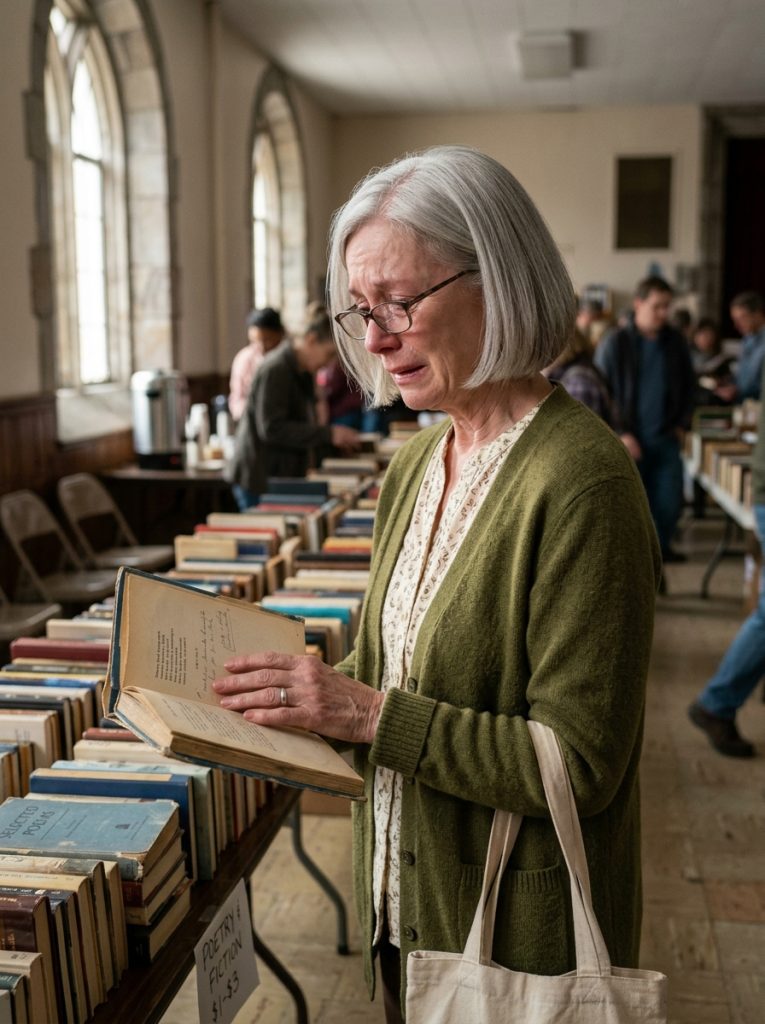
A young woman at the front desk of the care home asked who I was there to see.
I almost couldn’t answer. Sixty-eight years old and I stood in a bright lobby that smelled of disinfectant and lemon cake, clutching a dollar paperback, unable to make my mouth say his name. Finally I managed it. “Thomas Reyes. I’m — an old friend. From a long time ago.”
She smiled the careful smile they must teach them. “He has good days and not-as-good days. This is a quieter one. Don’t be discouraged if he’s somewhere else for a while. Sometimes things come back. Sometimes they don’t.”
She walked me down a hall hung with other people’s family photographs to a sunroom where an old man sat by the window.
I would not have known him on the street. Of course I wouldn’t. The boy I’d left in 1974 was nineteen and all energy; this was a thin man of seventy with a shock of soft white hair and slippers and hands folded loosely in his lap, watching the parking lot like it was a television.
But then he turned his head, and the eyes were the same. Fifty years older and somewhere far away, but the same.
“Hello,” he said politely. The voice of a man greeting a stranger. “Are you the new one? They keep changing the schedule.”
My heart cracked clean down the middle. He didn’t know me.
I sat in the chair beside him anyway. I’d driven across a city for this. I wasn’t leaving because it was hard.
“No,” I said. “I’m not staff. My name is Maggie.” I watched his face for anything. Nothing moved. “I brought you something, Thomas. I think it belongs to you.”
And I put the book of poems into his folded hands.
He looked down at it the way you look at any object handed to you — mild, unbothered. He turned it over. He opened the cover.
And he went very still.
His thumb found the inscription on the first leaf. The one I wrote in 1974, the one I told you I’d save. I’ll tell you now, because he read it out loud, in a whisper, in a sunroom in Maine, fifty years after I wrote it.
It said: “Tom — so you’ll always have someone arguing in the margins with you. Wherever I am. — M.”
He read it twice. His lips moved on the second pass. Then he lifted his head and he looked at me — really looked, the far-away thing in his eyes pulling closer and closer like a tide coming in — and he said, in a completely different voice, a young man’s voice almost:
“Maggie. You cut your hair.”
I started to cry the way you cry when something you’d given up on turns out to have been waiting.
For about forty minutes — the nurse later told me these windows are real, that a powerful old memory can pull a person all the way up to the surface for a little while — Thomas Reyes came back.
He remembered the bookstore where we met. He remembered the name of my terrible little car. He remembered the night before I moved, and the book, and that he’d argued with me about a poem on page forty and lost. He turned to page forty and there was his pencil argument, fifty years old, and he laughed at his younger self.
He remembered the lake, too. There was a lake that summer, and a dock we weren’t supposed to be on after dark, and a transistor radio he’d carried everywhere with one working earpiece we had to share. He hummed a few bars of a song and looked at me to finish it, and I did, badly, off-key, and he said, “You never could carry a tune,” and it was the kindest thing anyone had said to me in years because it was a thing only he could know.
He remembered writing to me. He said the letters stopped and he assumed I’d moved on, and he was too proud at twenty to chase a girl nine hundred miles, and then there was a marriage and a job and a daughter and a whole good life — but the book stayed on the nightstand, every house, every year. “I kept writing to you in it,” he said, touching the margins. “When I didn’t know where to send a letter, I’d just — write to you here.”
I turned to the note near the back. The shaky recent one. “M — the one I should have called.”
“I wrote that last spring,” he said quietly. “When I could still feel it slipping. I wanted to put it down before I lost it. I didn’t think you’d ever see it.” He looked up. “How did you—?”
“A book sale,” I said. “A dollar table. Your family donated your library when you came here.”
He was quiet a moment. Then he smiled, and it was entirely the boy I’d known. “So you found me through a book I never gave back. That’s about right. You always said I owed you a book.”
I need to tell you the true shape of this, because I promised myself I wouldn’t dress it up.
The window closed. It always does. Forty minutes, maybe forty-five, and then I watched the tide go back out of his eyes, slowly, and he asked me politely if I was the new one from the schedule. The forty minutes did not come back that day. He didn’t remember, an hour later, that I’d been there at all.
We did not get a second chance at a whole life. That ship sailed in 1974 and neither of us was brave enough to swim after it, and no reunion at the end can give back the fifty years in the middle. I know that. I’ve made my peace with the size of it, mostly, on the good days.
But here is what we got.
I come on Tuesdays now. I bring the book. We read the poems out loud — he likes that even on the foggy days, even when he doesn’t know my name, because the rhythm of being read to is older than memory. And every few visits, the book does its work, and the tide comes in, and for half an hour I get my Tom back. He calls me Maggie. He tells me I cut my hair. We argue about the poem on page forty. He always loses, and he always laughs.
I’ve learned the geography of those windows now. They don’t come on command. Some Tuesdays I read for an hour to a polite stranger who thinks I’m staff and never once surfaces, and I drive home and let myself cry in the car, and then I come back the next Tuesday, because that’s what you do. You don’t visit someone only on the days they can remember you. That’s not what the love was ever for. I spent fifty years being too proud and too busy and too far away. I am not going to be too anything ever again.
His daughter found me there one afternoon. She’d heard about “the woman who reads to Dad.” When I told her who I was, she put her hand over her mouth, and then she said, “You’re M. From the margins. We always wondered.” She hugged me in the hallway. She said her father had had a happy marriage and a good life and she didn’t want me to think otherwise — and I told her I was glad of it, truly, because I’d had one too. “But,” she said, “he never stopped writing to you in that book. We just didn’t know your last name.”
I sat with Thomas again last Tuesday. It was a foggy day; he didn’t surface. I read him the poem on page forty anyway, the one he always argued about, and at the end his eyes were closed and he was smiling, and his lips moved along with the last line like something his bones remembered even when his mind couldn’t.
I closed the book and held his hand by the window, two old people in the late light, and I did not feel cheated.
Fifty years late is still not too late to read a man his favorite poem.