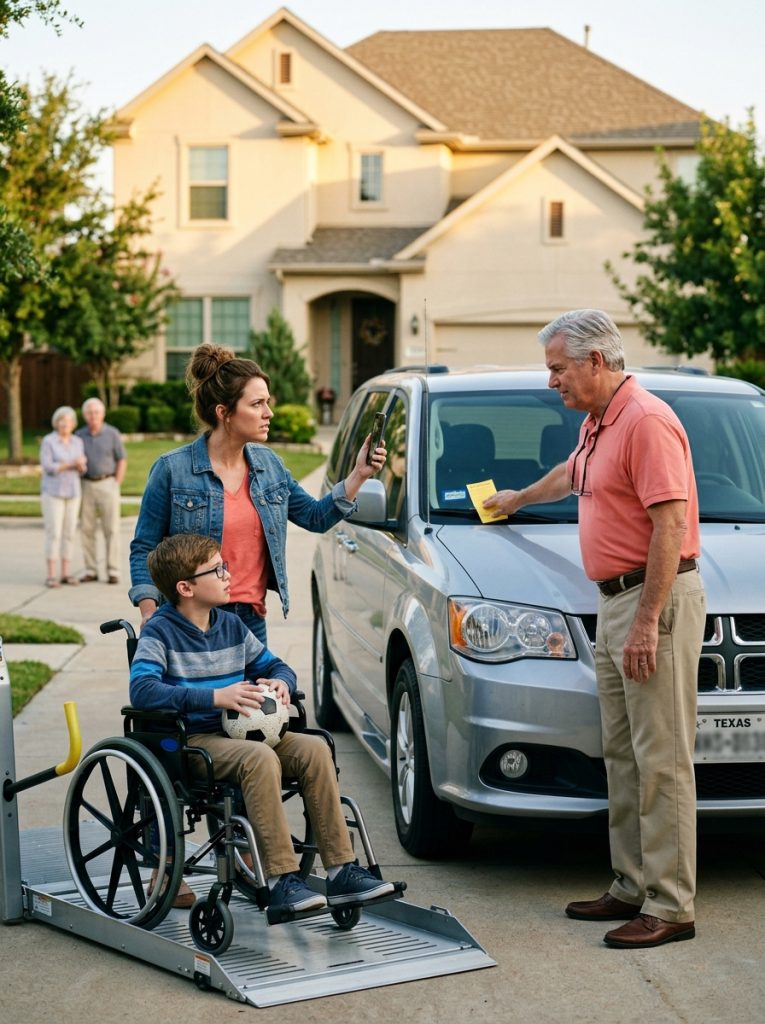
Roland Pike said the towing line twice. The second time, he said it slower, for the camera he didn’t know was rolling, because he wanted to be sure I understood.
I understood perfectly. I just wasn’t scared the way he wanted.
I lowered the phone, helped Eli’s lift the rest of the way down, and got my son into the van for his clinic. He’d heard all of it. On the drive he was quiet, and then he said, “Mom, is it true they can take the van?” And I told him the truth, which is that no, they couldn’t, and that some grown-ups confuse a rule book with a kingdom, and that we were going to be just fine. I believed it. But my hands were tight on the wheel the whole way.
I want you to understand what that month had actually been like, because the fines are only the part you can put a number on. Eli had started asking me to park the van in the garage so the neighbors wouldn’t “be mad” — a twelve-year-old learning to make himself smaller, to apologize for the equipment that keeps him alive. One morning Pike planted himself at the end of the driveway photographing us and Eli froze on the lift, halfway down, and refused to come the rest of the way while a grown man pointed a phone at him. We were late to therapy that day. I sat in the parking lot afterward and shook. That was the morning I decided I was done being polite about it.
Here’s what Roland Pike didn’t know about the two weeks before he stood in my driveway.
The woman two doors down — the one he’d also been fining, over a small flag she flies for a son who didn’t come home — is named Patrice. We’d gotten friendly at the mailboxes. And the week the first citation showed up on my windshield, Patrice mentioned, almost in passing, that before she retired she’d spent twenty years as a fair-housing attorney.
She did not say it as a threat. She said it as a neighbor. But she also said one sentence I wrote down: “Megan, a wheelchair lift is not a contractor’s ladder rack. They’re citing your son’s disability and calling it a vehicle code. There are federal laws with very sharp teeth about exactly that.”
So while Roland stacked his fines and parked across the street to photograph my driveway, Patrice and I had quietly done three things.
We’d filed a reasonable-accommodation request with the HOA in writing — the formal kind, the kind with legal weight, asking them to recognize that an accessible vehicle for a disabled child is exactly the sort of thing the rules must bend around. Roland’s board had ignored it. In writing. Which is the single best thing they could have done for us, because “we received the request and chose to do nothing” is a sentence that ends careers in fair housing.
We’d filed a complaint with the Department of Housing and Urban Development, and a parallel one under the Americans with Disabilities Act framework, with Patrice’s name on it as counsel.
And I’d started keeping every scrap. Every citation. Every photo he took of us. Every fifty-dollar fine. A timeline.
The video of him in my driveway — promising to tow my disabled son’s accessible van and put a lien on my home — was simply the last brick.
Patrice watched it that night and got very still and said, “Megan. He just narrated the discrimination, on camera, in your driveway, to your face, with your son sitting on the lift.” She almost smiled. “I have built entire cases out of a fraction of this.”
It moved fast after that. Faster than I ever imagined.
HUD does not move fast as a rule, but a documented refusal to accommodate, paired with a recording of the board president threatening to tow medical-access equipment, gets attention. The HOA’s own insurance carrier got a letter, and insurance carriers are allergic to the word “discrimination,” and suddenly the management company that backs our HOA had its own lawyer on the phone, asking Roland Pike a lot of questions he did not have good answers to.
Then the local news called.
I hadn’t gone looking for them. Patrice knew a reporter who covered exactly this kind of thing — the small suburban cruelties that turn out to be illegal — and the reporter asked if she could come film. I thought about it hard. Eli is a kid, and I will not turn my son into a spectacle. But Eli, who is twelve and sharper than all of us, said, “Mom. If they put it on TV, maybe the next kid doesn’t have to fight.” So we did it. On our terms. Eli in his chair on his own lift, telling a reporter, plainly, that his neighbor tried to take away the thing that gets him to the doctor.
The segment ran on a Thursday. They played a clip of the video. Roland Pike’s own voice, in my driveway, saying “gone by Friday or we tow it.” Then they showed Eli’s face.
You cannot win the argument after the whole city has heard you say that to a boy in a wheelchair. There is no binder thick enough.
The HOA board called an emergency meeting. I went. So did half the neighborhood, including people who’d brought me silent cookies and finally found their voices. One by one, neighbors stood up — the man across the cul-de-sac, the young couple with the newborn, two people Roland had fined over their own petty nonsense — and said they were done.
Patrice stood up last. She didn’t raise her voice. She just laid out, in the flat calm of someone who has done this in real courtrooms, what the law required, what the board had already failed to do, and what it would cost every homeowner in the association if this went where it was heading. She mentioned that fair-housing penalties don’t come out of one man’s pocket — they come out of the whole HOA’s reserves, the money that’s supposed to fix everyone’s roads and roofs. You could watch the room do that math. Roland’s last allies on the board found their consciences at roughly the speed of their wallets.
The board did three things that night, with Roland sitting right there going the color of his salmon polo.
They voted to formally rescind every citation against us and refund every fine, with an apology entered into the minutes.
They adopted a written accommodation policy so this could never happen to another family — accessible vehicles, ramps, lifts, all explicitly protected, no future president’s mood required.
And they removed Roland Pike as president. Not by some dramatic gavel — by a vote, quiet and final, the way you’d retire a piece of equipment that’s become a liability. He resigned from the board entirely a week later, I heard, when it became clear the HUD complaint wasn’t going away just because he’d lost the title.
Patrice and I settled the federal complaint after that. I won’t share the terms. I’ll just say the HOA paid for its silence, that some of it went into a fund for accessibility improvements in our own neighborhood — curb cuts, a ramp at the clubhouse pool Roland never thought twice about — and that Eli picked the pool ramp himself.
The van still sits in my driveway. Lift on the side, ramp decals and all.
Some afternoons I watch my son ride that lift down to the driveway, soccer ball in his lap, on his way to a life nobody gets to vote on. And I think about how the man who tried to tow his freedom away handed me the recording that set it in stone — talking slow, for the camera, so I’d be sure to understand.