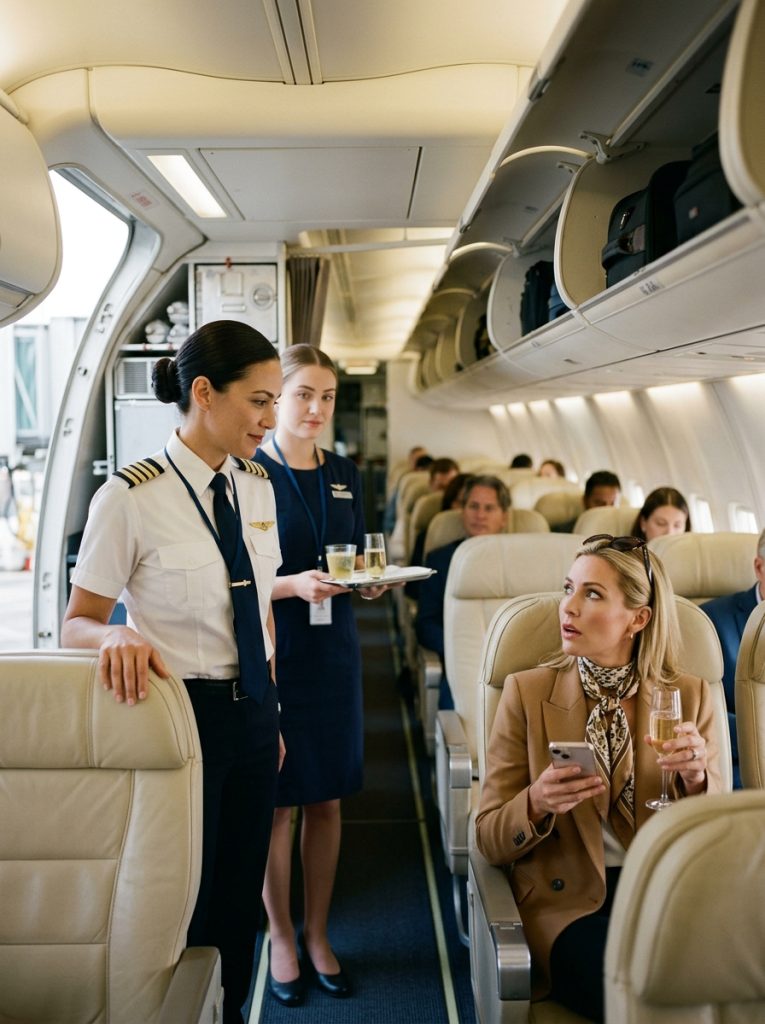
Before we pushed back, I did the thing I most wanted to do, and it wasn’t to Brooke.
I crouched in the aisle next to Hannah at the forward galley, where the first few rows could hear, and I told her — clearly, not in a whisper — that she’d handled 2A with more grace under pressure than most people manage in a year, and that I’d be noting it for her file, and that nobody on my aircraft has to apologize for the speed of a champagne pour. Hannah’s eyes went bright. She stood a little taller for the rest of the flight.
I didn’t say one word to Brooke. I just let her watch me say it to Hannah.
Then I went up front, and we pushed back, and I flew the airplane.
For about ninety minutes it was an ordinary flight. Smooth, on time, the sun on the wings. And then Kansas City Center came on with the news that the line of storms over Missouri had stopped behaving like the forecast said it would. It had bowed out, gone severe, and grown a wall of weather that was now sitting directly across our route, building faster than anyone on the ground had predicted.
This is the part of my job nobody sees. The part that isn’t a uniform.
People think flying is the takeoff and the landing. It isn’t. It’s the judgment in the ninety quiet minutes in between, the decisions you make before they’re emergencies. It’s everything the girl from Cedar Pines bought one rating at a time — instrument, commercial, multi-engine, type — washing dishes and instructing teenagers and studying weather charts at a folding table after midnight. There was a check ride in my twenties I almost failed, an examiner who rode me hard, who I later realized was rough on purpose because the sky doesn’t grade on a curve and neither would he. I think about him every time the weather turns. He taught me that calm is a skill you build, not a mood you’re born with.
I talked to Center. I talked to dispatch. I pulled up the radar and read the gaps the way you read a face you’ve known for years. There was no punching through that line — only around it, and around it meant a long deviation south, into a narrow corridor that was closing, with other aircraft all asking for the same gap and the fuel math getting tighter by the minute.
I made the calls. I requested the reroute early, before the corridor jammed, because eleven years of this teaches you that the pilots who wait for certainty are the pilots who get stuck on the wrong side of a storm. I briefed my first officer. I slowed us down to put us in the smoothest air. And I picked up the handset.
“Folks, this is Captain Ford again. You may have noticed we’ve turned south. There’s a line of weather over Missouri that’s grown a little more ambitious than the forecast promised, so we’re going to go around it rather than through it. It’ll add about twenty-five minutes. I know that’s a nuisance. But I’ve been flying this part of the country for a long time, and the smooth way is the long way today, so that’s the way we’re going. Sit back. Let my crew take care of you.”
The cabin went quiet the way cabins do. And in that quiet, I’m told — Hannah told me later — Brooke Vanderlin gripped her armrests and went pale, because turbulence frightens her, it always has, and the voice telling her she was safe was a voice she’d spent four years trying to make small.
We threaded the corridor. There were a few minutes of solid bumps where the cabin chimes went off and the cups rattled, and then we slid out the south side into air as smooth as glass, and I brought us down through a clean evening sky onto the runway so gently that a man in row 14 actually applauded, which pilots pretend to be embarrassed by and secretly love.
I want to be honest about those few minutes in the bumps, because that’s where the whole thing lived. The airplane was working hard. The radar painted a notch I had to thread, maybe eight miles wide, with red building on both shoulders of it. My first officer called the airspeed, I flew the gaps, and Center cleared two other jets out of my way because I’d asked early and asked clearly. That’s the job. Not bravado. Just a hundred small correct decisions stacked on top of each other until the people behind you step off the airplane never knowing how much of nothing-happened was on purpose.
We were only twenty-two minutes late.
I stood at the front as everyone deplaned, the way I like to — “thank you, bye-bye, thanks for flying with us” — and I watched Brooke Vanderlin come up the aisle, dragging her designer bag, and I watched her realize she was going to have to walk directly past the captain to get off the airplane.
She stopped in front of me.
For a second I saw the whole cafeteria in her face. The held nose. The fifteen kids standing up. I’d had twenty years and a thousand hours of sky to decide who I’d be if this moment ever came, and I’d promised my mother, the office-cleaner who told me to get so big they’d have to look up — I’d promised her I wouldn’t become small to get even.
“Reyna,” Brooke said. Barely a whisper. “Reyna Ford. From — “
“From Cedar Pines,” I said. Pleasant. Even. “Welcome aboard. I hope the ride wasn’t too rough.”
Her chin started to go. “The things I said to you. In school. I was—” She stopped. Started again. “I have a daughter now. She’s fourteen. If anyone treated her the way I treated you, I’d—” And she couldn’t finish that one either.
I could have made her finish it. There was a version of me, a younger one, who’d have stood there and made her say every word with the whole jet bridge listening.
But I thought about Hannah, twenty-four, apologizing for a champagne pour to a woman who snapped her fingers. And I thought about how the thing I’m actually proud of isn’t the four stripes. It’s that I know how to be steady when other people are scared. In the air and on the ground.
“Brooke,” I said. “We were kids. You weren’t kind to me, and we both know it. But I’m exactly where I’m supposed to be.” I nodded toward Hannah, at the door. “If you want to make it right, she’s the one who served you today. She was wonderful. Tell her.”
And Brooke Vanderlin — camel blazer, perfect blowout, the queen of the other side of the highway — turned to a twenty-four-year-old flight attendant and apologized to her, voice shaking, in front of everyone.
Then she looked back at me, and she said the truest thing she’s probably said in years. “Your mom must be proud of you.”
“She is,” I said. “She cleaned offices so I could do this. She tells everyone at her church that her daughter flies the big planes.”
Brooke nodded, and her eyes were wet, and she walked up the jet bridge into a smaller life than she used to think she had.
I texted my mother from the gate, the way I do after every flight. “Threaded a squall line over Missouri. Greased the landing. Guess who was in 2A.” She wrote back a single line, the same one she’s been writing me my whole life, the one I built everything on top of.
“They had to look up. Love you. Fly safe.”
I put the phone in my pocket, picked up my flight bag, and walked through the terminal in four stripes, while strangers stepped aside.