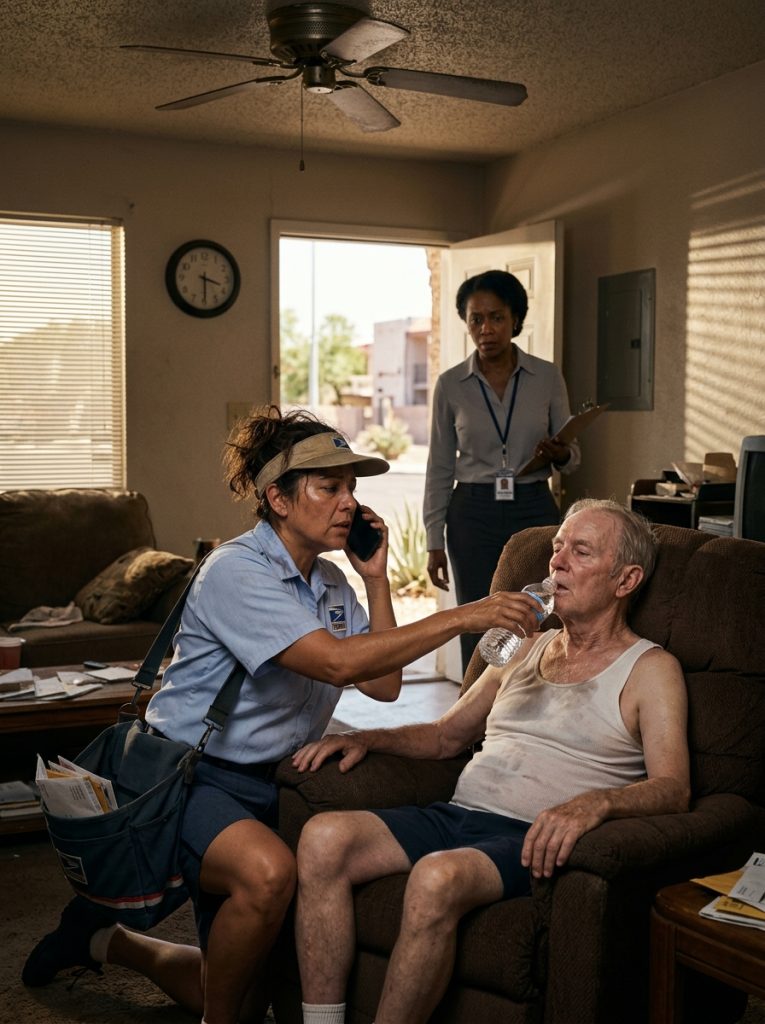
I got him on the floor, flat, the way you’re supposed to.
Mr. Abernathy was conscious but wrong — gray, confused, skin hot and dry as paper, which the dispatcher told me later is the bad sign, the one that means the body has stopped being able to cool itself. I had him on the cool kitchen tile with the water bottle at his lips and my phone on speaker and I was answering the 911 operator’s questions while I held a damp dish towel against his neck and his wrists.
And the whole time, Ms. Powell was in the doorway with her clipboard.
For exactly three seconds.
Then she dropped the clipboard. I mean dropped it — I heard it hit the floor — and she was on her knees on the other side of him, sleeves up, asking me what she could do. She found his AC unit dead and got the windows open for a cross-draft. She soaked another towel. When the paramedics came pounding up the walk she met them at the door and rattled off everything — his age, how long, what we’d done — clean and fast, like someone who’d done it before.
They got an IV in him on the kitchen floor. They packed ice at his neck and his groin and under his arms. His temperature, the medic said quietly, was a number I’m not going to type, because Mr. Abernathy has grandkids and they don’t need to read how close it was.
But they got it down. And as they wheeled him out he caught my hand — that papery hot hand — and he said, “Gloria. You always bring the mail right to the box.” Like that was the thing worth saying. Like a person who notices the mail was the only thing that made sense to hold onto.
He lived. I’ll say that now so you’re not sitting in the same fear I sat in for two days. Three nights in the hospital, fluids, a fan and a window unit that the social worker made sure actually got fixed. He’s fine. He sends me a card now too.
I sat on his front step after the ambulance left, soaked through, shaking the way you shake when the adrenaline leaves. And Ms. Powell sat down next to me on the hot concrete in her nice gray blouse and didn’t say anything for a minute.
Then she said, “How many more like him are on your route?”
I told her the truth. Mrs. Ruiz. The Promise sisters. Three or four others I had a bad feeling about. I told her about the water bottles I’d bought with my own money. I told her about the heat-safety complaint I’d filed and what it got stamped.
And I told her — because I figured I was already fired, so what did it matter — that I knew she’d been sent to document me. That I knew the “time-and-motion audit” was just a clean way to build a case against a carrier who stops too long at old people’s doors.
Ms. Powell took off her lanyard and turned the badge around so I could read it.
She wasn’t from my station. She wasn’t a route auditor. She was the District Operations Director — Brad’s boss’s boss, the person three rungs above the man who’d put me on final warning. She’d come out personally, unannounced, riding routes in the heat-wave zones, because complaints had been coming up from carriers all over the district about heat safety and being told to ignore it — and she wanted to see for herself which stations were taking care of people and which were running them like stopwatches.
“I came out today to find out whether the carriers were the problem,” she said. “I have my answer.”
Then she did something I didn’t expect. She didn’t leave. She got in her car and followed my cart for the rest of the route, and at every door on my bad-feeling list, she came up the walk with me. We found Mrs. Ruiz sitting in the dark with her walker and her window unit tripped off by the rolling blackout, too proud to call anyone, fanning herself with a church bulletin. We got her to her daughter’s air-conditioned place across town. The Promise sisters had a generator their nephew had set up, thank God, and lemonade, and they tried to make Ms. Powell take a glass while she was checking their color and their water. By the time the sun finally dropped, a district director in a ruined gray blouse had personally knocked on nine doors in a heat wave, and I think it rearranged something in how she saw the whole job.
“You’ve been doing this alone,” she said, in the cart, near the end. It wasn’t a question. “On your own dime. On a final warning.”
“Somebody’s got to,” I said.
She just nodded, and wrote something down, and for once I didn’t flinch at the clipboard.
Here’s how it went, in the weeks after.
Ms. Powell pulled the records. Not just mine. She pulled my “route deviations” and laid them next to what I’d actually been doing on those minutes — the groceries carried, the welfare checks, the wellness calls I’d made on my own time. She pulled my heat-safety complaint and the “not a postal function” stamp. And she pulled Brad’s inbox, where it turned out I wasn’t the only carrier who’d raised the alarm and gotten stamped down. He’d buried at least a dozen of them. Mine was just the loudest.
Brad had spent a lot of energy documenting the seconds I “wasted.” He’d documented himself right into a corner. Every clipboard, every stopwatch number, every write-up sat in the record next to a heat-emergency complaint he’d dismissed — and when a seventy-nine-year-old man nearly died on a route the day after that dismissal, the paper told the whole story without anyone having to raise their voice.
He’s not the supervisor at our station anymore. I’ll leave it there. He was given the kind of reassignment that is technically not a demotion and is understood by everyone to be exactly that. The stopwatch is gone.
They didn’t fire me. They did the opposite, and it embarrassed me, honestly. There was a small ceremony I didn’t want. A letter. A pin. A regional safety award with my name spelled right.
But the thing I actually care about is this. Ms. Powell took my buried complaint, the one stamped “not a postal function,” and she built it into a real thing. It’s a heat-season wellness protocol now — earlier start times when the warnings hit, water stops built into the day, and a list at every station of the vulnerable addresses on each route, with carriers cleared to knock and check. Cleared. In writing. The thing I got written up for is now the thing they train people to do.
They asked me to help write it. Me. A carrier who fuels her own car and buys her own water bottles. I sat in a conference room with people whose titles I can’t pronounce and told them what nineteen years on Route 12 had taught me about which doors to worry about.
Mr. Abernathy came to the little ceremony. Made his grandson drive him. He stood up, slow, in a clip-on tie, and told a room full of postal brass that the United States mail had saved his life, and then he winked at me, because he knew it wasn’t the mail.
I still carry Route 12. Same streets, same dogs, same mailboxes.
But now when the heat climbs and the warnings come, I don’t have to choose between my job and my people. I just knock — and somewhere above me, in writing, somebody finally decided that was the job all along.