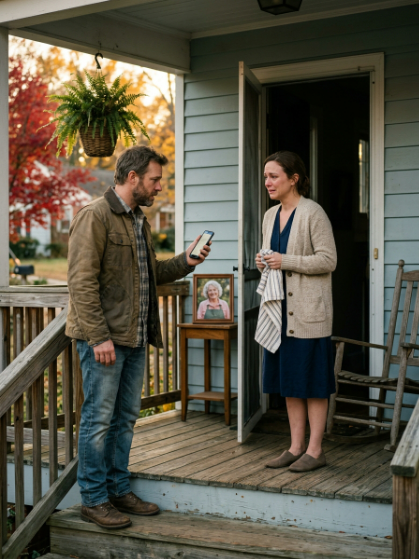
“You’d better come in,” Ruth said, and her voice told me everything before the room did.
I stepped onto a braided rug in a house that smelled like cinnamon and old books. The framed photo on the side table was bigger up close — Nell in her gardening apron, silver curls, that smile I’d built eight years of mornings around.
“She passed in February,” Ruth said. “Pancreatic. It was fast, at the end. I’m her daughter.”
Too late by four months. I’d driven six hundred miles to thank a woman who’d been gone since winter.
I should have felt foolish, standing in a stranger’s living room holding grocery-store flowers and a phone with a dead woman’s voice on it. Instead I just felt the floor of the thing I’d come to say drop out from under me.
“I’m sorry,” I managed. “I shouldn’t have— I’ll go. I just wanted her to know that a voicemail she left, a long time ago, it— it kept me here. When I didn’t want to be here anymore. I wanted to say thank you in person.”
Ruth went very still.
“What voicemail,” she said. Not a question. Something more careful than that.
So I played it.
The little speaker filled her mother’s living room with her mother’s voice. Hi sweetheart, it’s Mom. I know you’re having a hard week. I’m proud of you and there is nothing you could do that would make me stop. Call me when you can. I love you. Bye-bye now.
Ruth sat down hard on the arm of the couch.
She put her hand over her mouth, and then she did the thing I did not expect: she laughed, wet and broken and amazed, and the tears came at the same time.
“That was never meant for you,” she said softly. “And it was never meant for a wrong number either.” She looked at the photo. “Eight years ago this spring, my brother David died. That voicemail — those words — that’s what my mother used to say to him. He had a hard road. Addiction. She never gave up on him, not once, not for a single day. ‘Nothing you could do would make me stop.’ That was their whole life, that sentence.”
I didn’t understand yet. She saw it.
“After we lost him, Mom couldn’t bear to disconnect his cell phone. She kept paying the bill. And she’d call it. Late at night, the bad nights, she’d call David’s number just to hear it ring and leave him a message, like he was away at school and might call back.” Ruth wiped her eyes. “We begged her to stop. The grief counselor said it wasn’t healthy. She did it anyway, for years.”
The room tilted.
“The phone company reassigned his number,” I whispered.
“To you,” Ruth said. “Eight years ago. She was calling her dead son. And it was ringing on the phone of a stranger who needed exactly those words to stay alive.” She laughed again, that astonished broken laugh. “She never knew. We never knew. She thought she was leaving messages into the dark.”
We sat with that for a long time, the two of us, in the last gold light through the window.
Her grief — the thing her whole family had treated as a wound that wouldn’t close — had reached across a city in the dark and put its hand on the shoulder of a man in a truck who was about to give up. Her love for one lost son had, without anyone knowing, saved another mother’s.
“She’d have wanted to know that,” Ruth said. “God, she’d have wanted to know that so badly.”
“I’m sorry I didn’t come sooner.”
“No.” Ruth shook her head fiercely. “You came exactly when I needed to hear it. Do you understand? I’ve spent eight years thinking those phone calls were just my mother breaking her own heart over and over for nothing.” She looked at me. “You just told me they were the opposite of nothing. You’re the reason they weren’t nothing.”
I stayed for coffee. Then for dinner. Ruth showed me David’s photo — he had his mother’s smile too. I told her about the bad year, the truck, the eight years since, the life I’d managed to build on the back of four borrowed sentences.
Before I left, Ruth pressed something into my hand. A small framed copy of the gardening photo.
“So you can put a face to her,” she said. “She’d like that. She always wanted to know who she was talking to.”
I drive home with Nell on my dashboard now.
I still play the voicemail some nights. But I don’t feel like I’m eavesdropping on a stranger’s love anymore.
I feel like I’m part of it — the long, accidental, unbreakable chain of a mother who refused to stop, reaching one more son she never met.
I keep the porch light of my own on now. You never know whose dark it lands in.