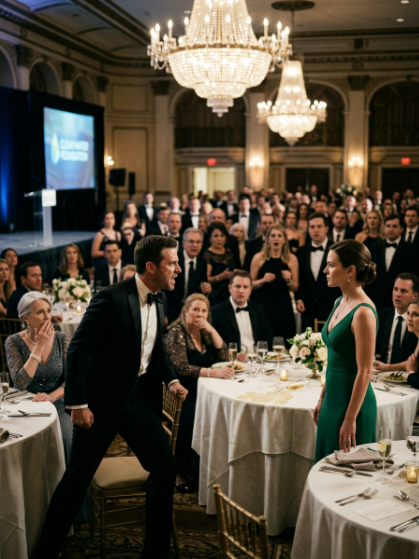
Adrian sat back down slowly, like the chair might not hold him.
Three hundred people were still pretending to look at their plates. His mother, Margaret, had both hands flat on the white linen, and she was looking at me with an expression I knew well — the one we’d shared in a hospital corridor five years ago, the look of two women keeping a dying man’s secret.
“Tell him, Margaret,” I said. “Or I will. We’ve kept it long enough.”
She couldn’t speak. So I did.
“Five years ago, your father called me. Not you. Me.” I kept my voice level, the way you do when the room is the jury. “Harold’s kidneys were failing. He’d known for months. He didn’t tell you because you were closing the Lagos deal and he was terrified that if you knew, you’d walk away from the thing he’d spent his life building, just to sit by his bed. That’s how proud he was. That’s how proud you both are.”
Adrian’s jaw worked. “He told me he had a virus.”
“He told everyone he had a virus.”
I let that land.
“He needed a living donor. The list was years long. So I got tested quietly, because I was healthy and I was family, and I was a match. Margaret and I coordinated everything — the consults, the cross-matching, the pre-op — on a second phone, at night, at a transplant center two hours away, under a different name, because your father made us swear you would not find out until it was done.”
The messages.
The ones he found. The unsaved number that texted me at 11 p.m. The “I’ll be there, don’t tell him, he can’t know yet.” The nights I disappeared and came back exhausted and wouldn’t say where I’d been.
I’d been getting cut open so his father could live.
“You found those texts,” I said, “and you decided what they meant in about an hour. You never asked. You wanted betrayal more than you wanted the truth, because betrayal was a story you knew how to be angry at. So I let you have it. I signed the papers. I left without a dollar.” My voice finally cracked, just once. “Because the alternative was telling you what I’d done, and watching you feel like you owed me your marriage. I didn’t want to be owed. I wanted to be believed.”
Margaret found her voice at last. “Adrian. She gave your father a kidney. He’s upstairs in this hotel right now because he refused to miss this gala. He has eaten dinner every night for five years on her left kidney, and we let you hate her to keep an old man’s pride intact.” She put her hand over her mouth. “It was the worst thing I have ever done. I am so sorry, Elise.”
The ballroom had stopped pretending.
Adrian Vance, who I had watched stay composed through hostile takeovers and a brutal divorce, put his face in his hands at his own gala, in front of everyone, and came apart.
Here is the thing about E26, about misunderstandings explained: the wall comes down, but you don’t always get to walk through it the way you would have five years ago. Too much got built on the wrong side.
We didn’t fall back into each other’s arms. That’s not how it went, and I’m glad, because that would have been a story and what I wanted was the truth.
What happened was quieter.
Harold came down from his suite in his wheelchair an hour later, having heard from a frantic Margaret what his pride had cost. He took my hand in both of his papery ones and he wept and called me daughter, and he said, loud enough for his son to hear, “I robbed you of your name in this family to save my own. Forgive an old fool.”
Adrian found me near the coat check as I was leaving.
“I spent five years building a story where you were the villain,” he said. “Because if you were the villain, then I wasn’t a man who threw away the best person he ever knew over a phone he was too much of a coward to ask about.”
“I know,” I said.
“Can I—” He stopped. “Is there any version where you let me try to know you again? Slowly. With no story this time. Just questions.”
I thought about it for a long moment.
“You can call me,” I said. “And the first time you assume instead of ask, I hang up for good.”
“That’s fair.”
It wasn’t a reunion. It was a door, left open a crack, which is more than I’d had walking in.
I drove home alone that night, my left side aching the way it does when I’m tired, the way it’s ached for five years.
For the first time, the ache didn’t feel like a secret.
It felt like the truth, finally out, breathing in the open air.