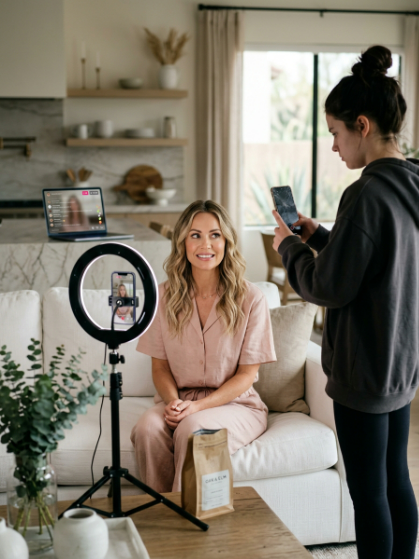
“Not now” is the only thing my mother has ever said to me with total consistency.
So I didn’t stop.
“Hi,” I said, to my cracked little phone, to my two hundred bots, to whoever was actually there. “I’m Maya. I’m the daughter you’ve watched in the background for eleven years. You’ve never heard my voice, because in this house the camera is the only thing that gets to talk.”
On her livestream, the viewer count kept climbing. I could see it reflected in the window behind her — both our screens glowing, both still rolling.
“This breakfast isn’t real,” I said. “We can’t eat the eggs, they’re styled. That coffee bag is angled at the lens because it paid for this morning. And the line she just said — ‘they raised themselves’ — she’s said it before. It’s in a script doc. It has a comment from her manager that says ‘great, relatable.'”
My mother’s smile didn’t fall all at once. It came apart in pieces, the way a set comes down after the shoot.
“Maya.” Quieter now. The audience smile gone. “Turn that off.”
“You always say that, too.”
And then — this is the part I didn’t plan — I didn’t yell. I wasn’t even angry anymore. I just told the truth.
“I don’t want to ruin you, Mom. I want you to see me. That’s all I’ve ever wanted. I’m not content. I’m your kid.”
Her comment feed, which had been little floating hearts, turned. I watched it happen in the window’s reflection. Thousands of people typing the same realization at once.
Brooke lunged for the tripod and killed the stream.
But the internet had already done what the internet does. Clips. Screenshots. Mine and hers, side by side. By dinner it was everywhere, and by morning the sponsor — the coffee company whose bag was angled so lovingly at the lens — had “paused the partnership pending review.”
Two more dropped by the weekend. Brands don’t like the word that was trending under her name.
I thought I’d feel triumphant. Mostly I felt scared, and then I felt sad, because tearing down the thing that pays your family’s mortgage is not a victory, it’s an earthquake, and you still have to live in the house after.
Here’s the part that didn’t make the clips.
Three days later, my mother knocked on my door. No ring light. No phone. Hair in a real, unstyled mess.
She sat on the floor of my room — the one room she’d never filmed — and for a long time she didn’t say anything.
Then she said, “I started the account when you were five because I was lonely and broke and it made me feel like I mattered. And somewhere in there I stopped being able to tell the difference between you and the version of you that performed well.”
She cried. Not the apology-video cry. I know the difference now; I grew up studying the difference.
“I don’t know who I am without it,” she admitted.
“Then maybe we find out,” I said. “Off camera.”
It wasn’t a movie ending. Money is real, and the bills were real, and she had to take a normal job at a marketing firm that nearly killed her pride and probably saved her life. We went to family therapy in a strip-mall office with bad chairs. She deleted the script doc. She asked, for the first time, what I actually wanted to do with my life. (Photography. Behind the camera. Imagine that.)
The hard weeks were genuinely hard. There were nights she sat at the kitchen table doing math she’d never had to do when the brand deals were rolling in, and I’d catch her looking at her old follower count like a photo of someone who’d passed away. Strangers were cruel in the comments — the same internet that had crowned her now wanted to film the fall. I had to learn that exposing a lie and hating the liar are two different things, and that the second one wasn’t what I’d wanted. I wanted my mom. There’s a difference, and at sixteen I had to figure it out in public.
What helped was the smallest thing. She started asking me questions and then actually waiting for the answer, instead of glancing at the door to see if the light was good.
She still posts sometimes. Way less. And there’s a rule now, one I made her write down: nothing with me in it goes up without me seeing it first and saying yes.
The first time she asked my permission, she held the phone out to me with both hands, almost shy.
“Is this okay to post?”
It was a blurry, badly lit photo of the two of us laughing over burnt real eggs. No ring light. No angle. My hair a disaster.
“Yeah,” I said. “That one’s real. You can post that one.”
She did. It got a fraction of her old numbers.
She framed it anyway, and hung it in the kitchen, where the camera used to live.