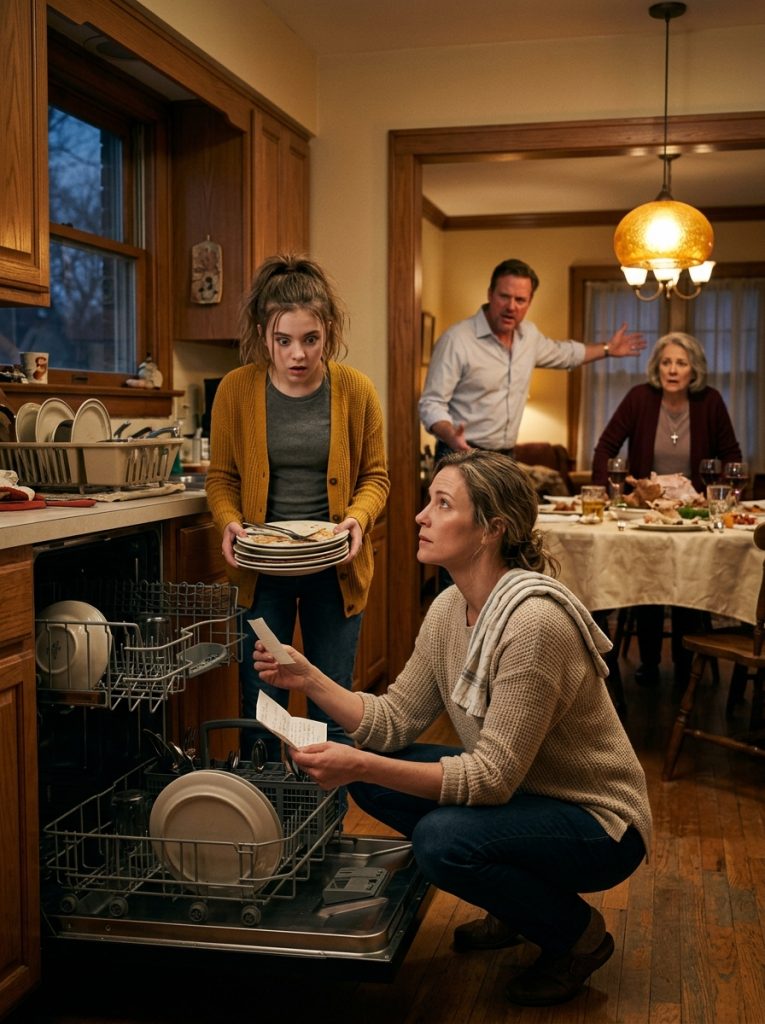
Grant left before the pie.
He said he had an early drive. He kissed Mom on the top of her head, the way he always does, and he didn’t look at me once on his way out the door. The screen door clapped shut behind him and the whole house exhaled.
Maddie was still standing by the dishwasher with the note in her hand like it might burn her. I took it from her gently and slid it into my pocket. Then I knelt by my mother’s chair.
“What second mortgage, Mom?”
She wouldn’t say it out loud. Sixty-some years of keeping the peace in this family had trained the words right out of her. But she put her thin hand over mine and she squeezed, twice, hard, and she whispered, “Don’t let him take the house, Tessie. I tried to stop it. I didn’t understand the papers.”
I didn’t sleep that night.
At 8 a.m. the day after Thanksgiving, while everyone else was at the outlet malls, I sat at the kitchen table with my mother’s accordion file of paperwork and I started pulling threads.
It took two hours to find it, because he’d been careful. A home equity loan against my mother’s house — the house she owns free and clear, the house my father died paying off — taken out fourteen months ago. Sixty thousand dollars. The monthly payments were what had been draining her accounts, the slow bleed I’d blamed on my own bad math.
My mother’s signature was on the loan documents.
Except it wasn’t. Not really.
I have signed my mother’s name to permission slips and pharmacy forms for two years with her sitting right beside me telling me to. I know my mother’s signature better than my own. And the loop on the L was wrong. The hand was too steady. My mother’s hand hasn’t been that steady since before the first surgery — and the date on these documents was three months after that surgery, when she couldn’t hold a fork without help.
Somebody had practiced her signature. Somebody had forged it.
I called the bank Monday morning and asked, as her caregiver, for the contact information on file for the account. There was an email address I didn’t recognize and a phone number I did. It was Grant’s cell.
The loan money had gone out in three transfers. I traced where, the way you trace anything now — a few calls, a few favors, a cousin who works in lending and went quiet when I read her the numbers.
It went to Holloway Auto, my brother’s dealership.
Here’s the part I didn’t know until that week. Grant’s business had been dying for two years. The pandemic, then the rates, then a partner who walked off with the service-department cash. He’d remortgaged his own house first. Then he’d run out of his own things to borrow against. So he’d turned to the one asset in the family that was paid off and sitting in the name of a woman too sick to read the fine print.
He didn’t ask her. He took her.
And then — this is the part that still makes my hands cold — he got ahead of it. He started telling the family I was the one stealing. Because he knew that someday the missing money would surface, and when it did, he needed a thief already standing in the room. He built me into the villain so that his own crime would have somewhere to hide.
I called a lawyer. Her name is Ms. Okonkwo and she does elder law, and she listened to the whole thing without saying much, and at the end she said one sentence that I wrote on the inside of my wrist: “Forgery against a vulnerable adult is not a family disagreement. It’s a felony.”
That week, Grant doubled down. He must have sensed something shifting, because the calls started. Three voicemails the first day, each one warmer than the last. “Hey, Tess, just checking on Mom.” “Tess, I think we got off on the wrong foot Thursday.” “Tess, call me back, I don’t like how we left things.”
Then, when I didn’t answer, the calls changed shape. He started working the family again — but faster now, sloppier. My aunt Carol phoned me Wednesday night, stiff and formal, and said maybe it would be “healthiest for everyone” if a neutral party handled Mom’s money. A bank trustee. A professional. Anyone, the subtext ran, but me.
I almost laughed. He was still building his thief. He just didn’t know I’d already found the receipts.
“Aunt Carol,” I said, “has Grant told you about the second mortgage on Mom’s house?”
A long pause. “What second mortgage?”
“Ask him,” I said. “Then call me back.” She did call me back, two days later, in a completely different voice.
I didn’t want my brother in prison. I want to be honest about that. Something in me still saw the kid who taught me to ride a bike. But I wanted my mother’s house safe, and I wanted the whispering to stop, and I wanted, just once, for the truth to be louder than Grant’s charm.
We did it in Mom’s living room. Two Sundays later. Ms. Okonkwo on speaker. Grant, who came because I told him Mom wanted to discuss “the finances,” walking in with that easy smile, ready to perform.
I laid the loan documents on the coffee table. The forged signature. The bank’s contact record with his phone number. The three transfers into Holloway Auto.
The smile came apart slowly, the way it had at the Thanksgiving table.
“Tessa,” he started, “you don’t understand the pressure I was—”
“I understand all of it,” I said. I didn’t raise my voice. I’d learned a long time ago that the calm one wins the room. “I understand you forged Mom’s name. I understand you told everyone I was the thief so no one would look at you. I understand exactly what you did.”
He looked at our mother. “Mom. Tell her. Tell her I was going to pay it back.”
And my mother — seventy-two, burgundy cardigan, the little silver cross — lifted her chin and said the bravest thing I have ever heard her say to her son.
“You used my name, Grant. You used my name and you blamed your sister. I held you the day you were born and I have never been more ashamed.”
The room went so quiet I could hear the furnace tick.
Here is how it ended, because the truth deserves an ending and not just a reveal.
Grant signed a confession of judgment Ms. Okonkwo drew up — a legal admission of the debt — rather than have me file the forgery report I had ready in a folder. He refinanced his dealership’s building to pay off my mother’s loan in full; it took him four months and it cost him the last of his pride, and the house is clear again, in her name, untouchable. Ms. Okonkwo helped my mother sign a proper power of attorney, witnessed and notarized and real this time, naming me. So that no one can ever practice her signature in a back office again.
The family knows now. The whispering stopped the way a faucet stops — all at once, with a clunk. The cousin who’d looked at me sideways at Thanksgiving brought me a casserole and an apology I didn’t ask for and accepted anyway.
Grant and I don’t talk much. He sends a card on my birthday. I’m not ready to do more than read it, and maybe I never will be, and I’m learning to be okay with that.
Maddie texts me almost every day now. The kid who found the note. She wants to do elder law when she grows up. I told her she’d be good at it. People underestimate the quiet ones who unload the dishwasher.
My mother sleeps easier now. I checked the locks last night, the way I do, and then I checked on her, and she was already asleep with the lamp on and the silver cross resting in the hollow of her throat, and the house — paid for, fought for, hers — was finally, completely quiet.