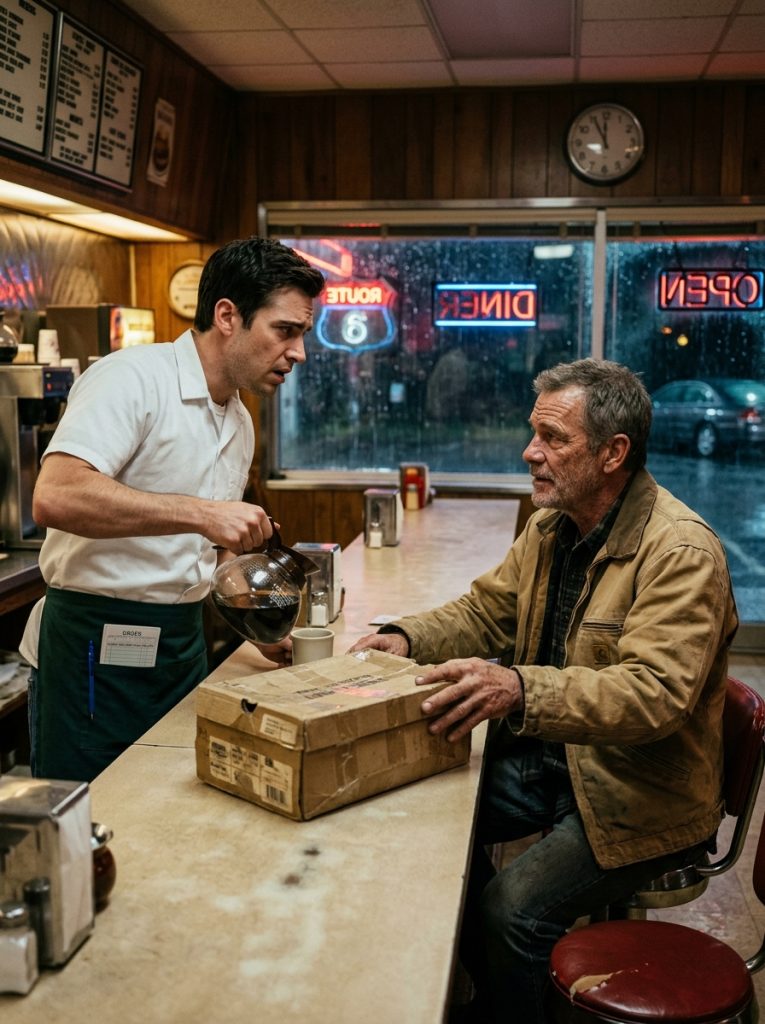
I didn’t tell him to leave. I locked the front door instead, flipped the sign, poured myself a coffee I didn’t want, and sat down on my side of the counter. The owner could dock my pay for the eleven dollars. Some conversations are worth eleven dollars.
“Talk,” I said. “I read the box. Now I want to hear it from you.”
So he talked, and the clean simple story I’d carried for twenty years got complicated the way real things always are — not into a story where he’s secretly a hero, but into a story where everybody was just a person who got hurt and made the wrong call with the tools they had.
Here’s what I’d always known: he left when I was eight. One day there, the next day gone. My mother told me he didn’t want us, that he’d chosen himself, that we were better off. I believed her completely, because she was the one who stayed, and you believe the one who stays.
I want you to understand how total that belief was. I had a whole museum of it. The Father’s Day in fourth grade when I made a card in class and then quietly dropped it in the trash on the way out. The way I’d flinch a little when a friend’s dad showed up to a game — not sadness exactly, more like looking at a thing written in a language I’d never been taught. I’d built a man in my head, selfish and cold and gone by choice, and I’d visited that man my whole life the way you visit a grave. Turns out I’d been mourning someone who was alive the entire time, working a shift two states over, licking a stamp.
Here’s what I didn’t know.
He and my mother detonated. Not a quiet drifting-apart — a real, ugly, screaming end, the kind with a night the neighbors called somebody and a morning where lawyers got involved. I don’t know all of it and I’ve decided I don’t need to; both of them did things in that stretch they weren’t proud of. But the upshot was that my mother told him, in the rawest moment of her life, to get out and never come back, that she never wanted me to see his face again, that as far as she was concerned he was dead.
And he believed her. That was his great mistake, the one he’s spent twenty years paying for. He took the worst thing a devastated woman said in the worst week of her life and he treated it like a verdict instead of a wound. He left town because he thought leaving was what she needed, what I needed, what a decent man does when he’s told he’s the problem. He was wrong. A kid doesn’t need his father to disappear; a kid needs his father to fight to stay, even when it’s awkward, even when the other parent is furious. He knows that now. He knew it about a year too late, which is the worst time to learn anything.
But here’s the part the shoebox proved, the part that rearranged something in me.
He never stopped sending. The first of every month, a money order — small at first, when he had nothing, bigger as the years got steadier. And letters. Birthday letters, mostly, and a lot of plain ones that just said what he’d been doing, where he was working, that he hoped I was tall now, that he was sorry, always that he was sorry. He sent them to the only address he had, our old house, the one my mother kept.
And every single one came back. RETURN TO SENDER, in handwriting I finally recognized, sitting there at the counter at midnight, as my mother’s.
She sent them back. All of them. For twenty years. She intercepted the mail, refused every money order, and returned every letter unopened, and she never told me a single one had come. In her mind — and I’ve had to work hard to understand this without hating her, because she’s sick now and she’s still my mother and she did stay — she was protecting me. From getting my hopes up. From a man she’d decided was unreliable. From the whiplash of a father who might vanish again. She built a wall and she called it love, and the terrible thing is that part of it probably was.
So both of them lied to me, in a way. He let me believe a silence he didn’t choose. She let me believe an abandonment she manufactured. And I grew up the only child of that lie, building my whole idea of men and leaving and trust on a foundation that was never the true one.
I asked him why now. Why, after twenty years of returned mail, did he finally get in a truck and drive to a diner on a rainy Tuesday.
He said a cousin had found me on the internet — my name, the diner, a photo somebody tagged. The cousin had also heard my mother was sick, that I was working myself into the ground to cover her bills, that I was twenty-eight and carrying a load no kid should carry alone. “I figured the wall was hers to keep,” he said, “and I’d respect it as long as she was the one behind it. But you’re a grown man now. The wall’s not yours, and you never got a vote on it. You deserved to at least see the box. To know I sent. Even if you tell me to walk out that door and never come back — and you’ve got the right, I’m not arguing it — I needed you to know the leaving and the silence were two different things.”
I didn’t tell him to walk out. I’m not going to dress up what happened next as more than it was. We didn’t hug across the counter and cue the music. I poured him a second coffee. I asked him questions until the windows went gray. I cried twice and pretended I didn’t. He cried once and didn’t pretend.
We’re not fixed. You don’t fix twenty years in one rainy night, and I’ve stopped wanting the version of this where we do. But he’s local now — got a place across town, took a job at a shop that does engine work, the kind of thing his hands were always good at. We get coffee. Real coffee, where I’m a customer for once and somebody else pours. It’s awkward and it’s careful and sometimes we run out of things to say and just sit there, two men learning a language we should’ve grown up speaking.
He came into the diner again last week, on purpose this time, and sat in the same seat at the counter. Ordered the coffee. Left a tip that was, I noticed, exactly twenty dollars more than the bill — about the size of a money order, give or take twenty years of interest. Neither of us said a word about it. Some things you just let a man do.
I’ve seen my mother, too. I haven’t lit into her about the box; she’s too frail now and the time for that fight is long gone, and honestly, what would it give me besides the satisfaction of being right? I asked her once, gently, if she ever got mail from him. She looked at me for a long moment and then she just said, “I did what I thought would keep you from getting hurt.” And I believe that she believed it. Two people can love you and still build the exact wall that hurts you most. That’s the part nobody tells you about being someone’s kid.
The money orders, by the way — all those uncashed years of them — he wants me to use them now, for Mom’s bills, which is a kind of full circle I’m still not sure how to feel about. The man she sent away, paying her medical bills with twenty years of money she refused to take. I haven’t decided. But I keep the shoebox on the shelf in my apartment where I can see it.
It was 11:52 on the worst shift of a bad month when the father who walked out twenty years ago sat down at my counter.
Turns out he didn’t walk out the way I thought. Turns out the story I’d survived on had a whole second half, sitting in a shoebox, stamped RETURN TO SENDER, waiting twenty years for someone to finally open the lid.