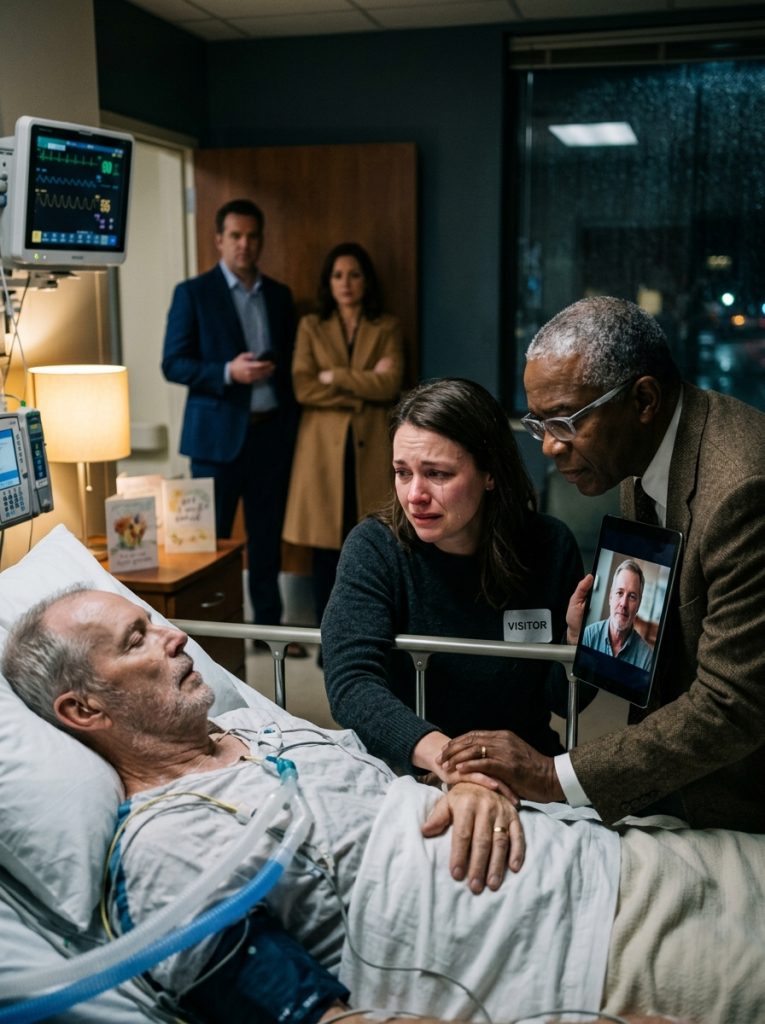
“I want Marley to decide,” my father said, from a screen propped on the rail of the bed he was dying in. “Marlowe. My youngest. If I can’t speak for myself, she speaks for me. Not because I love her more than the others — I don’t, and Vance, Bree, I need you to hear that — but because she’s the one who’ll actually ask what I’d want instead of what’s easiest. Arthur has the paperwork. It’s already signed. This part isn’t a conversation. I just wanted you to hear it from my face instead of a document.”
I have watched that ninety seconds of video more times than I can count, and it still does the same thing to my chest every time.
Vance made a sound in the doorway. Not a word — just a sound, the kind you make when a thing you assumed was yours turns out to have a different name on it. Bree’s arms came uncrossed and went slack at her sides. And me, I just held my father’s actual hand, the real one, warm and unconscious on the white blanket, while his recorded voice did the bravest thing I’d ever heard him do.
Because he kept talking. The video was longer than anyone expected. He’d clearly thought about every person who’d be standing in that room.
“Vance,” he said, “you’re going to want to handle this like a transaction, because transactions don’t hurt and grief does. I know you, son. You’ve been managing your feelings with a calculator since you were twelve. I’m not angry about it. But your father is not a line item, and I won’t have my last days run like a quarterly close. Slow down. Sit in the chair. Let it hurt. It’s allowed.”
“Bree,” he said, “you organize when you’re scared. You’ll have made a binder by now. Spreadsheets for the funeral. I love you for it and I need you to put the binder down for one hour and just be my daughter. The binder is fear in a three-ring shape. I see you, sweetheart. I always saw you.”
“And Marley.” His voice changed when he got to me. “You came every Sunday. You think I didn’t notice because I was asleep half the time. I noticed. I noticed who came when there was nothing to gain and the conversation was just an old man repeating himself. That’s not why I picked you to decide. I picked you because the person who shows up when it’s boring and unprofitable is the person who’ll show up when it’s hard and unprofitable, and dying is the most boring, unprofitable thing I’ll ever do. I’m sorry to hand it to you. But I trust you with it, and I don’t say that lightly, and you should write that down somewhere because I’m not the kind of father who said it enough.”
I was sobbing by then. We all were. Even Vance.
Now I have to tell you the hard part, the part that makes this bittersweet instead of triumphant, because I won’t pretend it ended in a courtroom victory and a high-five.
My father did not wake up. The video was not a movie miracle where he opens his eyes after the recording plays. He’d recorded it precisely because he knew there might not be a waking-up. That was the whole point. He’d looked his own ending dead in the face fourteen months early and made the decisions while he still could, so that none of his children would have to carry the weight of guessing, and so that we couldn’t tear each other apart in a hallway over what he “would have wanted.” He took that weapon off the table before any of us could pick it up.
What the video meant, in practical terms, was that the decision about his care was mine. And after I talked to his doctors — really talked, the long hard conversation about what was actually possible versus what was just prolonging — I made the choice I am quite sure he wanted, which was to stop fighting a battle his body had already lost and let him go gently, without machines turning a death into a procedure.
It was the hardest thing I have ever done. It will be the hardest thing I ever do. And I want to say clearly, because I know someone reading this is facing it: choosing to let someone go is not the same as giving up on them. My father taught me that with a video. The mercy was in the letting go. The cruelty would have been in keeping a man alive as a favor to our own fear of missing him.
He passed two days later, quietly, in the early morning, with the rain finally stopped and gray light coming through the window. I was holding the hand with the gold ring. Vance was in the chair — he’d finally sat in the chair — and Bree had her head on the edge of the bed, no binder anywhere in sight. We were, for the first time in years, just his three kids in a room, not fighting about anything. He’d arranged that too, I think. Even unconscious, he’d organized us into the family he wanted us to be at the end.
There’s a photograph a nurse took that morning, without us knowing, and gave me weeks later — the three of us around the bed in the gray light, not posing, not performing, just present. It’s the only picture of all of us together in a decade. Dad’s in it too, technically, though he’d already gone. I keep it next to the wall of get-well cards I never could bring myself to take down.
The estate, since I know that’s the thread the caption left dangling: there was a twist, and it wasn’t the one the older two feared. My father had not cut anyone out. He left things divided fairly, generously, with a tenderness in the wording that made Bree cry all over again. But he’d added one provision, and it was so perfectly him that I laughed through my tears when Arthur read it. The bulk of the liquid estate — the accounts everyone had been so quietly circling — was directed first to fully fund the care, for as long as they live, of the people who’d sent the wall of get-well cards taped up beside his bed. His old coworkers. The widow down the street he’d been quietly paying the heating bill for. The kid who mowed his lawn and was trying to afford community college.
“Money reveals people,” he’d written, in the letter Arthur read after. “I watched mine reveal you three. I’m proud of who two of you are becoming and worried about who one of you might become if you get a windfall before you’ve sat in the chair. So I’ve made the windfall small and the responsibility large, and I’ve put my trust where I put it in life — in the people who showed up. Marley will administer it. She’s the one who’ll ask what I’d want.”
Vance was angry for about a week. Then he wasn’t. The chair, I think, did its work on him eventually; grief you actually sit in changes you in a way grief you manage never does. We’re closer now, the three of us, than we were before Dad got sick. That’s the bittersweet of it — it took losing him to make us a family that doesn’t fight, and I’d trade it back in a heartbeat, and I can’t, and so I just try to be the daughter he said I was.
They wanted to pull the plug and split the estate.
Instead, a tablet on a bed rail handed my father the last word, and he used it to do the only thing he’d ever really wanted to do as a parent: he made sure that, at the very end, the people who showed up were the ones who decided. Including me. Especially me.
I miss him every single day. The video is still on my phone. I don’t watch it as often now. But it’s there, my father’s face, frozen and waiting, ready to remind me — whenever I forget — exactly who he thought I was.