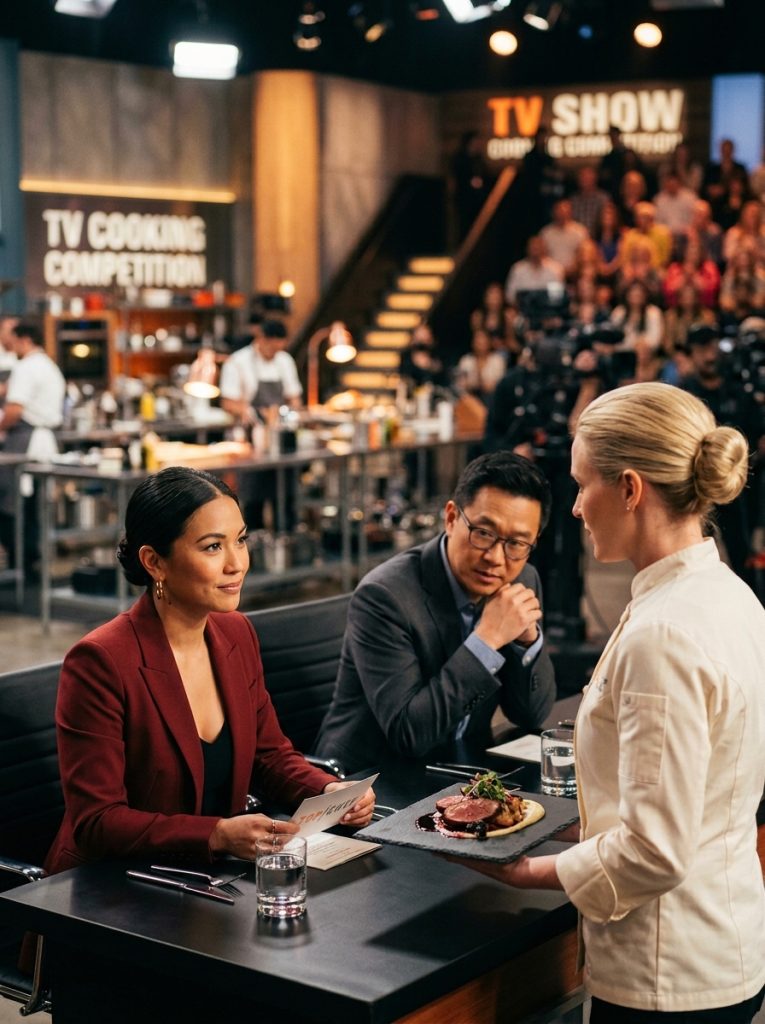
The question I asked was this: “The saffron. You bloomed it in something warm before you finished the sauce. What was it, and why that and not stock?”
It’s a small question. It sounds like a judge being thorough. But it isn’t, and Camille’s face told me she felt the trap close even before she understood what it was.
Because there’s a trick to that dish. The saffron doesn’t get bloomed in stock or wine like everyone assumes. It gets bloomed in warm orange-blossom water, for exactly the reason that it shouldn’t work and does — the floral note is what makes the whole plate taste like something you half-remember instead of something you’re tasting for the first time. I invented that. At twenty-two, broke, in a dorm kitchen, because I couldn’t afford good saffron and I was trying to stretch a pinch of cheap stuff into something that tasted expensive. Necessity. The orange-blossom water cost ninety-nine cents at the Middle Eastern grocery two blocks from campus. It is the single most “me” thing in the entire recipe, and there is no way to know it unless you are the person who failed your way into discovering it.
Camille said, “Stock. A rich chicken stock. It’s a classic technique.”
And the room, which had been so moved by her story, went quiet in a different way. Because the dish in front of me did not taste like chicken stock. It tasted like orange blossom. It tasted like my dorm kitchen. The other judges might not have been able to name why, but they’re professionals; they could taste that her answer didn’t match her plate.
I didn’t pounce. I want to be clear about that, because the internet version of this story would have me stand up and scream “I REMEMBER YOU” and flip the judging table. I’ve imagined that version. For about three years it was the only version I could imagine. But I’m thirty-five now, and I’ve done a lot of growing up in a lot of bad kitchens, and the thing I’ve learned is that revenge and justice look similar from a distance and feel nothing alike up close.
So instead I said, “Try again. Take your time. You bloomed it in orange-blossom water. I can taste it. So can you. The question isn’t what’s in the dish. The question is how you learned to make it.”
Her face did the thing faces do when the floor goes. And I watched her place me. I watched twelve years rewind behind her eyes until she landed on a scared scholarship kid at Bridgewater Culinary Institute, and her mouth opened and nothing came out.
“Hi, Camille,” I said. “It’s been a while.”
The host, who had no idea what was happening but could feel it was television gold, leaned in. “You two know each other?”
And here’s where I made my choice, the one I’d been rehearsing without knowing it for over a decade.
I could have destroyed her on camera. I had every fact I needed. The salt in my dish, the planted recipe card, the dean’s office, the scholarship she won on the back of a lie, the housing I lost the same week. I could have laid it all out and let four cameras watch her face come apart, and the audience would have eaten it up, and I’d have gotten my slow clap.
Instead I said, to the host, “We went to school together. Camille was the most talented person in our class. And this is my recipe — I created it as a student, and it’s been my signature ever since. So I’m a little surprised to see it here, presented as hers.”
That was it. That was the whole blade. I didn’t say “she got me expelled.” I didn’t say “she lied.” I said the dish was mine, which was simply, verifiably true, and I let the silence do the math for everyone watching.
Camille started to argue, and then she stopped, because she’s not stupid, and she could see exactly how the next sentence would go if she forced me to keep talking. And in front of the cameras, something in her just gave way. She said, quietly, “It is your recipe. I’m sorry. I’m — it’s your recipe.”
It wasn’t a full confession. She didn’t fall to her knees and detail the salt and the planted card. But she said the recipe was mine, on the record, in front of everyone, and for the first time in twelve years the truth and the public record were on the same side.
The audience didn’t gasp the way they do in the edited promos. It was quieter than that, and stranger. A couple of people clapped, then stopped, unsure whether clapping was the right thing to do. The other judges looked at me differently for the rest of the day. Marcus leaned over during a break and said, “That was your dish? The orange-blossom thing? I’ve eaten that at your restaurant. I cried a little.” He wasn’t joking. He’s a sixty-year-old man with a wall of awards and he got misty over a thing I invented because I was broke — and that’s when it really landed for me that the recipe had outgrown the wound it came from.
I did not put her through. Not because of the past — I want to be honest about my own heart here — but because the dish wasn’t hers, and “can you make something that is actually yours” is a fair bar for a show about cooking. I told her that. I said, “Come back when you bring me a plate that only you could have made. I mean that. You have the hands for it. You always did. You just have to stop borrowing other people’s stories, including mine.”
Here’s the part that surprised even me.
Three weeks later, Camille emailed the production. Not the producers — me, personally; she’d found my address. It was a long email and I’m not going to share most of it, because some apologies are meant for one reader. But the short version is that she told me the whole thing. The salt. The card. The fear. She’d been a nineteen-year-old terrified of losing the only scholarship that could keep her in school, and she’d made a choice that she’d spent twelve years building a personality on top of so she’d never have to feel it. She said watching herself say “it’s your recipe” on a monitor in the green room had been the first honest moment she’d had in a decade.
She asked if there was any way to make it right. I told her the only way you make a thing like that right is forward, never backward — you can’t un-expel me, you can’t give me back those three years in the food truck with the fever. But you can become a person who doesn’t do it again. That’s the whole repair. There isn’t another one.
She’s cooking again. Her own food now, I hear. We’re not friends. I don’t know that we’ll ever be. But we’re something cleaner than enemies, which at thirty-five I’ve decided is worth more than the slow clap would have been.
The episode aired months later. Production asked if I wanted the confrontation cut — legal nerves, probably. I told them to keep it, but to keep all of it: the part where I gave her the chance to try again, not just the part where she came undone. If it was going to be on television, I wanted the whole shape of the thing, including the mercy. Mercy makes worse television and better people, and I’m finished optimizing my life for television.
I think about that scared kid in the dorm kitchen sometimes, blooming cheap saffron in ninety-nine-cent orange-blossom water because she couldn’t afford better and refused to serve worse. She had no idea the recipe she was inventing out of pure necessity would, twelve years later, be the exact thing no liar could fake — the fingerprint that proved the food was hers.
Turns out the things you make when you have nothing are the things nobody can ever take. They can take the scholarship. They can take the housing and the years and the official version of events.
They can’t take the orange-blossom water. That part was always going to be mine.