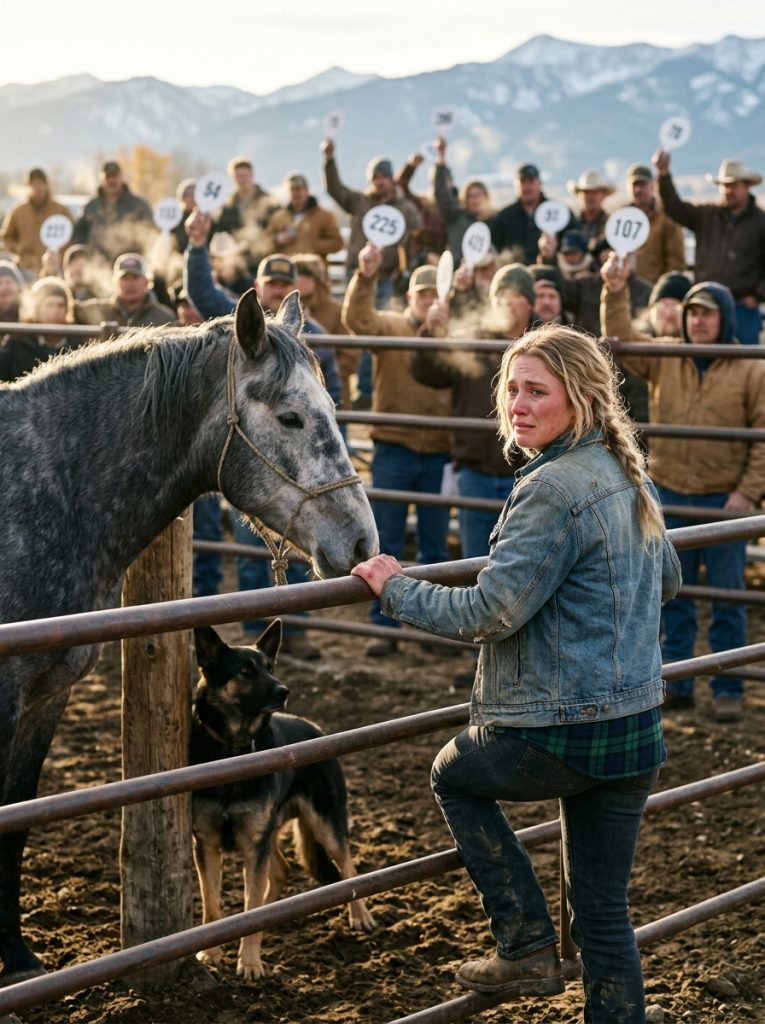
The voice belonged to Marv from the co-op, the same man who’d told me three days earlier that I was throwing good money after a lost cause. He bid the exact amount of Buck’s back feed bill — the debt that started this whole foreclosure — and when the auctioneer hesitated, Marv just said, louder, “That’s the bid. And nobody here’s gonna raise me.”
Nobody raised him.
That’s not how auctions work. An auction is supposed to be people bidding against each other; that’s the whole engine of the thing. But the entire Bitterroot Valley had quietly agreed, somewhere in the three days I’d spent too heartbroken to answer my phone, that they were going to run this one differently. One person would bid the minimum on each lot. Nobody would bid against them. And every animal would go for almost nothing, to a neighbor who’d already promised where it was really going.
Back to the ranch. Back to my grandfather.
I found out later how it came together. The woman who runs the diner — her name is Patty — had started a list behind the register the day the foreclosure notice ran in the paper. Just a legal pad. “Mallory animals — who can take who.” People signed up for the ones they had room for. The Hendersons took the goats because they had goats. The vet took the blind donkey, Pepper, because he’d been treating Pepper’s eyes for free for years and figured he’d just keep doing it on his own porch. A retired schoolteacher took Goose, the three-legged shepherd, and then immediately renegotiated with me because Goose, it turns out, will not live anywhere I am not.
They didn’t tell me. That was deliberate too. Patty said later, “If we’d told you, you’d have argued. You’d have said it was charity and you don’t take charity. So we just didn’t give you the chance to be stubborn about it.”
I want to be honest about the shape of this, because it would be easy to tell it as a story where everything was saved and everyone was happy and the music swelled. That’s not quite what happened. Some of these animals are old. Buck is old. Pepper is blind and old. Saving them from an auction isn’t the same as saving them from time. What the valley bought back wasn’t a future of unlimited tomorrows. It was the right thing — the dignity of the animals living out their actual lives where they belonged, instead of being scattered to strangers and a price.
And there was the matter of my grandfather, who did not know any of this was happening, because he was in a hospice bed in his own front room, and we were not sure how many more mornings he had.
Here’s the part I can barely write.
After the auction, the trucks didn’t go to twenty different farms. They followed each other in a long line back to the Mallory ranch, like a funeral procession running in reverse, bringing the living home instead of carrying them away. And while they unloaded — while two dozen neighbors put every animal back in its own paddock, back where it knew the smell of the dirt — Patty and the vet went inside, and they wheeled my grandfather’s bed right up to the big window that looks out over the corral.
He’d been mostly sleeping for two days. But the vet leaned down and said, “Silas. Open your eyes a second. There’s something out the window you’ll want to see.”
And Silas Mallory, seventy-eight years old, oxygen line in his nose, opened his eyes and looked out at his entire herd standing in the corral in the gold afternoon light, with half the valley leaning on the fence rail, and Buck’s gray head lifted toward the house like the old horse knew exactly which window mattered.
My grandfather didn’t say anything for a long time. Then he said, “Who paid for all that?”
And Patty said, “Everybody, Silas. Everybody paid for it. Turns out you’ve been making this withdrawal for forty years. Town just decided to let you cash it.”
He laughed. It was a thin laugh, and it turned into a cough, and then it turned into him crying, which I had seen my grandfather do exactly once before in my whole life. He held my hand and watched out that window until the light went orange and then gray, and the neighbors drifted home one truck at a time, and the animals settled into the dark of the only place they’d ever felt safe.
He lived nine more days. I want you to know they were good days. The kind of days where people kept coming by, and somebody was always doing his chores so he could watch them get done, and the window stayed open so he could hear the animals even when he couldn’t sit up to see them. He told me stories I’d never heard — about the first horse, about my grandmother, about why he started taking in the broken ones in the first place. (“Because somebody took in me, once,” he said, “and I never did pay it back to him. So I been paying it forward to whatever showed up.”)
On the seventh day he made me promise two things. First, that I’d never sell Buck — not for any price, not for any reason — and I never will; that horse will die on this ranch and be buried on it. Second, that I’d stop apologizing to people for caring about animals more than they thought was reasonable. “Reasonable,” he said, “is just the size of a heart that’s never been broke open. Yours has. Don’t you let ’em talk you back down to reasonable.”
He passed on a Tuesday morning with the window open and Goose asleep on the floor beside the bed. I was holding the hand with the work-worn knuckles. It was quiet, and it was sad, and it was not the worst way for a good man to go — surrounded by every life he’d refused to give up on.
The bank got its money from the auction, technically. But here’s the thing nobody at the bank understood: they sold a herd and a foreclosure. The valley bought back a man’s entire life’s work and handed it to him as the last thing he saw. You can’t put that on a balance sheet. They don’t have a line for it.
We’re turning the ranch into a real sanctuary now — a nonprofit, in his name. Patty’s on the board. The vet’s on the board. Marv keeps the books, which is funny, given he started the whole thing with a single bid. We take in the broken ones. The horse nobody can ride. The dog that lost a leg. We’ve already got a waitlist, which tells you something about how many unwanted animals there are and how few Silas Mallorys.
The first animal we took in under the new name was a swaybacked mule somebody left tied to our gate in the night, with a note that just said “heard you take the ones nobody wants.” We do. We named him Silas, which my grandfather would have hated and secretly loved. He’s mean as a snake and he bites Marv specifically, and every time he does it I laugh until I cry — because it’s the most stubbornly alive thing on the whole property, and it came to us the exact way my grandfather came to whoever took him in all those years ago: unwanted, untrusting, and worth feeding anyway.
People still sometimes call me a fool for it. For pouring my paycheck and my whole twenties into creatures that don’t make money and don’t last forever.
But I learned something standing at that auction rail watching paddles I never asked for rise into the cold. Worth really is just a story people tell about a price. My grandfather spent forty years telling a different story, to anybody who’d listen and a lot of folks who wouldn’t. And on the day it counted, the whole valley showed up to tell it back to him.
That’s not foolish. That’s the least foolish thing I’ve ever seen.