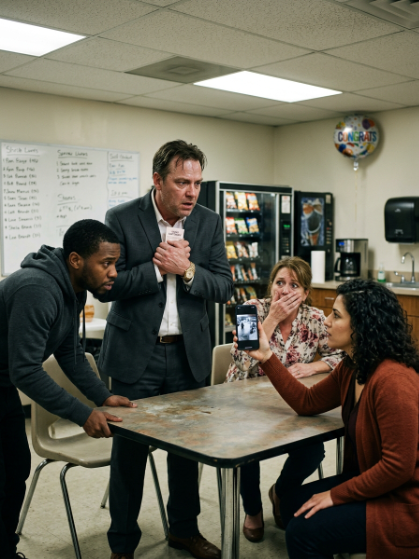
Doug looked at the camera still on my phone like it was a snake.
“That’s — you can’t just — that’s an invasion of privacy,” he sputtered.
“It’s a gas station, Doug. You’re on camera buying scratchers in there twice a week.”
The still showed him at the QuikFill register that Tuesday, our marked manila envelope in his left hand, the cashier counting our sixty dollars. Time-stamped 4:47 p.m. I had the group text from the Friday before with a photo of all twelve tickets, numbers visible, sent at 5:52 p.m. The winning numbers matched ticket number seven in that photo exactly.
He’d bought our tickets with our money and then decided four million dollars was worth more than eleven friendships and his own name.
The room turned on him. Not loud. Worse than loud. Sheila just said, “Doug. We bought you a card when your mom passed. We covered your route when you had the flu.” Marcus from the mailroom shook his head and walked out.
Doug’s cousin in HR stopped returning to the situation real fast once I forwarded the same evidence to the regional director, the state lottery’s claims office, and a lawyer a friend recommended. Turns out lottery commissions take this exact scenario seriously, because it happens constantly. They have a process. They have forms. They have a fraud unit.
I want to be honest about how frightening it was to be the one holding the spreadsheet. People I’d worked beside for years went quiet around me. Doug started a whisper campaign — that I was “doing this for attention,” that I’d “always been jealous of him.” For about a month, walking into that break room felt like walking into enemy territory. The truth doesn’t protect you from the discomfort of being the person who insists on it out loud.
The lottery had not yet released the jackpot. That was the part Doug hadn’t thought through. You don’t walk in and get four million in cash. There’s a claims period. Verification. And during verification, twelve people submitting a signed pool agreement, three years of Venmo records, a time-stamped photo predating the drawing, and gas-station footage is the kind of thing that freezes a payout cold.
It took five months. I won’t pretend it was fun. There were lawyers, and there was a deposition where Doug’s attorney tried to suggest I’d “fabricated a group chat,” which fell apart the second the phone company confirmed the timestamps.
In the end the court ruled it a pooled ticket. Four million, split twelve ways, minus the lawyers and the taxes. It came to a little under two hundred thousand each after everything.
Doug got a share too. That surprised people. But he’d paid his five dollars that Friday like everyone else, and the law doesn’t dock you for being a liar, only for being a thief, and he hadn’t managed to actually steal it. He just tried.
He didn’t keep his job, though. The company has a policy about defrauding your coworkers, as it turns out. He was gone by spring.
Here’s the part I actually care about.
There’s a woman in our pool named Sheila. Fifty-one. Raising a grandson on a clerk’s salary. The week of that drawing, money was so tight she almost texted me to skip her five dollars. She told me later she’d typed the message and deleted it because she “didn’t want to be the one who broke the streak.”
That decision — that five dollars she almost didn’t put in — became a hundred and ninety-some thousand dollars. She paid off her car. She fixed her roof. She started a little account for the grandson with the words COLLEGE, MAYBE written on the envelope, because she’s superstitious about saying it out loud.
When the checks finally cleared, the eleven of us went to the diner across the street, the cheap one, and ordered like it was the diner across the street, because that’s who we are.
Doug wasn’t there. Nobody mentioned him.
We left the waitress a tip that made her come back out to the parking lot to make sure it wasn’t a mistake.
It wasn’t a mistake.
I keep the spreadsheet still. New tab now. Same twelve minus one.
Turns out the receipts were never about the money. They were about who you turn out to be when four million dollars asks you a question.