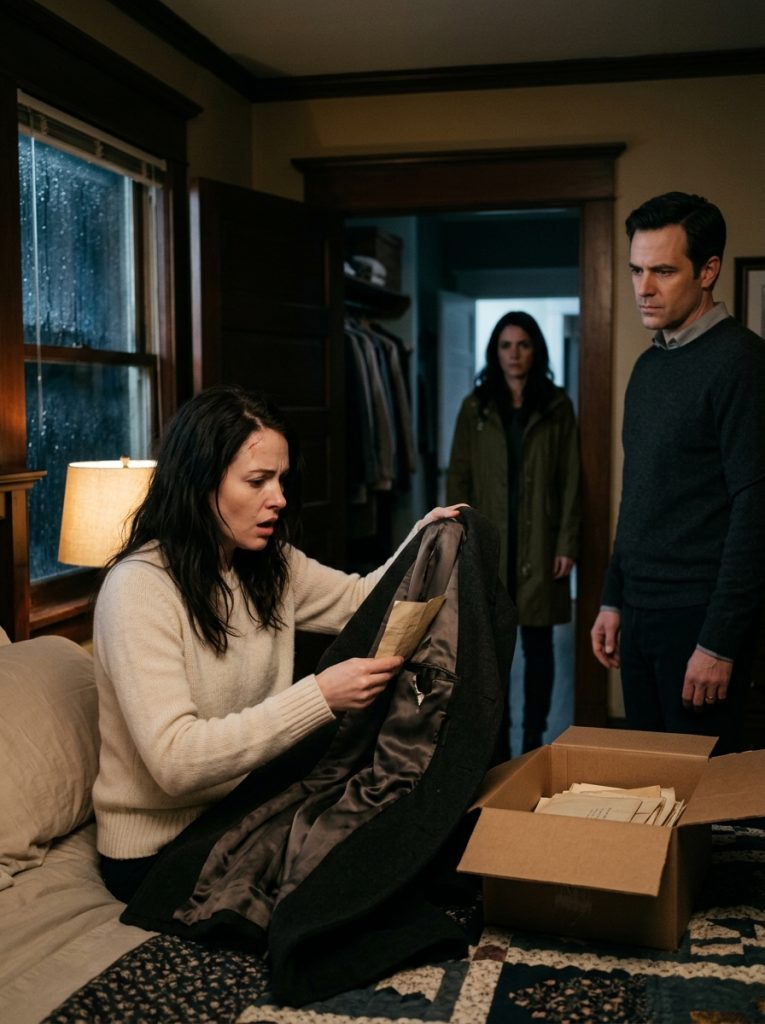
“Claire,” Annie said again, stepping out of the doorway and into the lamplight. “We don’t have much time. Read it. Read whose handwriting that is before he comes in here and tells you it’s nothing.”
I looked down at the will trembling in my hands. My handwriting. Dated three weeks before the crash that erased me.
Tires on wet gravel. A car door. Victor’s footsteps coming up the walk.
“Whatever he says,” Annie said quickly, low and urgent, “you wrote this. You. Before. You knew something was wrong, and you protected yourself the only way you could.”
The front door opened.
“Claire?” Victor’s voice, smooth as ever. “Whose car is—” He came into the bedroom and stopped cold when he saw the three of us, the open box, the coat, the paper in my hands. For one unguarded second, before he rebuilt his face, I saw something in his eyes I had never let myself see in a year of trusting him.
Fear.
“Annie,” he said, and his voice went tender and sad, the voice he used for my own good. “You shouldn’t be here. Claire, sweetheart, this is the woman I told you about. She’s not well. She’s been trying to get to you for months, to confuse you, to get at the money. Give me the paper. You’re confused. You don’t remember—”
“Then explain it to me,” I said.
He stopped.
“Explain what I’m holding,” I said. “It’s my handwriting, Victor. You’d know — you copied it onto every drawer in this house so I’d feel at home. It’s a will. Dated before the accident. And it leaves everything to a sister you swore didn’t exist.”
“You weren’t well before the accident either,” he said, smoother now, recovering. “You were paranoid. You imagined things. Annie took advantage of that. This is exactly the kind of thing—”
“Stop,” I said. “Just — stop talking. For one minute. Let me think.”
And in that minute, with my husband’s mouth finally closed, my body told me what my memory couldn’t.
The drawer my hand always knew. The song that made me cry. The photo-strip girl I ached for. The feeling, every single time he said trust me, that I was forgetting something I wasn’t supposed to forget.
It hadn’t been confusion. It had been my own self, buried under his story, knocking on the inside of the door.
“Say my full name,” I told Annie suddenly.
She blinked. “Claire Margaret Donovan. Except it isn’t Donovan, not really. You were Claire Shaw until you married him. You hated giving up Shaw — you said it felt like handing him a piece of you to keep.”
Donovan. The name copied onto every drawer in this house. The name I’d been wearing like a borrowed coat for a year.
Something in me eased, the way a held breath finally lets go.
Annie set a folder on the bed beside the box. Her hands were shaking too.
“I brought proof,” she said. “Because I knew he’d say I was crazy. He’s good at that.” She opened it. “Bank records, Claire. The accounts he moved into his name while you were in the hospital. The house, refinanced. Your grandmother’s trust — he had you sign it over to him eight months ago. You don’t remember signing it because he told you it was insurance paperwork.”
I looked at the documents. My signature, shaky and post-accident, on things I’d never understood.
“And these.” Annie laid down printed call logs. “Forty-one calls from me. All blocked. He changed your number twice. I drove past the house and he met me at the curb and threatened to call the police if I ever came back. I’m your sister, Claire. We talked every day of our lives until a year ago. He didn’t tell you I abandoned you. He erased me, the way he erased everything that was yours before him.”
Victor’s mask slipped one more degree.
“You have no idea what I gave up for you,” he said, and there it was, the cold underneath the warm. “I took care of you. I fed you, I dressed you, I told you who you were, when you couldn’t even—”
“You told me who you needed me to be,” I said.
The room went very quiet.
I understood it all now, the whole architecture of the year. I had married a man who loved my grandmother’s trust more than he loved me. Somewhere before the accident, I’d seen it — seen enough to hide a will in a coat lining and leave everything to the one person who’d never wanted a dime. And then a slick road and a guardrail had handed Victor the one thing he could never have engineered: a wife with no memory and no witnesses.
I would never know exactly what I’d seen before the accident. That memory was on the far side of the wall with all the others. But I didn’t need the whole picture. I had the proof of it in my own hand — a woman careful enough, frightened enough, to hide her own will in the lining of a coat and trust that some future version of herself would find it.
Past me had thrown a rope across a year I couldn’t remember. All present me had to do was reach out and take it.
He’d spent a year writing over me like I was a house he’d bought cheap.
“I want you to leave,” I said.
“Claire—”
“Leave, Victor. Tonight. My sister and I are going to call a lawyer in the morning, and we’re going to call the bank, and we’re going to undo every single thing you did while I couldn’t remember my own name.” My voice was steadier than my hands. “And if you fight it, that folder goes to people whose job is exactly this. You exploited a woman who couldn’t protect herself. There’s a name for that, and it isn’t husband.”
For a moment I thought he’d keep performing. Then he looked at the folder, and the will, and Annie, and he did the math men like him always do.
He left that night.
It wasn’t clean and it wasn’t fast. Lawyers rarely are. But the will held, because I’d been careful even when I was afraid, and the bank records were exactly what Annie said they were, and a man who steals from a vulnerable adult leaves a trail he can’t gaslight away. The trust came back to me. The house. My name.
There were consequences for Victor, too — the dry, paperwork kind that men like him fear more than any shouting. The county had an office for exactly what he’d done: financial exploitation of a vulnerable adult. He signed everything back rather than let it go in front of a judge. The marriage was annulled. He moved to another state. I hope he’s someone else’s problem now, and I hope that someone reads their mail.
Annie moved into the guest room “just until you’re steady.” That was a year ago. Neither of us has mentioned her leaving.
My memory never fully came back. The doctors say it might not. There’s a whole life behind a wall I can’t climb.
But Annie sits with me in the evenings and tells me the stories — the mall photo booth, the song, the camping trip where I broke my wrist and laughed anyway. She can’t give me back the memories. She gives me something better. She gives me the truth about who I was, told by someone who loved me before there was anything to gain.
We found the photo-strip girl, by the way. It was us. Annie and me, nineteen and twenty-one, crammed into a mall booth that’s a parking lot now, making faces at a tiny camera. I keep the strip on the fridge. Some mornings I look at those two laughing girls and I don’t remember the day at all.
But my whole body still aches for her, the way it did in the closet with the coat in my hands. The doctors don’t have a word for that ache.
I do. It’s called a sister.
The other night I reached for a drawer in the dark and found it exactly where my hand expected.
I didn’t feel afraid this time.
I just felt like myself — a woman remembering, one true thing at a time, that she was always somebody before anyone tried to tell her who to be.