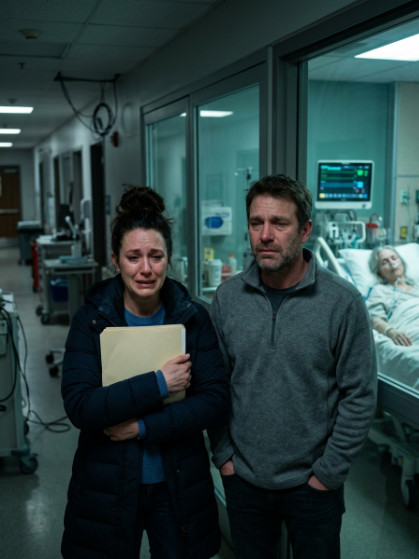
My mother asked Mark to get the folder from her overnight bag, in the cabinet by the window.
His hands were shaking so badly he dropped it. Papers slid across the ICU floor. I knelt to gather them, and that’s when I saw the header on the top page.
CITY OF ELMHURST FIRE MARSHAL — INCIDENT REPORT. Dated three weeks after the fire. The fire that took our father.
I had never seen it. Neither had Mark. We were kids. Nobody shows a fifteen-year-old the official document about the night their dad died.
Mom watched us both go still.
“Read the cause,” she whispered.
I found the line. I read it twice before my mouth would work.
PROBABLE CAUSE: ELECTRICAL FAILURE, KNOB-AND-TUBE WIRING IN THE EAST WALL. NON-PREVENTABLE. NO INDICATION OF OCCUPANT NEGLIGENCE.
Knob-and-tube wiring. The old stuff in the walls of that old house. A short in the east wall, behind the staircase. Nothing to do with a candle. Nothing to do with a space heater in the basement on the other side of the house.
“It wasn’t the candle,” I said. My voice didn’t sound like mine.
Across the bed, Mark made a sound. “It wasn’t the heater,” he said.
We looked at each other for the first time in years. Really looked.
“You thought it was the heater,” I said.
“You thought it was a candle,” he said.
And then the whole terrible arithmetic of our lives laid itself out in that little room. Twenty-five years. Two kids who each walked out of that fire certain they had killed their own father. Each one too ashamed to say it. Each one assuming the other one knew, and blamed them, and that’s why we could never sit in a room together.
We hadn’t been angry at each other.
We’d been hiding from each other.
I thought about all of it at once. The college graduation Mark skipped because he couldn’t bear to sit in a row of family. The wedding I never invited him to because I assumed he’d refuse. The nephew he had never met. Every cold, careful absence we had both engineered over the years to avoid a single conversation neither of us believed we could survive — a conversation about a thing that, it turned out, never happened at all.
“I knew,” our mother said. Her voice was almost gone. “I saw it in both of you. The way you each flinched at the other one. I got the report and I understood what you were doing to yourselves.” She closed her eyes. “I should have shown you that night. I was afraid the blame would just move onto the house, onto your father for never fixing the wiring, and I couldn’t… I couldn’t lose him twice. So I hid it. I told myself I’d explain when you were older.”
“Mom,” I said.
“I let my children carry a coffin that was never theirs,” she whispered. “For twenty-five years. That’s my sin, not the fire’s.”
Mark came around the bed. He hadn’t been on my side of a room in so long. He took my hand. His was wet. So was mine.
“I’m sorry,” he said. “I spent half my life sure you knew what I did. I couldn’t look at you.”
“I couldn’t look at you for the same reason,” I said.
We held onto each other over our mother’s bed while the monitor beeped its slow patient count, and twenty-five years of distance came apart all at once. It didn’t feel like relief. It felt like grief for all the Thanksgivings we’d missed protecting a secret that was never even true.
Mom died four hours later, just before dawn. We were both there. Both holding a hand. She knew we were on the same side again before she went. I have to believe that’s why she held on long enough to drop that folder on the floor.
We buried her next to Dad.
Mark and I drove back from the cemetery in the same car, which we hadn’t done since we were teenagers. Halfway home he pulled over because neither of us could see the road.
“Twenty-five years,” he kept saying. “Twenty-five years.”
“We have the rest of them,” I said. “However many that is.”
He’s coming to my kids’ birthdays now. They have an uncle they barely knew. He teaches my son how to fix things, real things, wiring and pipes, “so you always know what’s behind the wall,” he says, and only I know what that means.
The fire took our father. Then it took twenty-five years.
We decided it doesn’t get to take anything else.