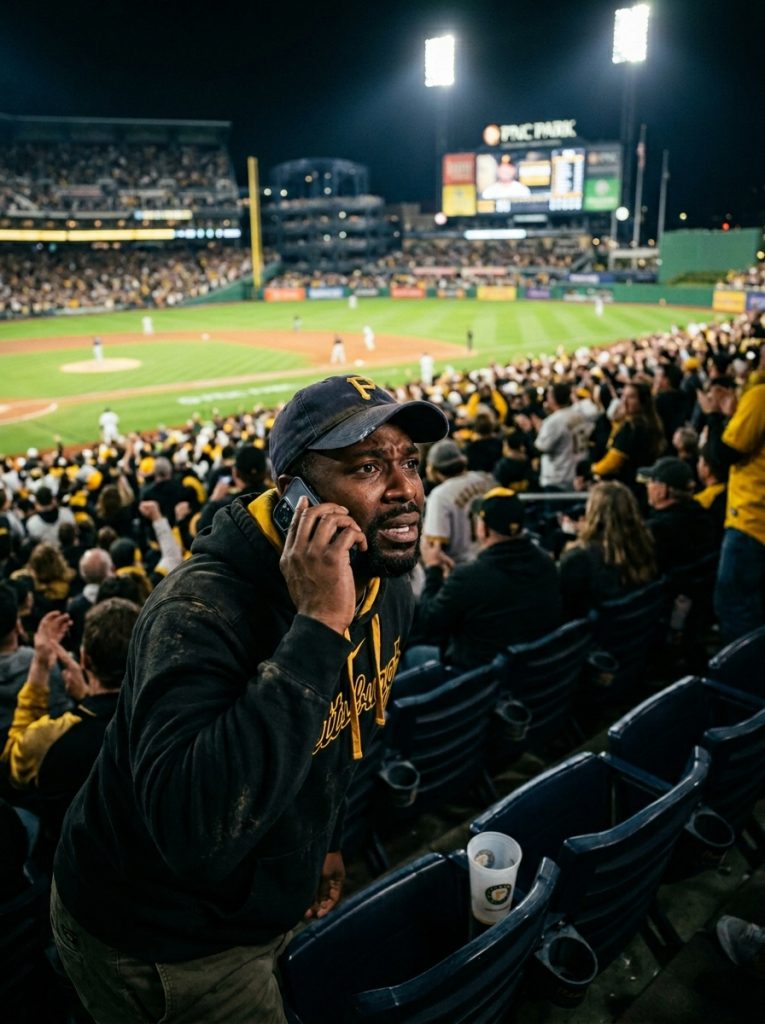
I don’t remember the drive to Allegheny General. I remember running the wrong way down a stadium ramp against the crowd, and then I remember a nurse saying his room number, and the rest is gone.
The waiting room smelled like every hospital I’d ever sworn I’d never set foot in again. The last time I’d sat in one, I was holding my mother’s hand while a machine went quiet. I’d promised myself I was done with plastic chairs and the particular silence of waiting for someone to come tell me a person was gone.
And here I was. Doing it for the man I’d spent my whole life calling the reason I had to grow up fast.
A cardiac event, they told me. Massive. They’d stabilized him, but his heart was failing and it was old damage, years of it, the kind a body keeps quiet about until it can’t anymore.
“He’s awake,” the nurse said. “He’s asking if you came. He’s asked four times.”
I stopped outside the door.
Twenty-six years of rehearsed speeches, and every one of them left me at that threshold. I’d planned, across a whole bitter life, what I’d say to Ray Bell if I ever saw him again. None of it fit through the door of an ICU.
I went in.
He was smaller than the man in my three memories. Gray. A tube at his nose, machines counting him down. But his eyes found me, and his whole ruined face lit like a kid on the first day of the season.
“You came,” he breathed. “Marcus. You came.”
“They told me about the seats,” I said. My voice didn’t work right. “Six years, Dad. You bought the seat next to me for six years and never sat in it. Why?”
And in a voice that kept stopping to find air, my father finally told me the thing I’d been owed for a quarter of a century.
He hadn’t left because he didn’t want me.
He’d left because he was a drunk, back then, and a bad one, and one night he’d scared my mother badly enough that she told him to go. He went. It was the right call — he said that himself, no excuses, even now. “Your mother did right,” he wheezed. “I was no good to be around. She protected you. That was her job and she did it.”
I thought about my mother then — gone four years, fierce and exhausted. She’d carried me alone and never once let me see her break, and I had worshipped her for it. I still do.
But she was a wounded woman making the best call she could with a heart full of fear, and somewhere inside that fear she’d told a lie that grew teeth and ate twenty years. People who love you can protect you and rob you in the very same breath. I was learning that twice in one night.
He got sober four years later. Alone, in a rented room, white-knuckling every holiday.
And when he finally felt steady enough to come back, he called my mother.
“She was scared,” he said. “Scared I’d come around, get you attached, then fall off again and break your heart twice. I can’t blame her. I’d given her every reason.” He swallowed. “She told me you hated me. That you’d said you never wanted to see me. That the court gave her the say, and if I loved you at all, I’d stay gone and let you have a clean life.”
“That wasn’t true,” I said. “I never said that. I was a kid. I would have—”
“I know that now,” he said. “I didn’t know it then. I believed her, because believing her hurt less than believing I’d ruined it myself. So I stayed away. Worst thing I ever did. Worse than the drinking.”
“Then the seats,” I said.
His eyes went wet.
“I found out you had season tickets. A buddy who works concessions told me. Section 119.” He almost smiled. “I couldn’t make myself walk up to you. Coward’s heart, even sober. So I bought the two seats beside yours. Both of them, so no stranger would ever sit between us. I’d come to games, Marcus. I sat up in the cheap seats across the stadium with a pair of binoculars and I watched you watch the game. Every season. I kept telling myself, next year I’ll have the nerve. Next year I’ll go sit down.”
“Why two seats, Dad?” I asked. “Why not just the one?”
He looked almost shy. “Bought the pair so I’d never have to watch a stranger drop down in the spot I wanted. And I figured — if the day ever came, if you ever forgave me — maybe you’d want a buddy in the third one. A whole row of us. A family in a section.” He huffed a laugh that turned into a cough. “Big dreams for a coward with a pair of binoculars.”
Twenty-six years of anger doesn’t vanish. But it can change shape. Standing there, mine turned into something else entirely — grief for all the games we’d both attended alone, forty feet and one lie apart.
“You should have sat down,” I said, and I was crying now, openly, the way I hadn’t since I was eight. “Dad. You should have just sat down.”
“I’m sorry,” he said. “For all of it. I’m so sorry.”
I took his hand. It was the first time I’d touched my father since I was a child.
“Then sit down now,” I said. “When you get out of here. Section 119. The seat’s yours. It’s been yours the whole time.”
He held on so tight.
The doctors didn’t think he’d make it through the week.
He made it through the winter.
It turns out Ray Bell was stubborn about the things that finally mattered to him. He came home — to a small apartment near mine, where I could check on him. We didn’t try to cram twenty-six years into one. We just started where we were. Two grown men, a bad heart, and a sport that had quietly kept a seat open between us the whole time.
Opening Day, I drove him to the ballpark.
I walked him down to Section 119, slow, his hand on my arm. And I watched my father lower himself into the seat beside mine — the seat he’d paid for and grieved over and never once allowed himself to use — and sit down.
He looked around the stadium like a man who’d finally been let into a room he’d pressed his face against for years.
“Best seat in the house,” he said.
“It always was,” I told him. “You just had to sit in it.”
We got most of that season together. He taught me to keep score the old way, in pencil, in a paper book. I learned the smell of his coat again, sober this time. He met the woman I’m going to marry. He was wrong about being no good to be around.
There were hard days. His heart kept its own schedule, and there were nights I drove him back to the hospital with my hazards on, sure it was the last time. There were things we never fully resolved — words from the silent years that don’t dissolve just because you want them to.
But there were also Tuesday afternoon games, half-empty and perfect, where he narrated the pitching like he’d been in the dugout all along. There was the day he taught my fiancée to keep score and got the rules wrong on purpose just to make her laugh.
He passed in September, in his sleep, the week before the playoffs. Peaceful. Forgiven. Forgiving.
I still hold the tickets. Three seats. Section 119.
These days my fiancée sits on one side of me, and the other one stays empty, and when people ask if it’s taken, I tell them the truth.
“Yeah,” I say. “That one’s my dad’s.”
And for nine innings, the empty seat beside me doesn’t ache. It just keeps him close, the way it turns out it always did.