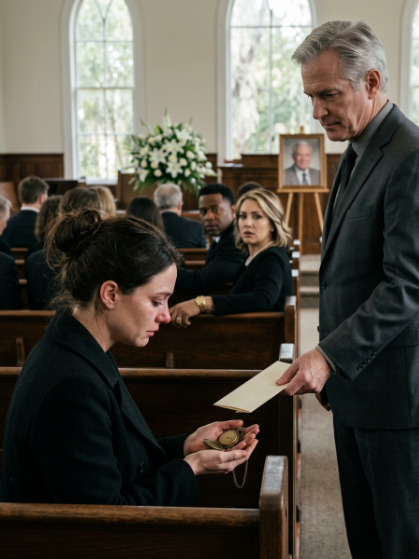
I took the envelope with the hand that wasn’t holding the watch.
My fingers were shaking. Behind Mr. Banks, Gregory had stood halfway up out of the front pew. Pauline had a look on her face like she’d bitten into something rotten.
“Read it here, if you like,” Mr. Banks said gently. “Your father was specific. He wanted it read where everyone could see.”
So I opened it. And in the back row of a funeral home in Savannah, with lilies sweating in the heat, I read my father’s last letter to me out loud.
It wasn’t long.
He wrote that he knew what they said about me. That I’d abandoned him. That I was the difficult one, the ungrateful one. He wrote that he’d let them believe it, because it kept the peace, and because he was a coward about his own children in a way he wasn’t about anything else.
He wrote that he counted. Every visit. Every Sunday drive. The nurse I’d quietly paid for when the money ran thin and I told him it was “covered by insurance” so he wouldn’t fuss.
“Two hundred and eleven visits in six years, Maren,” the letter said. “Your brother came twice. Both times to talk about the house.”
The chapel had gone dead silent.
Mr. Banks took it from there. The will my father signed fourteen months ago — replacing the one Gregory and Pauline had been planning around — left the Savannah house, the land, and the remainder of the estate to me. Sole heir. Sole executor.
To Gregory and Pauline, he left one item each.
A page.
A photocopy, Mr. Banks explained, of the visitor logbook my father had kept by his chair. Every entry in his own shaking handwriting. Their two visits circled. The date of every phone call they didn’t return noted in the margins.
“He wanted you to have the record,” Mr. Banks said to them, not unkindly. “He said you’d know what to do with it.”
Gregory and Pauline had spent the drive to Savannah, I learned later, arguing over who would get the lake property — the one Dad quietly sold back in 2019 to pay for a surgery neither of them ever knew he’d had. They had been dividing up a man who had already given most of himself away. The logbook was the only inheritance honest enough to show them that.
Gregory exploded the way men like Gregory do. Lawyers. Contest. “She manipulated a sick old man.”
I didn’t say anything. I just held up the watch.
“He gave me this three years ago,” I said. “He told me I’d know when. I didn’t understand. I do now.” I looked at my brother. “He was telling me to wind it. To keep his time going when none of you would.”
Pauline started crying. Not the performed kind. The other kind.
Here’s the part I didn’t expect.
I didn’t feel like I’d won.
I drove to the house that afternoon — my house now — and walked through rooms full of a life I’d been on the edge of for years. His reading chair. His coffee mug. The logbook, real and heavy, two hundred and eleven entries under one name.
And I sat down and I grieved, finally, without an audience. Without having to perform being either the villain or the saint.
The estate, it turned out, was modest. The house needed a roof. There was no secret fortune, no twist about millions. Just a tired old home and the truth, which was the only thing my father had left that anyone in that family actually needed.
I found the logbook on the third day, in the drawer of his nightstand. I read every page. The early entries were in his strong hand; the last ones were barely legible, the pen pressed too hard, the letters shaking. But he never missed one. Every visit dated. Every call. Beside one Sunday he’d written, “Maren brought soup. Stayed four hours. Didn’t ask for anything.” I sat on his bed and cried over a bowl of soup I barely remembered making.
I offered Pauline a weekend at the house, later, when the lawyers had gone quiet. She came. We sat on the porch he and I used to sit on. She asked, in a small voice, why he’d let everyone think I was the bad one.
“Because I let him,” I said. “I stopped explaining myself to people who’d already decided. It cost me my reputation in this family. It bought me him.”
She didn’t have an answer for that. There isn’t one.
I still wind the watch every morning. It’s an old brass thing, scratched, stops if you forget.
I don’t forget.
He told me I’d know when. Turns out “when” was every day for the rest of my life.