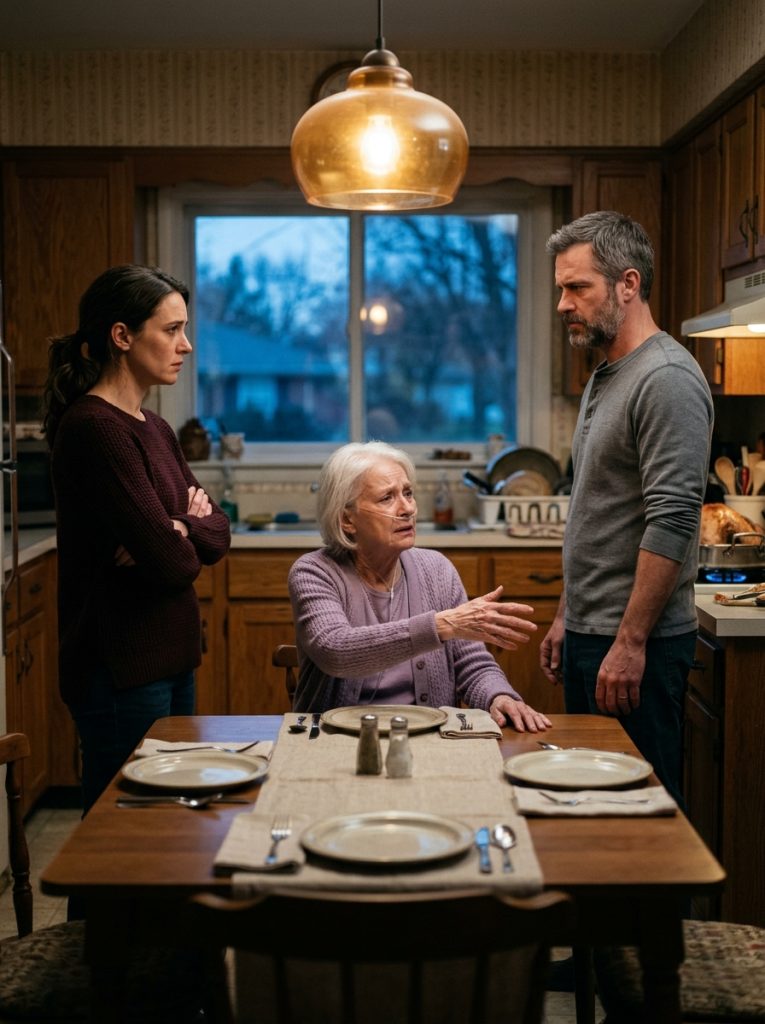
“The money never went to me,” Wes said. “It went to Dad’s mess. All of it.”
Mom made a small sound, like something tearing.
I gripped the back of a kitchen chair. “What are you talking about? Dad didn’t have a mess. Dad was—”
“Dad was broke,” Wes said, and the word landed in that warm kitchen like a dropped plate. “He was broke and he was drowning and he begged me to make sure you never found out.”
I sat down. I had to.
Wes pulled out the chair across from me, the table between us still half-set for a Thanksgiving none of us were going to eat.
“You remember how Dad was,” he said. “The big man. The provider. Took the whole family to dinner and grabbed the check before anyone could blink. You loved that about him. We all did.”
“He worked his whole life,” I said. “He had the pension. He had—”
“He had nothing, Claire.” Wes’s voice cracked. “The last ten years, he made bad bets. A buddy’s business that folded. A second mortgage he never told Mom about. Then the pension fund he’d rolled everything into collapsed, and he was too proud and too scared to say a single word. He spent his last years pretending, and paying for the pretending with money that wasn’t there.”
I remembered the dinners now with new eyes. The way Dad always insisted on the nicest table. The way he’d wave off any talk of money like it was beneath him. The way, near the end, his hands shook when the check came, and I’d told myself it was just age.
It wasn’t age. It was terror. My father had been performing a man who no longer existed, and the performance was eating him alive.
I looked at Mom. She was crying without sound, the oxygen line fogging with each breath, nodding.
“It’s true, baby,” she whispered. “I didn’t even know all of it. Your father kept it from me, too. Wes is the only one he told.”
“When?” I asked.
“At the end,” Wes said. “In the hospice. He grabbed my arm and he made me promise. He said, ‘Don’t let Claire find out who I really was. Let her keep her dad.’ And then he made me the one with power of attorney, because he knew I’d do it and you’d ask too many questions.”
“He was right about that,” I said, and a laugh came out that was mostly a sob. “I’d have torn the bank statements apart.”
“I know,” Wes said. “You always needed the whole truth. Dad just couldn’t stand for you to have this particular one.”
The room blurred.
All of it reorganized itself in front of me, every fact I’d been so sure of flipping over to show its other side.
The money draining from Mom’s account — not stolen. Spent. Covering the debt Dad left, the second mortgage, the collection notices that came in Mom’s name after he died.
I thought of the envelopes I’d seen on Mom’s counter over the years, the ones she’d sweep into a drawer the second I walked in. FINAL NOTICE stamped in red. I’d assumed they were nothing. I’d assumed a great many things.
“The medical bills,” Wes went on, quieter now. “When Mom got sick, there was nothing left to cover them. Dad had burned through it. So I—” He rubbed his face. “I took a second job. Nights. Driving freight. That’s the truck, Claire. The truck you decided I bought to rub my new money in your face. It’s a work truck. I sleep in it between runs sometimes.”
“There’s a cooler in the back,” he added, almost to himself. “A pillow. A picture of you and me as kids taped to the dash. I kept it there the whole time you thought I’d forgotten this family ever existed.”
I made a sound I didn’t recognize.
“I sold my house two years ago,” he said. “I rent a room now. Every extra dollar went to her bills and his debt. I let the family think I’d run off and gotten rich because that was easier than the truth, which was that our father wasn’t who you needed him to be, and I’d promised a dying man I’d protect that for you.”
“You let me hate you,” I whispered. “For seven years. You let me stand in this kitchen and call you a thief in front of everyone.”
“I let you keep your dad,” Wes said simply. “It seemed like a fair trade at the time. You only had the one.”
I have replayed the next part many times.
How I came around that table. How my brother flinched, actually flinched, like he expected me to keep hitting him with the old accusation. How instead I put my arms around him and felt him shaking, felt seven years of carried weight come loose all at once.
“I’m so sorry,” I kept saying. “I’m so sorry, I’m so sorry.”
“You didn’t know,” he said into my shoulder. “That was the whole point. You weren’t supposed to know.”
Mom reached out from the head of the table, both trembling hands now, and we went to her, both of us, kneeling on either side of her chair the way we had when we were small and the world was simple.
“There,” she breathed, a hand on each of our heads. “There. That’s all I wanted. That’s the only thing I ever wanted.”
“Why didn’t you tell me, Mom?” I asked. “All these years.”
“Because it wasn’t only my secret to tell,” she said. “And because I kept hoping you two would find your own way back before—” She didn’t finish. She didn’t have to.
She held on long enough to get her wish, and not much longer.
My mother died three weeks before Thanksgiving the following year, in the early morning, with both her children in the house at the same time for the first time in almost a decade.
We buried her in the lavender cardigan. Wes and I planned the funeral together. We didn’t argue about a single thing.
That year, I learned my brother again from the beginning.
I learned he still takes his coffee black and bitter. That he can’t sing but does anyway. That he’d saved every voicemail our mother ever left him, hundreds of them, and played them back on the long night hauls so the cab wouldn’t feel so empty.
I learned that the man I’d spent seven years calling a thief was the most loyal person I have ever known, and that his loyalty had cost him his house, his savings, and very nearly his sister.
I paid back what I could. Not the money — he wouldn’t hear of the money. The years. I gave him back the years the only way a person can, which is by refusing to waste a single one more.
And when November came, we did what she made us promise.
We hosted Thanksgiving. Together. In her kitchen.
Wes brought his wife, who I was meeting properly for the first time, and the niece and nephew I had seven years to make up for. I cooked Mom’s stuffing from the card in her recipe box. Wes carved, badly, the way Dad used to.
We set a place at the head of the table and left it empty. Not for sorrow. For her.
Before we ate, Wes cleared his throat, and my brother who’d carried so much in silence finally said something out loud.
“To Mom,” he said. “Who knew us better than we knew ourselves. And to Dad.” He paused. “Who wasn’t perfect. But who loved us enough to be scared of disappointing us. We can hold both.”
“We can hold both,” I echoed.
We ate until the windows went dark. The kids fell asleep on the couch. Wes and I did the dishes side by side, shoulder to shoulder, two people who’d lost seven years and refused to lose one more.
At the end of the night, drying the last of Mom’s plates, my brother bumped my arm with his.
“Same time next year?” he asked.
“Same time next year,” I said. “And every year after. You’re not getting out of it now.”
He laughed — really laughed, the sound I’d missed without letting myself know I missed it — and somewhere, I am certain, our mother set down whatever she’d been carrying, too, and finally rested.