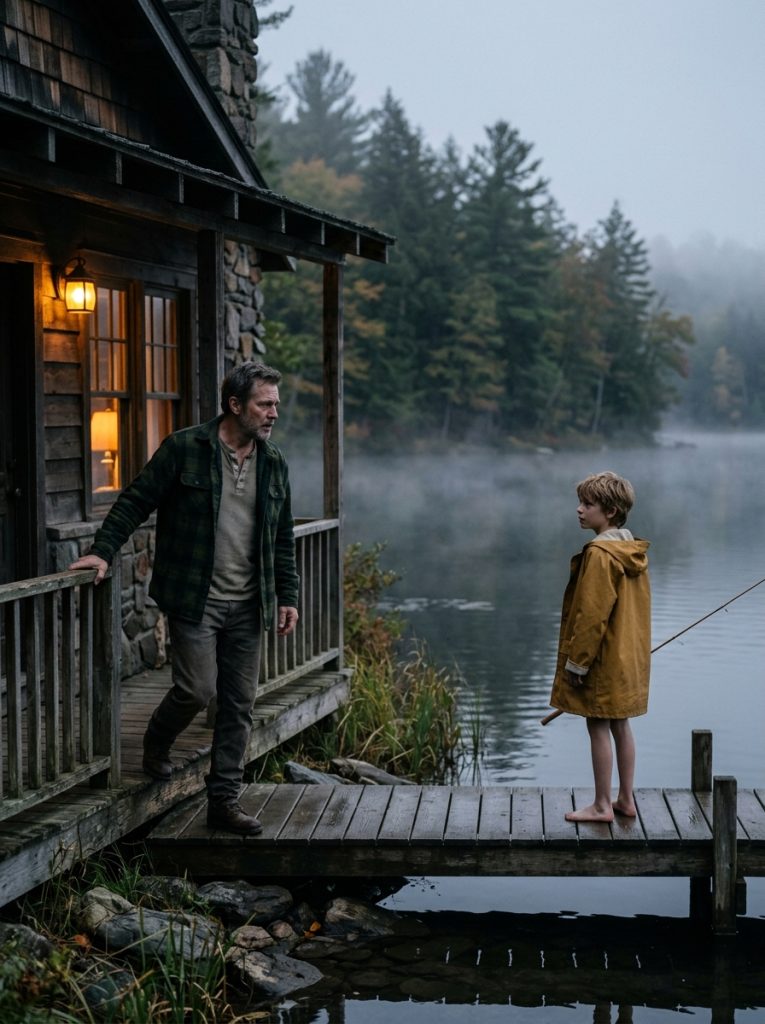
“She promised,” Sam said again, and this time his voice broke, and he was just a small boy in a too-big coat, afraid I’d leave.
I crossed the room and knelt down so we were eye to eye, the way Eleanor used to kneel for anyone smaller than her, which was almost everyone.
“Then let’s start there,” I said. “Tell me about her. Tell me everything.”
It came out in pieces, the way truth does from children.
Sam’s mother had been young and sick. They’d met Eleanor in the chemo ward two towns over, in the long beige hours when strangers become family because they’re all watching the same clock. Eleanor was dying. Sam’s mother was dying. And between the IV poles, the two of them made a plan.
“Mama said Miss Eleanor was the kindest person she ever met,” Sam whispered. “She said when she got too tired, Miss Eleanor would make sure I was okay.”
His mother passed fourteen months ago. He’d gone to live with his grandmother, two miles down the lake road. And three weeks ago, his grandmother’s heart gave out in her sleep, and Sam had been alone in a quiet house waiting for a county van to come decide what to do with him.
That was when he’d walked to the cottage. Because Eleanor had told him, near the end, exactly what to do if he ever ran out of people.
Go to the lake house. Keep the lamp in the window. He’ll see it. He’ll come.
“What lamp, Sam?”
He went to the window and lifted it carefully. A small camping lantern, the kind that charges in the sun. Eleanor had left it on the sill with a note taped to its base.
The note was in her handwriting. My wife’s handwriting, that I would have known in the dark, at the bottom of the sea.
It said: Keep me lit. He is slower than he looks, but he always comes.
I had to sit down.
On the table beside Eleanor’s chair was the tin, and now I opened it all the way. Inside were folded notes, dozens of them, each dated in her hand, the dates marching out past her death and into a future she knew she wouldn’t see.
She’d written them in her last months. One for Sam’s first day at his grandmother’s. One for his birthday. One that just said, You are not a burden. Say it back to me. One for “the day you’re scared no one is coming.”
And at the very bottom, in an envelope with my name on it, a note for me.
My hands shook so hard I tore the flap.
Daniel, it began. If you’re reading this, you finally came back to the lake, which means you’re finally ready to stop standing still. I know you. You’ll have driven up to sell it. Don’t you dare.
I laughed, wet and broken, because it was so exactly her.
There’s a boy, she wrote. His name is Sam, and his mother and I ran out of time at the same place, and I made her a promise I intend to keep even from here. I couldn’t tell you while I was alive. You were so deep in losing me that you had nothing left to give anyone, and that’s all right. Grief is a tunnel. But tunnels end.
You always said you’d have been a good father. You never got the chance, and I know it carved a hole in you that my dying only made wider. So here is the last thing I can give you, my love. Not a goodbye. A beginning.
He needs someone. You need someone to need you. I have done the math on this the way I did the math on everything, and I am, as usual, right.
The lamp will lead you to him. The rest is up to you.
I am not gone while you are kind. — E.
I read it three times. Then I folded it and pressed it to my chest and cried in a way I had not let myself cry in three years, the kind that comes from the floor of you.
Sam stood very still, watching me, deciding something.
“Are you going to leave?” he asked.
“No,” I said. “No, Sam. I don’t think I am.”
Headlights swept the gravel outside. A car door. Footsteps on the porch. And then a woman in her sixties came in without knocking, in a way that told me she’d been coming in without knocking for a long time.
“You must be Daniel,” she said. “I’m Ruth Calloway. I look after the place. And I’ve been looking after him.” She nodded at Sam, and her stern face cracked. “Your wife paid me three years up front to keep the cottage warm and the lamp charged and to call her lawyer the day a boy named Sam ever showed up at that door. I made the call last week. The lawyer said you’d already signed papers to sell. I prayed you’d come up to see it one last time before you did.”
“You’re the caretaker,” I said.
“I’m the backup plan,” she said. “Eleanor didn’t believe in leaving things to chance. Not even her own funeral. Especially not you.”
We talked for a long time, the three of us, at the table where my wife had once read about lighthouses. Ruth had documents. Eleanor had documents. My wife, it turned out, had spent her dying months not in despair but in logistics — guardianship paperwork, a small trust, a folder labeled FOR WHEN HE’S READY in her tidy block letters.
There was even a sealed letter for Sam in that folder, marked to be opened the day he turned eighteen. I didn’t open it. Some promises you keep without reading them.
She had set the whole thing up so that all I had to do was not run.
I didn’t run.
The county van came two days later. By then I had a lawyer of my own and a folder of my own and a guest room that used to be an office, aired out and made up with a quilt in this year’s yarn that I finally understood Eleanor had knit for a child.
It was not simple. Grief never is, and neither is a frightened ten-year-old, and neither am I. There were hard nights. There were nights Sam cried for his mother and I cried for my wife and we sat at opposite ends of the dock and let the lake hold both.
A grief counselor in town started seeing us, together and apart. She told me one thing I keep close: you don’t replace the people you lose, you make room beside them. So Sam’s mother got a shelf in his room — her photo, her hairbrush, a recipe card in her writing. Eleanor kept the mantel. Nobody had to move over to make space for somebody new.
But there were other nights, too.
Nights he beat me at checkers and crowed about it. Nights he asked me to read the lighthouse book and fell asleep before the keeper found his way home. Nights I stood in the doorway of a room that was no longer an office and listened to a child breathe and felt the hole in me close over, slowly, like water.
I never did sell the lake house.
I moved us up there for good the following spring. I take Sam to school on the gravel road every morning. I learned to bait a hook. I am, it turns out, slower than I look.
Ruth Calloway still comes by without knocking. She brings pie and pretends it’s for Sam. She and I have become the kind of friends two people become when they’ve quietly loved the same stubborn, far-seeing woman.
On the anniversary of the day I found him, we put fresh wildflowers on Eleanor’s grave, and beside them, the crayon drawing — the man, the woman, the boy in the yellow coat, all holding hands under a setting sun.
Sam asked if she could see it.
I told him the truth, which is the only thing I know how to tell him.
“She saw it before either of us did,” I said. “That’s how she is.”
That night the lamp glowed warm in the window, the way it has every night since, and I sat on the dock with my son and watched the dark water hold the light, and I thanked my wife out loud for the family she sent me from a place I cannot follow yet.
The lake didn’t answer.
It didn’t have to. She’d already said everything, three years ahead of time, in her own steady hand.