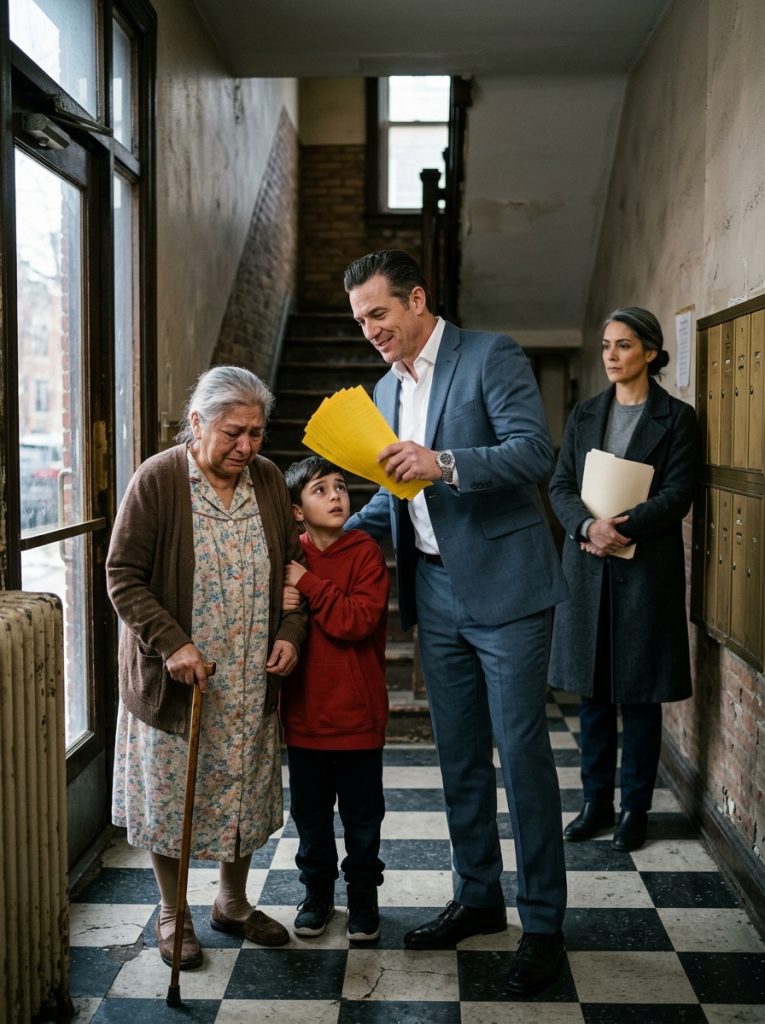
Grant Mercer opened the folder like a man humoring a child.
Then he stopped breathing.
The top page was a deed. Not for the building — for the land beneath it. The lot itself. And the name on it wasn’t his holding company.
It was the Alvarez-Pilsen Land Trust.
“This is a forgery,” he said, but his voice had lost its polish.
“It’s recorded at the county,” I said. “Stamped, witnessed, and paid in full. You’re welcome to call them. They open at nine.”
He flipped to the second page. The third. His jaw worked.
“You bought the building,” I said gently. “Congratulations. You own the bricks, the boiler, the bad plumbing. What you don’t own is the dirt it stands on. That’s a ground lease, Mr. Mercer. Ninety-nine years, signed by the previous owner in 1974. And it expires in four months.”
The lobby was silent. Mrs. Alvarez had stopped staring at the floor. Theo was watching me with his mouth open.
“That’s not possible,” Mercer said. “My attorneys did due diligence. The land was—”
“The land was held by a trust your attorneys never bothered to look through, because the trust was small and quiet and didn’t matter to anyone trying to flip a building fast.” I let that sit. “I bought it eleven years ago, when the last landlord tried to do exactly what you’re doing now. I was a tenant then, too. I just happened to have something he didn’t expect.”
“And what’s that,” Mercer spat.
“Money,” I said. “And a reason to use it that wasn’t myself.”
He laughed, sharp and ugly. “A cleaning lady with money. Sure.”
“Funny thing about money,” I said. “The people who have the most of it almost never look like it. You’d know that if you’d ever looked at anyone in this lobby as more than square footage.”
Here is the part Grant Mercer didn’t know, the part none of them knew.
My name is Nora Vance, and before I ever picked up a mop, I was a structural engineer. I spent fifteen years designing high-rises for a firm downtown. I was good at it, and I was paid like I was good at it.
Then my husband died, suddenly, the way the healthy ones sometimes do, and the firm sent flowers and expected me back in a week. I came back. And one afternoon I watched them quietly approve a development that would put four hundred families out of their homes, and I heard a vice president call it “unlocking value,” and I went home and I did not go back.
I had savings. I had a settlement. I had a building I’d been renting in for years, full of people who’d brought me food the week of the funeral when my own colleagues couldn’t be bothered.
So when the old landlord put the land up to cash out, I bought it through a trust and named it after the woman in 3B who’d fed me. And I stayed. I mopped the floors. I fixed the radiators. I let everyone believe I was the caretaker, because the day they found out I owned the ground was a day I was saving for exactly this.
I didn’t do it to play hero. I did it because I’d spent fifteen years raising towers for people who would never live in them, and I wanted, just once, to protect something for the people who actually would.
A building isn’t value waiting to be unlocked. It’s where Mrs. Alvarez’s husband took his last breath, and where Theo learned to read on the front steps. You can’t put that on a spreadsheet. So I bought the one thing that could keep it safe — the dirt underneath.
“You’ve been the landlord,” Mercer said slowly. “This whole time.”
“No,” I said. “I’ve been the neighbor. There’s a difference. You wouldn’t know it.”
He tried to rally. Men like him always do.
“Fine,” he said. “Fine. The lease renews. I’ll negotiate the ground rent. Everyone has a price, Ms. Vance. Name yours.”
“I already named it,” I said. “When I drew up the lease renewal terms last year. You can read them on page nine.”
He turned to page nine.
I watched his face fall through every floor of the building.
The renewal terms were simple. The ground lease would renew — for a single tenant. A new entity I’d formed: a limited-equity housing cooperative, owned by the people who actually lived here. The rent to the trust would be one dollar a year. Any owner of the structure who wished to operate it as luxury condos would owe ground rent calculated at fair market value for the land.
Which, for prime Pilsen land that a developer had just leveraged himself to the eyeballs to acquire, was a number with a great many zeros.
“You can keep your building,” I said. “You can even build your condos. You’ll just pay the trust the true value of the ground every single year to do it. Or you can sell the structure — to the cooperative — for what you paid, and walk away whole. Your choice. I’m not in the business of ruining people. Even people like you.”
“You planned this,” he whispered.
“I prepared for this,” I corrected. “There’s a difference there, too.”
“I’ll tie this up in court for years,” he said, grasping. “You’ll spend every dollar of that little trust on lawyers.”
“You’re welcome to try,” I said. “I’ve spent eleven years making sure every comma sits exactly where it belongs. My attorney is the woman in 2C — she’s handling it for nothing, because her mother lives in 4A. You’ll find we’re a lot harder to outspend than you think.”
Mercer had borrowed against everything to buy our building cheap and sell it dear. He’d told his investors the land was his. He’d never read the dirt. And now the math that was supposed to make him rich turned, line by line, into the math that would bury him.
He looked around the lobby, at the faces he’d called charity cases an hour ago, and for the first time he understood that he was the only person in the room without leverage.
“I need to make some calls,” he said.
“You do,” I agreed.
He gathered his yellow notices with hands that weren’t steady anymore. At the door he turned, searching for one last thing to wound me with, and found nothing. The door swung shut behind him.
The lobby stayed quiet for a moment.
Then Mrs. Alvarez laughed — a small, disbelieving sound — and pressed both hands to her mouth.
“Nora,” she said. “The trust. You named it—”
“After you,” I said. “Took me a while to tell you. Sorry about that.”
Three weeks later, Grant Mercer sold the building to the cooperative for exactly what he’d paid, took his small loss, and disappeared into whatever city eats men like him next. His investors were not gentle with him. I heard the condo brochure had already been printed. I heard a lot of things.
The tenants bought their own homes for shares they could afford, with rent that could never again be raised by a man with a spreadsheet and a smile.
We held the first cooperative meeting in the lobby, by the brass mailboxes, under the radiator that still knocks in January.
Mrs. Alvarez was elected president. She cried. Theo brought a poster he’d made, and we taped it over the spot where the demolition notice used to appear.
The poster was a crayon drawing of the whole building, every window lit, every family’s name written under its floor. Mine was up there too, on the top floor, in shaky blue marker, right where it had always been.
I still mop the stairwell.
People ask me why, now that everyone knows. I tell them the truth, which is that a building is just bricks until the people in it decide to belong to each other.
That night I stood in the clean lobby a long time after everyone went up to bed, listening to the old place settle, the radiator ticking like a heart that finally had no reason to stop.
Then I turned off the light, and I went home, which was upstairs, which it had been all along.