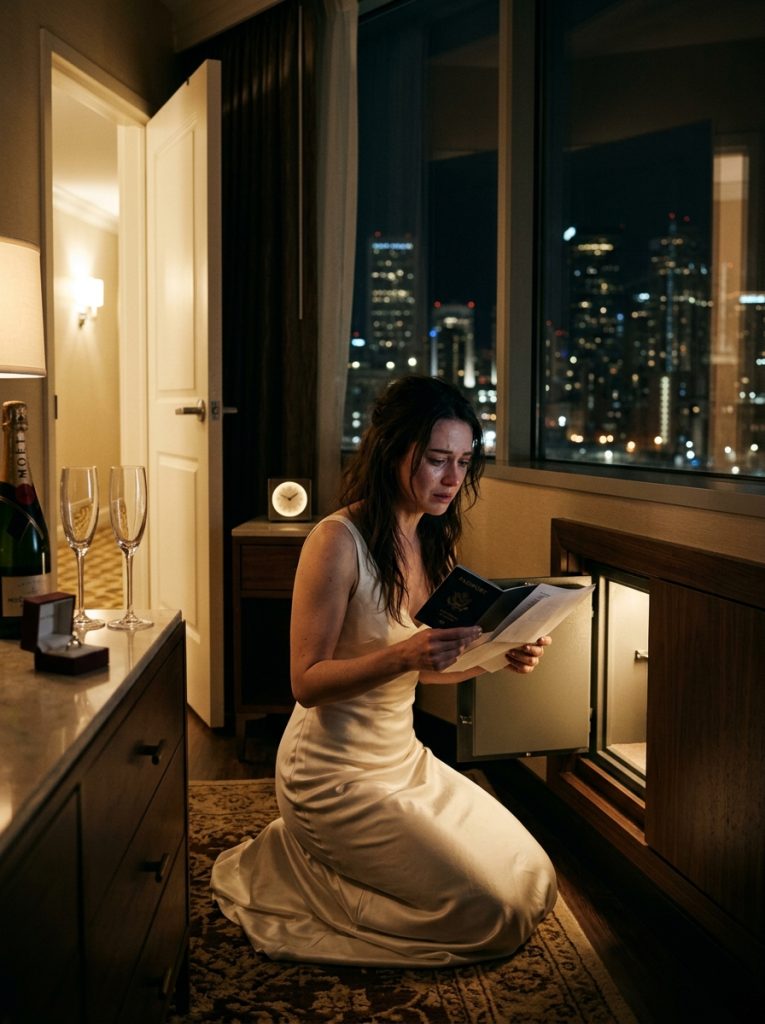
He came in the way he did everything — easily. Bow tie undone, jacket over his shoulder on one finger, that smile he’d practiced on me for eight months and, I now understood, on other women before me.
“There she is,” Adam said. “Mrs. Keller. You disappeared on me.”
“I came up to put my rings away,” I said, and held up the champagne. “I poured us a glass. Sit with me a minute? I feel like we haven’t had thirty seconds alone all night.”
He sat. Of course he sat. He thought he was sitting with the soft, distractible heiress he’d spent the better part of a year studying. He clinked his glass against mine. “To us,” he said.
“To honesty,” I said, and watched a flicker cross his face before the smile smoothed it over. “Adam. Can I ask you something? Where were you planning to be tomorrow afternoon?”
“Tomorrow?” He laughed. “On a plane to Belize with my wife. Why?”
“It’s just,” I said, “I found the strangest thing in the safe.”
I will give him this: he was good. The smile didn’t drop. His eyes went to the closet panel, just for an instant, and came back. “What do you mean?”
“I mean the annulment papers,” I said. “Dated tomorrow. And the cash. And the passport with your face and somebody else’s name. I have to say, the name threw me. I kept thinking, who is this man my husband is pretending not to be?”
The room got very quiet. The city glittered behind him. And I watched the charm drain out of Adam’s face like water out of a sink, and what was left underneath was not even angry. It was calculating. He was already running the numbers on a new plan.
“Okay,” he said slowly. “Okay. I can explain the—”
“Please don’t,” I said. “I’d rather you didn’t waste either of our time, because the explanation doesn’t matter anymore. What matters is what you got wrong.”
“And what did I get wrong?”
I set down my glass.
“You did your homework on me,” I said. “I know you did. You knew my grandmother left the family holdings in a trust. You knew the number. You knew enough to wave off a prenup as insulting and to book a honeymoon somewhere with no extradition treaty. You did so much homework, Adam. You just stopped one question short.”
“Which question?”
“Who controls the trust.”
I let that sit.
“You assumed it was some bank. Some committee of gray men I’d have to beg. It’s not. My grandmother didn’t trust gray men; she’d been married to one. She named a single trustee, with sole signing authority, specifically so that no charming stranger could ever sweep in and move the money in a weekend.” I smiled at him for the first time since he’d walked in. “It’s me, Adam. I’m the trustee. I’m the signature. There is no soft account for you to drain. There’s just me, and a wall I built myself, with lawyers who have my cell number, because my grandmother sat me down at nineteen and told me that one day a man would smile at me exactly the way you smile at me.”
He was very still now.
“The annulment dated tomorrow,” I went on. “The cash. The second identity. That’s not a man getting cold feet. That’s a man who built an entire marriage as a smash-and-grab and scheduled the getaway before the reception ended. The only problem is, the vault was empty, and the vault was paying attention.”
“You can’t prove I was going to—”
“I photographed all of it,” I said. “Forty minutes ago. The forms, the cash, both pages of that passport. I sent the photos to my attorney, to my head of security, and to one other person you’re going to find very interesting, before you ever stepped out of the elevator. So everything in that safe is already somewhere you can’t reach. Go ahead and check.”
He didn’t check. He knew I wasn’t bluffing. People like Adam can always tell when they’ve finally met someone who did more homework than they did.
I want to tell you I felt powerful in that moment. I didn’t, exactly. What I felt was cold, and very awake, and grateful in a way that frightened me — grateful that my grandmother had been paranoid enough, decades ago, to build the wall I was now standing behind. Without her, I’d have been one of the women who came before me. I’d have spent two years trying to convince people I’d been robbed by my own husband while they smiled and decided I was just bitter. The only thing separating me from that life was one old woman’s foresight and ninety seconds of refusing to fall apart in front of an open safe.
Here is the part that turned my stomach, and the part that made me certain I’d done the right thing.
The “very interesting” person I’d sent the photos to was a woman named Marisol, in Phoenix. I’d found her in about four minutes, because the name on Adam’s second passport wasn’t random — it was a name he’d used before, and a name he’d married under before, to a woman who had spent two years and most of her savings trying to warn anyone who’d listen about the charming man who’d vanished with her grandmother’s jewelry and her trust in human beings. There was a third woman in Sacramento. The passport name was the thread; once I had it, the whole tapestry came apart.
Adam wasn’t a bad husband. He was a profession. And I was supposed to be his retirement.
He left that night. Not on his terms. My head of security was, as it happened, already in the lobby — another thing I’d arranged in those nine minutes, because my grandmother also taught me that clarity without backup is just a nice speech. There was no scene. There rarely is, with men like him; the whole point of the performance is that it never makes noise. He simply walked out of the Ardmore into the cold Denver night with his jacket over one finger, and somewhere out there I imagine he is right now, three glasses of champagne into a story, smiling at someone new.
I hope she did her homework. I left enough of a trail that she can.
The annulment got filed after all — by me, with the date corrected, and with company. Marisol and the woman from Sacramento and I are, improbably, in touch now. We are not friends, exactly. We are something stranger and more durable than that: three people who met the same storm and compared notes on the wreckage.
Marisol was the one who finally laid out the whole pattern for me, on a long phone call a few weeks later. He always married women with family money and no living parents around to ask the hard questions. He always moved fast. He always waved off prenups as insulting. He always chose venues with in-room safes. And he always built the exit before the wedding, because the wedding was never the point — it was the cover, the legal doorway that let him reach for what he was actually after. “You did the one thing none of us managed in time,” she told me. “You opened the safe before the honeymoon instead of after.” I told her it was luck. She said luck is just preparation that happens to show up on schedule, and that my grandmother had done the preparing twenty years before I ever needed it.
People ask me if I’m heartbroken. The honest answer is that you can’t break a heart that was never actually given. He proposed to a balance sheet. He married a wall. I spent three hours as a wife and the rest of my life as a woman who opened a safe expecting her grandmother’s rings and found, instead, exactly who she was dealing with — in time.
My grandmother was right about almost everything.
She was especially right that the difference between a victim and a survivor is about ninety seconds of clear thinking.
I had nine minutes.
I used every one.