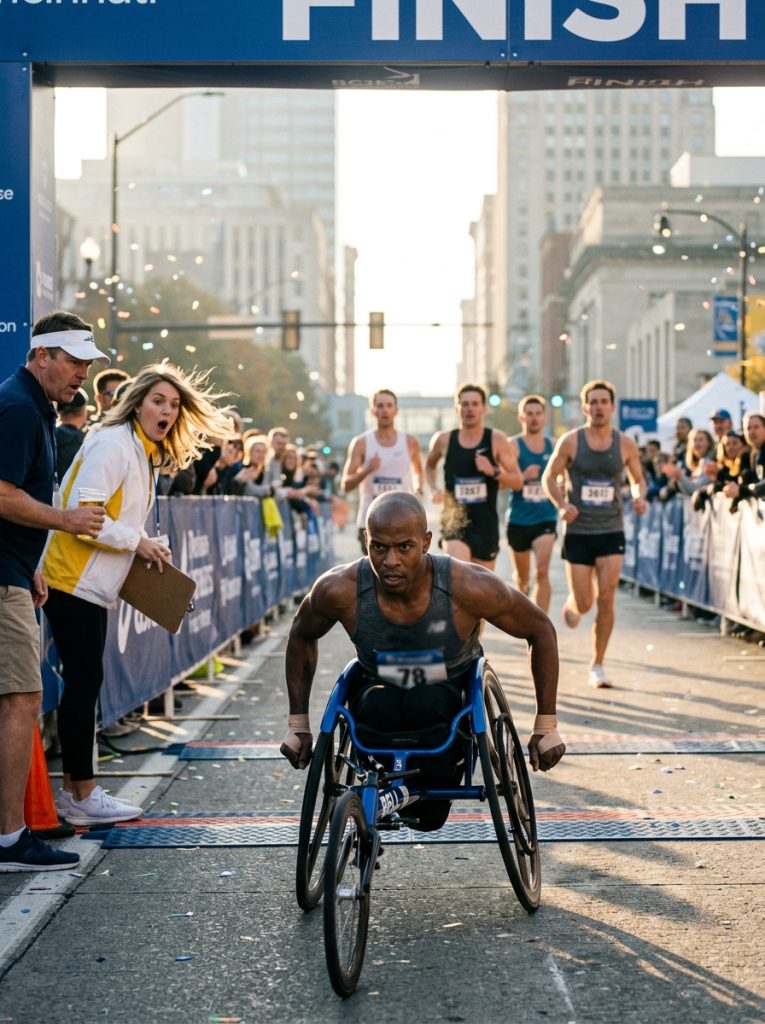
The finish line is a strange place when you arrive before you’re expected. The volunteers with the foil blankets weren’t even in position yet. A man with a clipboard was still arguing with a timing tech about whether the elite chairs had already come through. They had. It was me. I was sitting right in front of him, lungs heaving, and he was looking past me for the athlete he assumed had to be somewhere else.
Then Dana reached me.
She came across the finish chute fast, her yellow jacket flapping, and the first thing out of her mouth wasn’t an apology. It was damage control.
“Sir — Mr. Bell — there’s been a mix-up with the seeding, I want to make sure we get your time recorded correctly—”
“You had my email,” I said. I wasn’t angry. I was just done being quiet. “You had it this morning. You looked me in the face and sent me to the back behind a man in a hot dog costume.”
“That was a safety decision.”
“For who?”
She didn’t have an answer for that, because there has never been a good one.
That’s when the man with the lanyard stepped between us — not to interrupt, exactly, but to make sure the timing tech and the two reporters drifting over could hear him clearly.
“I’d like the official record to show,” he said, “that this athlete posted the third-fastest time on this entire course today. Across every division. And I’d like it on the record that a race official attempted to remove him from his seeded start.” He turned to Dana, pleasant as Sunday. “You did say that, didn’t you? I was standing right next to you at the rail. ‘We don’t want anyone tripping over you.’ I have it on my phone, actually. I record start-line audio for scouting. Habit.”
Dana’s face went the color of the pavement.
The man stuck out his hand to me. “Theo Marchetti. I coordinate the national para-athletics development program. I came here today to watch a sprinter from Dayton.” He smiled. “I’m leaving with someone else.”
I shook his hand because my mother raised me to, but my head was somewhere up around the finish arch, floating.
My coach, Reyes, found me twenty minutes later in the recovery corral. He’d watched the whole thing from the press pen. He crouched down in front of my chair — this man who had never once in eleven months told me I was brave, who had only ever given me my splits and my mistakes — and he put both hands on my shoulders.
“I timed you off the broadcast clock,” he said. “You negative-split a marathon. From a dead stop. After a sixty-second penalty.” His voice did something I’d never heard it do. “Marcus. Do you have any idea what you are?”
“You always told me not to ask that question,” I said. “You said it’d make me soft.”
“Yeah, well.” He cleared his throat and looked away. “Ask it tonight. Just tonight.”
“You ran down nineteen thousand people from a standing sixty-second penalty,” Theo said. “Do you understand what that is? That’s not inspiration. That’s a engine. We have a development squad. We have coaches, equipment sponsors, a track in Colorado Springs, and a competition pipeline that ends at the Paralympic trials. I want you in it. Today, if you’ll let me make some calls.”
I have replayed that morning a thousand times, and I always get stuck on the same small thing. It wasn’t the offer that undid me. It was the word he used in the next sentence.
“You’re not a participant, Marcus,” he said. “You’re a competitor. There’s a difference, and everyone here just watched it.”
Behind him, the man in the white visor — the one who’d laughed that it was cute I was out here trying — was standing very still with his beer hanging at his side, because a reporter had turned her little camera toward him and was asking, with great innocence, whether he’d been the spectator overheard mocking the third-place finisher.
He mumbled something about not meaning anything by it.
“He didn’t,” I said to the reporter. I meant it. “He just didn’t know what he was looking at. Most people don’t. That’s the whole problem.”
It made better television than if I’d torn into him. But it was also just true.
Here is what happened in the weeks after, because the finish line is only ever half the story.
The marathon launched an internal review of its “athlete safety” start-line policy — the one that had, for years, quietly shuffled wheelchair and adaptive athletes to the back “for everyone’s comfort.” Theo’s recording, plus my email, plus two other adaptive athletes who came forward to say the same thing had happened to them, turned a vague embarrassment into a written rule change. Seeded adaptive starts. No reassignments without the athlete’s consent. They named it, with no sense of irony, the Equal Start policy. Dana was not fired — I asked them not to, and I’ll be honest, I’m still not fully sure why, except that being made small does not make me want to make other people small. But she was required to help rewrite the very policy she’d used against me. I’m told she did it well.
Theo made his calls. By spring I was training in Colorado Springs with a coach who measured my pushes in fractions of a second and a chair sponsor who built me a frame so light it felt like an extension of my own ribs.
The first time I rolled into that training facility, there was a wall of photographs in the lobby — athletes mid-race, mid-throw, mid-flight, every one of them in a chair or on a blade or guided by a tether. Not a single foil blanket. Not a single pity clap frozen in a frame. Just sport, at the only speed sport has. I sat in front of that wall for a long time. I had spent eight years believing the interesting part of my life was behind me, and here was a building full of people who’d have laughed me out of the room for thinking it.
The two other athletes who’d come forward after Cincinnati — a thrower named Cass who’d been told to compete “in the warm-up flight so she wouldn’t slow things down,” and a kid named Devon who’d been turned away from a 10K start entirely — both ended up in the same development pipeline. We text. We send each other our splits and our finish-line photos. We have a group chat that is just the three of us calling each other “participant” as an insult and then laughing about it. I’m not going to tell you I won everything. I didn’t. The development squad is full of people who ran down their own nineteen thousand. But I made the team. I have a number on my back that I was seeded to wear, at the front, where they can’t move me.
The part I actually came here to tell you, though, isn’t the medals.
It’s Imani.
My daughter was waiting at mile eighteen that morning with a cardboard sign. By the time the news clip went around — the veteran in the racing chair who beat the field after they tried to bench him — kids at her school had seen it. And she came home one afternoon and told me, very seriously, that a boy in her class had said, “Your dad’s the guy from the video. The one everybody underestimated.”
And she’d told him, “No. He’s the one everybody underestimated once.”
I framed that sentence. It’s on the wall next to the start-line photo, the one where I’m crossing the tape and the whole running field is a blur behind me and Dana is frozen at the rail with her clipboard at her side.
People still call me brave. I let them now. I’ve made peace with the word.
But somewhere out there is a course official who learned, on a cold gold morning in Cincinnati, that the safest thing you can do is give a person their fair start and then get out of the way.
And somewhere out there is a man in a white visor who, I sincerely hope, looks a little harder now before he decides who’s worth cheering for.
I wasn’t out there trying.
I was out there racing.
There’s a difference. Everybody watched it.