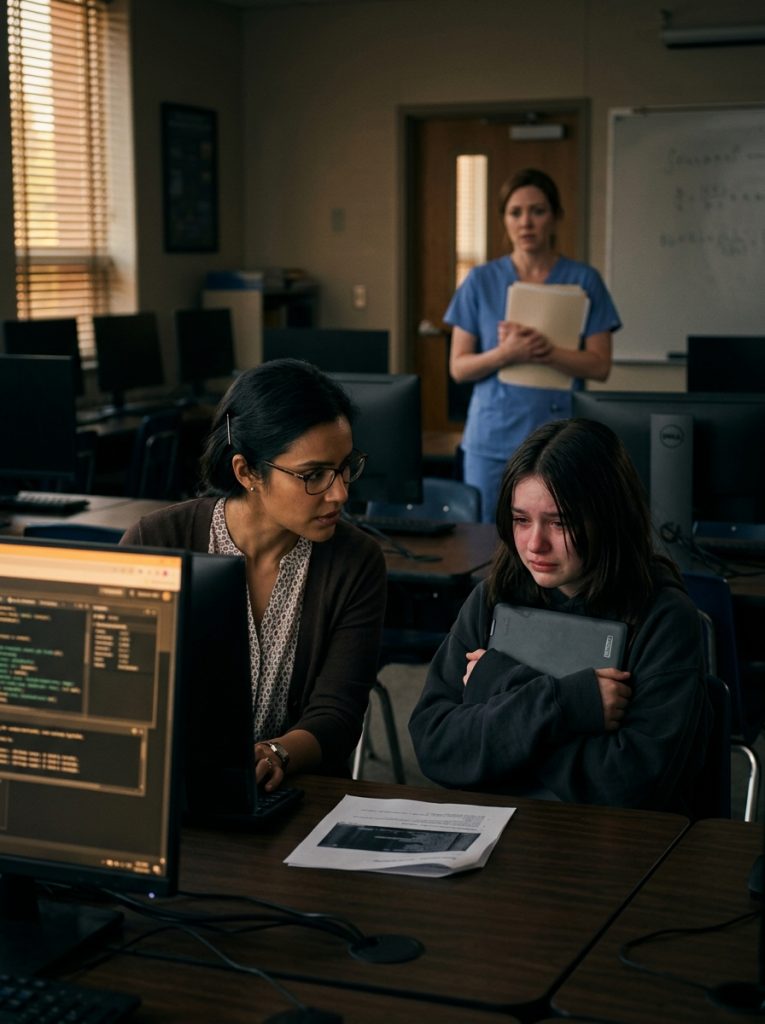
The name attached to the account was Delaney Frost.
I read it three times before I let myself believe it.
Delaney Frost. Eighth-grade honor roll. Student council. The girl who held the door for teachers and won the citizenship award two years running. The principal’s favorite. The face on the slide in every parent night about “the Glenmoor difference.”
The last student in that building anyone would ever suspect. Which, I would come to understand, was the entire point.
I sat in that empty classroom for a long time before I did anything. I checked the log twice more. I checked the device assignment against the roster. I checked the timestamp against the bell schedule. Part of me wanted it to be a glitch — because Delaney was the easy kid, the kid who made adults feel like the school was working, and naming her would cost something. I understood, sitting there, exactly how Mr. Vance had let two months go by. It is so much more comfortable to believe the quiet girl is just sensitive than to believe the golden girl is cruel.
I checked it a fourth time. The data didn’t blink.
I didn’t go to Hazel. I didn’t go to Delaney. I documented everything — the decoy detail I’d planted, the timestamp, the device ID assigned to Delaney in our own system, the account that took the bait — and I printed it twice. Then I went to the principal.
Mr. Vance did not want to look at it.
“Priya, Delaney Frost? Do you understand what you’re suggesting? Her mother is on the foundation board. Her family—”
“I understand the data, Mr. Vance. The account that’s been tormenting Hazel Mercer for two months logged in from Delaney’s assigned device, and reached for a piece of bait that only the person running that account would have chased. This isn’t a hunch. It’s a log.”
He pushed the papers back the way he had the first time. But his hand wasn’t steady doing it.
“These things are complicated,” he said. “Devices get shared. Accounts get hacked. We could be looking at—”
“Then let’s ask her,” I said. “With her parents in the room. If it’s a mistake, the data will clear her. I’d be glad to be wrong. Will you?”
That stopped him. Because he knew, and I knew, that he’d spent two months calling a suffering child “sensitive” so he wouldn’t have to do anything hard. And now the hard thing had a name he liked, and there was no looking away from it.
We held the meeting two days later. Delaney. Her parents. Mr. Vance. Me. The district’s technology director, whom I’d quietly looped in so it couldn’t be buried.
Delaney was poised at first. She’d had practice being the good one. She said she had no idea what any of this was about, in that clear rehearsed voice, and her mother’s chin lifted like a drawbridge.
Then the tech director walked through the logs. Plainly. No drama. The device. The timestamps. The decoy — a fake “anonymous tip line” detail I’d seeded that only the bully would have reason to test, accessed from Delaney’s login at 9:48 on a Tuesday night, from the family’s own home network.
The poise held for about ninety seconds.
Then it didn’t.
I have been teaching thirteen- and fourteen-year-olds for a long time, and I will tell you that the moment a child’s mask comes off is never triumphant. It’s just sad. Delaney started to cry — real crying, not the performance kind — and what came out between the sobs was uglier and smaller and more human than anyone in that room expected.
She was drowning. Straight-A drowning. The kind of pressure that lives in some houses where love is spelled achievement. Hazel — quiet, unbothered, doodling little games in the back row, indifferent to the rankings Delaney was killing herself to top — Hazel had something Delaney couldn’t buy with a perfect GPA, and Delaney hated her for it. So she’d built an anonymous account to take it apart, piece by piece, in the dark, where the golden girl would never be suspected.
It didn’t excuse one word of what she’d done to Hazel. The harm was real; I’d watched a child go gray over it. But it explained the shape of it, and it meant the answer couldn’t just be a hammer.
There were consequences, real ones. Delaney was suspended. She was removed from student council and the honor assembly. The account was preserved and reported through the proper channels, and her parents were told, in plain language, that the next instance would not stay inside the school’s walls.
But there was also a requirement I pushed for, and Mr. Vance — chastened now, and trying — backed me on it. Delaney would do the long, unglamorous work: counseling, real counseling, not a checkbox. A written accountability she had to read and own. And no contact with Hazel unless and until Hazel ever wanted it, on Hazel’s terms, never Delaney’s.
Because this was never about destroying a fourteen-year-old. It was about protecting one. And the protected one had a name too, and we’d spent two months forgetting to say it.
Hazel.
I told her myself, with her mother there. Robin had been carrying that folder of screenshots like armor for months, and when I said we’d found who it was and that it was over, she folded forward and just shook.
Hazel didn’t cry. She got very still. Then she asked the only question that mattered to her:
“So everyone knows it wasn’t me being dramatic? It was real?”
“It was real,” I said. “It was never you. And everyone who needs to know, knows.”
Something came back into her face right then that had been gone for two months. Not happiness, exactly. Just — weight lifting. The look of a kid who’d been told the floor was solid after all.
The school changed after that. It had to.
We built an actual anonymous reporting system — a real one, that goes to people who act, not a suggestion box that goes nowhere. We brought in training, the kind led by people who’d lived it, not a video nobody watches. And it became policy, in writing, that “she’s just sensitive” is not an investigation, and a logged complaint gets looked at by someone with the skill to look.
I’d like to say Mr. Vance had a grand transformation. He didn’t. But he learned the one thing I needed him to learn: that the comfortable answer and the true one are rarely the same, and the job is choosing the true one even when the family’s on the board.
Hazel started raising her hand again. Slowly. By spring she was writing little games in class again — a maze, a quiz, a tiny thing where a pixel cat jumps a wall. She showed me one she’d built, and at the end, when you win, the cat holds up a sign.
The sign said: “you’re not too sensitive. you were right.”
I didn’t ask her what it meant. I knew.
Her mother stopped by my room at the end of the year. Robin wasn’t carrying the folder anymore — I noticed that first, the empty hands. She told me Hazel had asked to join the coding club I run on Thursdays. That she’d started sleeping again. That she’d laughed at the dinner table the week before, loud, at something dumb, and that Robin had to leave the room because she hadn’t heard that laugh in so long she’d forgotten the sound of it.
“You went looking,” Robin said. “Everyone else told me to have her log off. You went looking.”
I told her the truth — that I almost didn’t. That a folded note saved a kid, and I nearly threw it out with the worksheets.
People think the lesson of this story is that you can catch anyone, that no one’s really anonymous. That’s true, and it’s the smallest part.
The real lesson is the one Mr. Vance almost missed and Hazel almost paid for: when a quiet kid stops raising her hand, that is the alarm. That is the whole alarm. You don’t wait for proof to care. You just have to care enough to go looking.
I kept that folded note Hazel left on my desk. The one with four words in pencil, “please make them stop.”
They stopped. She’s loud now, in the best way. And the note lives in my desk drawer, so I never forget how close I came to grading right over the top of it.