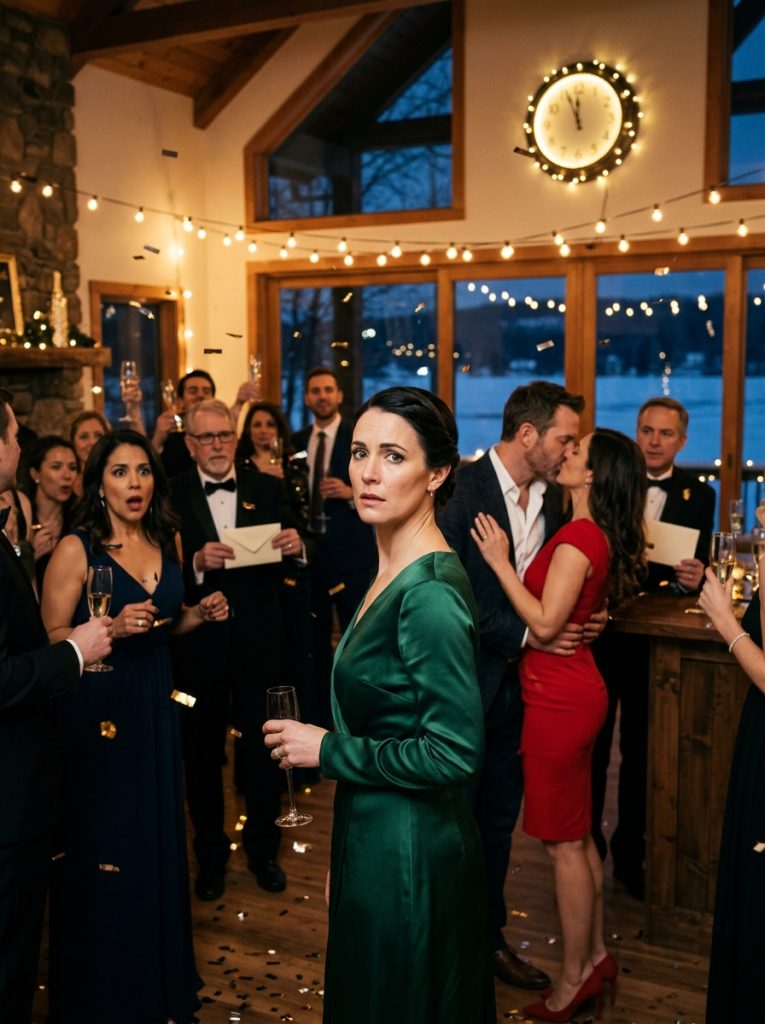
I crossed that room slowly, because there was no longer any reason to hurry.
Drew saw me coming a half-second too late. He pulled back from Sabrina, and his face did the thing I’d watched it do a hundred times when a reservation fell through or a review went bad — that quick scramble to rearrange the truth into something more convenient.
“Nell,” he said, with a little laugh. “Happy New Year. You should see your face. Sabrina just— it’s midnight, everyone’s kissing, it didn’t mean—”
“Don’t,” I said. Quiet. Almost kind.
The guests nearest us had stopped pretending not to watch. Marisol had a hand on my elbow, ready to catch me. I patted it once to let her know I didn’t need catching.
“You’re making a scene,” Drew said, lowering his voice, switching tactics. “You’ve been paranoid for months, El, and now you’re going to embarrass yourself in front of our friends over a holiday kiss.”
There it was. The word I’d been fed for a year. Paranoid.
“You’re right,” I said. “I have been paranoid for months. Funny how that works. You spend a year telling a woman she’s imagining things, and then you do the thing right in front of her, and somehow she’s still the problem.”
Sabrina had the decency, at least, to look at the floor. Drew did not have that gear.
“Let’s talk about this upstairs,” he tried.
“No,” I said. “I think we’ll talk about it here. You picked the venue. Midnight, in front of everyone — that was your call, not mine. I’m just going to finish the sentence you started.”
Across the room, Gordon Pierce, our accountant for nine years, was already moving toward me with the cream envelope in his hand. I’d asked him weeks ago to be here at midnight, and to bring it, and not to ask me why. Gordon is a discreet man. He’d brought it.
“Drew,” I said, “do you know what’s in this envelope?”
He didn’t answer.
“It’s a copy of the deed to this house. The lake house you love to host in. Your favorite stage.” I slid it from Gordon’s fingers but didn’t open it; everyone there knew the shape of a legal document. “It’s in my name. Only my name. It always has been. My grandmother left me the land. I built the house with money you never asked about because you assumed, the way you assume everything, that it was simply yours by marriage.”
A small sound moved through the guests.
“Here’s the part that’s going to matter more to you,” I went on. “Cassidy Hospitality Group. Your restaurants. The three of them you love to tell people you ‘built from nothing.'”
Drew’s jaw tightened.
“You did build them,” I said. “From my money. I’m the silent partner, Drew. I’ve always been the silent partner. The investor on your cap table behind the holding company you never bothered to read the name of, because reading the fine print was always my job. I own the majority stake in the company that employs you. Sabrina too, as it happens.”
Sabrina’s head came up at that.
“You see,” I said, turning to her, almost gently, “you weren’t sleeping with a restaurateur, sweetheart. You were sleeping with my employee.”
The room was so quiet I could hear the confetti still settling on the floor.
Drew laughed then — that incredulous, charming laugh he’d used to talk his way out of a decade of small things. But it landed on nobody. I watched him realize, in real time, that the laugh didn’t work anymore, that the audience he’d always been able to win had just watched him kiss another woman in his wife’s house and then call his wife crazy for noticing. The charm had finally run out of road.
“This is insane,” he said, but it came out thin.
“It’s arithmetic,” I said.
I want to tell you I planned a grand speech. I didn’t. I’d planned only one thing, in the cold clear weeks while I told myself I was paranoid and knew that I wasn’t: I would not be the woman who shattered. I’d seen Drew rehearse that story already, to friends, in little previews — Nell’s been so fragile lately, Nell’s not been herself. He’d built the narrative of my breakdown before I’d had one. So I simply declined to have it.
“I’m not going to scream,” I told him. “I’m not going to throw anything. I’m going to do the boring thing. On Monday my attorney files. You’ll find I’ve spent the last two months making sure every line is clean — the prenup you signed and forgot, the corporate records, the personal guarantees. Gordon has been very thorough.”
“You can’t just—” Drew started.
“I can, actually. That’s rather the whole point.” I set my untouched champagne on the nearest table. “You spent a year betting that I was too trusting, too in love, too dependent to see what was in front of me. It was a reasonable bet. I made myself easy to underestimate. I’ve been doing it my whole life — it’s restful, letting people think you’re not paying attention.”
I looked at the two of them, standing in the gold confetti they’d ruined.
“I was paying attention the entire time.”
Then I turned to my guests — my friends, most of them, some of them his — and I did the only gracious thing left to do.
“It’s a new year,” I said. “The bar’s still open, the car service is out front, and I’m so sorry your evening ended on a soap opera. Marisol, would you help me see everyone out?”
They left in a slow, stunned tide. A few squeezed my hand. One of Drew’s oldest friends muttered, “Nell, I’m sorry, I had no idea,” and I believed him, and I let it go.
The divorce took eleven months. It was not loud, because I refused to make it loud, which deprived Drew of the one weapon he was good with.
The numbers were not in his favor, because the numbers had never been his.
He did not get the house; it was never his to get. He kept his title at Cassidy Hospitality for exactly as long as it took the board — which is to say, me — to restructure his role into nothing and accept his resignation with a press release that thanked him for his service. Sabrina left the company that spring. I’m told the two of them lasted about four months once there was nothing left to split but each other.
I kept the restaurants. They’re doing well. Turns out the silent partner had opinions worth listening to all along.
Marisol stayed that first night, and the two of us swept up confetti at two in the morning in our gowns, not talking much, the way you don’t have to with the friend who saw it before you let yourself. She’d tried to tell me, gently, twice over the year. I’d waved her off both times. At the door she only said, “You didn’t need me to catch you.” She was right. But I was glad she’d stood close enough to, just in case.
I redid the lake house that spring. Not to erase him — to make it mine in the open, the way it had always been mine on paper. New light over the water. A long table that seats my actual friends. I host New Year’s there still. The first one after the divorce, Marisol made everyone do the countdown facing the windows instead of each other, “so nobody has to wonder who’s turning to whom,” and we laughed until we cried, and it was the first time the joke belonged to me.
People ask me, sometimes, whether I regret keeping the secret of what I owned for all those years. Whether things might have gone differently if Drew had known I held the purse strings, if he’d respected me for it.
I don’t think so. A man who can kiss someone else at midnight in his wife’s house was never going to be saved by knowing whose house it was.
But I’ll tell you the moment I keep.
Not the confrontation. Not the speech.
It’s later that night, after the last car pulled away, when I stood alone at the window with the lake black and frozen in front of me, and I realized the knot I’d carried in my chest for a year was simply gone. Not because I’d won. Because I’d finally stopped calling the truth paranoia.
The confetti was still on the floor when I turned off the lights in my own house, and for the first time in a long time, the quiet didn’t feel like something I was imagining.