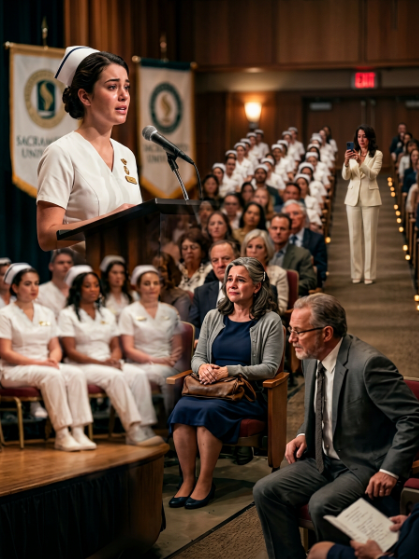
Sophia didn’t shout it. That’s not who I raised.
She just held the podium with both hands and told the room the truth in the steady voice of a woman who’d already decided to be brave.
“Most of you know me as the girl who worked two jobs through nursing school,” she said. “What you don’t know is why I never complained about being tired. It’s because I learned how to be tired from the best. From the woman who raised me.”
Bianca, frozen halfway up the aisle in her ivory pantsuit, lowered her phone an inch.
“When I was three,” Sophia said, “my mother left me with her sister and drove away. She sent postcards. Miami. Cabo. I used to tape them to my wall and tell the other kids my mom traveled for work.”
A few people laughed softly, the sad kind.
“The truth is my Aunt Tess raised me. She cut hair six days a week. There were months she paid the rent in coins from the tip jar — I counted them with her on the kitchen floor, so I know. She held me through every fever. She came to every recital my mother missed, which was all of them. She is the reason I am standing here in these whites tonight.”
I gripped my handbag so hard my knuckles ached. I had never wanted the credit. I’d told her a hundred times she owed me nothing. But she wasn’t paying a debt. She was telling the truth, in public, the way truth so rarely gets told.
Then she looked directly at Bianca.
“My mother came tonight,” Sophia said. “And an hour ago she leaned down to my aunt and called her my babysitter. Then she threatened to sue her over the college fund — the fund Aunt Tess built, dollar by dollar, while my mother was sending postcards.”
The room went cold and still.
Bianca’s face did something complicated. “Sophia — sweetheart — this isn’t the place — “
“It’s exactly the place,” said a voice from row three.
A man stood. Silver hair. Gray suit. Glasses. Dignified in a way that made the whole auditorium turn.
I knew him. Of course I knew him.
Harold Whitmore. Judge Harold Whitmore, family court, retired now. The man who, twenty years ago, when I’d walked into his courtroom terrified and broke with a three-year-old on my hip and no idea how to make any of it legal — had signed Sophia’s guardianship to me. He’d checked on us, quietly, for two decades. He was, though Bianca never knew it, the closest thing I’d had to a friend in the system.
“Forgive me,” Judge Whitmore said. “I’m here because Sophia invited the people who shaped her. But I can’t sit quietly through a threat of litigation built on a lie.”
He looked at Bianca.
“I signed the guardianship order myself, ma’am. Twenty years ago. I read the file every renewal. I know precisely who petitioned this court for the right to raise that child, and who never once answered a single notice we mailed. There were many. I signed them.” He let that land. “Any attorney you hire will pull that record in an afternoon. There is no college fund claim. There is no ‘alienation.’ There is a twenty-year guardianship, uncontested by you at every stage, and a paper trail as long as my arm. I would advise you, as a courtesy, not to embarrass yourself in a courtroom that already knows your name from its absences.”
Bianca opened her mouth.
Nothing came out.
You could hear, in that silence, twenty years of postcards landing exactly where they belonged.
Sophia turned back to the microphone.
“I don’t say any of this to shame my mother,” she said, gentler now. “I say it because tonight, when they pin me, a graduate gets to be pinned by the person who made her a nurse. And I’m not going to let the wrong woman stand up for that photo just because she has the louder coat.”
She looked to the back of the room. At me.
“Aunt Tess. Mom. Will you come up here and pin me?”
I don’t remember walking down that aisle. I remember my legs deciding before I did. I remember passing Bianca, who didn’t reach for me, who just watched with an expression I almost felt sorry for, the expression of someone realizing the seat she’d skipped was the only one that ever mattered.
I climbed the steps. My hands were shaking.
Sophia handed me the pin.
I have fastened a thousand small things in my life — buttons, barrettes, the strap of a shoe on a squirming three-year-old. My hands knew how to do this even while the rest of me came apart.
I pinned the cap. I smoothed her collar, the way I’ve smoothed her collars since she was small.
“There,” I whispered. “Now everybody can see what I always saw.”
She hugged me in front of all of them. Not a polite hug. The kind that knocks the breath out of you.
“You’re my mom,” she said into my shoulder. “You’ve always been my mom. The rest is just paperwork, and Judge Whitmore says the paperwork agrees.”
Bianca left before the reception. No scene. No threat. Her lawyer never called, because of course there was never going to be a lawyer — there was only a woman who’d hoped a loud entrance and a quiet threat would let her borrow a moment she hadn’t earned.
The college fund is intact. It’s Sophia’s. It always was.
Sophia works the ICU night shift now, at the same hospital where she was born. She’s tired all the time. She doesn’t complain.
She learned that from the best.
And on her first paycheck, she took me to the bank and added my name to a small savings account she’d started.
“For when you stop cutting hair,” she said. “You raised me on coins. I’m going to retire you on something better.”
I’ve spent twenty years not wanting credit.
Turns out the credit was never the point.
The girl was the point.
And she came up that aisle to find me in the back row, the way she always has — past the louder coat, straight to the woman who stayed.