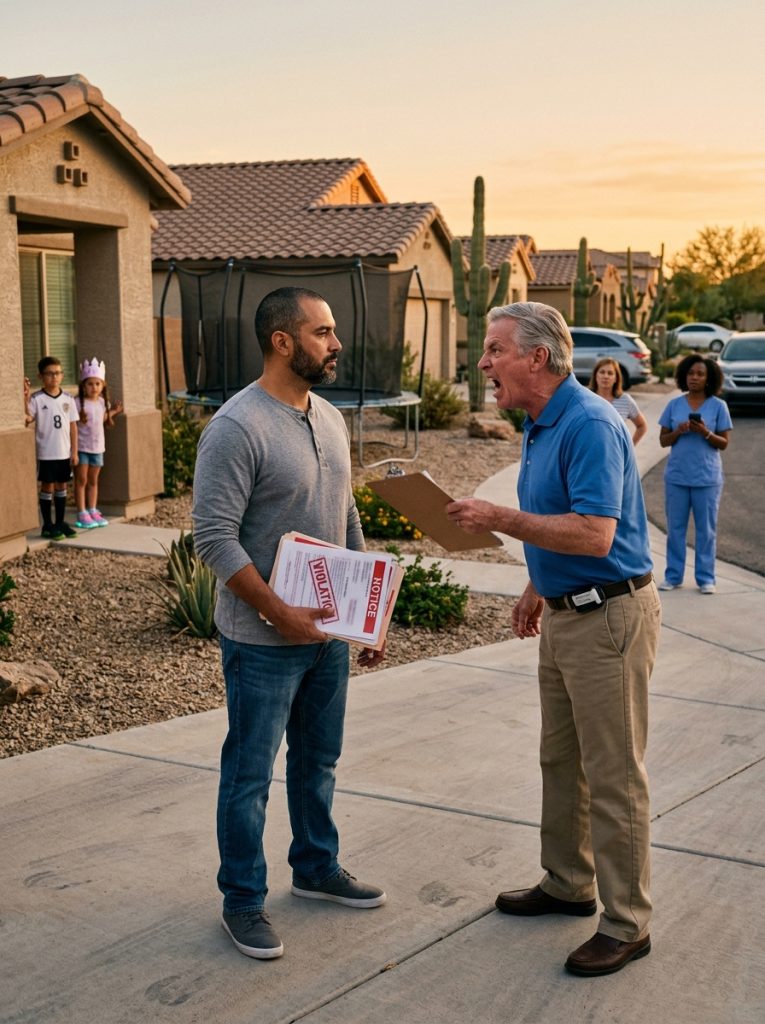
Gerald Stote stood in the doorway of that county hearing room holding his folder of fines, and I watched the color drain out of his face one shade at a time.
He knew me only as the difficult widower in the cul-de-sac. The troublemaker. The pushover with two kids who’d dared to ask where the reserve money went.
He had never once thought to ask what I do on the third Thursday of every month.
I sit at that dais. I chair the county’s assessment and HOA appeals board — the independent body that hears exactly the kind of complaint he’d come to file against me.
“You,” he said.
“Mr. Stote,” I said. “Have a seat.”
Now, I want to be fair, because fairness is the entire point of that board, and I take it seriously. The first thing I did was recuse myself from my own case. You cannot be the judge of a dispute you’re a party to, not if you want the result to mean anything. I said so, on the record, and I handed the gavel to our vice-chair, Eleanor Diaz, for the hearing that concerned my trampoline.
Gerald relaxed a little when he heard that. He thought it meant he was safe.
It did not mean he was safe.
Because while I’d stepped aside from my own fine, I had not stepped aside from the eight other appeals against Saguaro Vista that had crossed that board’s desk in the previous eighteen months. I’d sat on every one of them. And I had started, months before Gerald ever taped a notice to my door, to notice a pattern.
It’s a strange thing, sitting on that board. People assume an appeals chair is some powerful figure. Mostly it’s three neighbors and a pot of bad coffee on a Thursday night, reading other people’s misery in twelve-point font. But you see things. Over enough months, you see the same association name keep appearing, the same president’s signature on fines that don’t quite add up, the same homeowners showing up scared.
I’d flagged Saguaro Vista internally a year before any of this touched me. I just never imagined I’d end up on the other side of one of those notices myself. When the violation hit my own door, the first thing I felt wasn’t fear. It was a cold, clarifying recognition. Oh. It’s him. It’s been him all along.
Eleanor ran my case first, and it took about nine minutes.
She asked Gerald to produce the architectural rule the trampoline violated. He produced “unapproved recreational structure.” She asked him to produce the approvals for the Hendersons’ basketball hoop and the Wus’ casita. He could not, because there weren’t any — those neighbors had never filed Form 12-B either. They just weren’t on Gerald’s list.
She asked him to produce the date my Form 12-B had been received and denied. He produced a denial dated before the date I’d actually submitted it.
The room went very still.
“Mr. Stote,” Eleanor said, “this denial is dated three days before the application it denies was filed. Can you explain that?”
He could not.
The fines were voided on the spot. All four thousand dollars. The lien threat was declared improper and struck. Eleanor noted, for the record, that the selective enforcement appeared to be retaliatory, and that the board would be referring the matter further.
That referral came to me.
Here’s where the shoebox mattered.
My neighbor Pam had kept three years of Gerald’s notices, and once word got around the cul-de-sac that the fines had been thrown out, the shoebox stopped being just hers. People started coming to me — at the mailbox, at the kids’ bus stop, at my front door after dark like they were confessing something.
The Olsens, fined twice for a wheelchair ramp Gerald called “non-conforming.” A ramp. For a man who’d lost a leg to diabetes.
The Nguyens, threatened over a “for sale” sign in a language other than English, which it turns out is flatly illegal to do.
A widow two streets over who’d quietly paid Gerald’s fines for years rather than fight, on a fixed income, terrified of the lien letters.
And the reserve fund. The one I’d asked about at the meeting, the question that made me a marked man. When the board subpoenaed the HOA’s books, we found what Gerald had not wanted found. The “beautification assessment” — the twelve hundred dollars per house for entrance fountains — had a budget. The fountains had a much smaller invoice. The difference had been moving through a vendor account that traced back to Gerald’s brother-in-law.
It wasn’t a fortune. Pettiness rarely is. It was a man who’d confused a volunteer board seat with a small kingdom, and used the fines to punish anyone who questioned the throne.
The county referred the financial findings to the state. That part is still grinding through the slow machinery of the law, and I won’t pretend I know how it ends. But the homeowners’ association part — that part, the neighbors handled themselves, and it was something to see.
Pam started a recall petition. She didn’t need my help; she’d been ready for years and just needed to know she wasn’t alone. She got signatures from houses I didn’t think spoke to each other. The required threshold was a third of the homeowners.
She got past two-thirds in a weekend.
The recall meeting was held in the same clubhouse where Gerald had once called me “our resident troublemaker” to a room of nodding neighbors. The same fluorescent lights. The same folding chairs.
This time the nodding went the other way.
Gerald sat at the front for a while, the way men like that do, waiting for a moment that isn’t coming back. He tried, once, to speak — about “property values” and “standards” and how everything he’d done was “for the community.” A neighbor in the third row, the man with the wheelchair ramp, said quietly, “You fined my ramp, Gerald,” and that was the end of the speech. There was nothing left to stand on.
When the vote was read out, he gathered his clipboard and his label maker and he left through the side door, and the room did not boo him, and it did not cheer. It just let him go. The truth had already done the work.
We elected a new board that night. Pam ran the meeting. The first motion passed unanimously: the architectural rules would be enforced the same for every house, or not at all, and the appeals process would be printed in plain English on the back of every notice.
The second motion, which I did not expect and could not vote on because I’d recused myself from everything Saguaro Vista by then, was to formally approve “recreational structures including trampolines in fenced rear yards.”
Lucy’s trampoline is legal now. In writing. Forever.
She doesn’t know any of the rest of it — the dais, the recall, the brother-in-law’s vendor account. She’s eight now. What she knows is that the rule man stopped coming, and that Daddy didn’t fold, just like he promised.
She knows the trampoline is still there.
I think about my wife on that thing sometimes. How she’d have laughed at all of it — at me, the quiet one, the watcher, turning out to hold the one seat that mattered. She always said I let people underestimate me for so long I’d forget to correct them.
Gerald Stote underestimated a tired widower in a cul-de-sac. He had no idea the same man spent his Thursdays deciding whether fines like his got to stand.
The notices are gone from my door. The fine is gone from my account. The fountains never did get built.
But every evening, in a fenced yard in Saguaro Vista, two kids bounce against an Arizona sunset on a trampoline nobody can fine us for anymore — and the laughing, I’ve decided, is the only assessment that ever mattered.