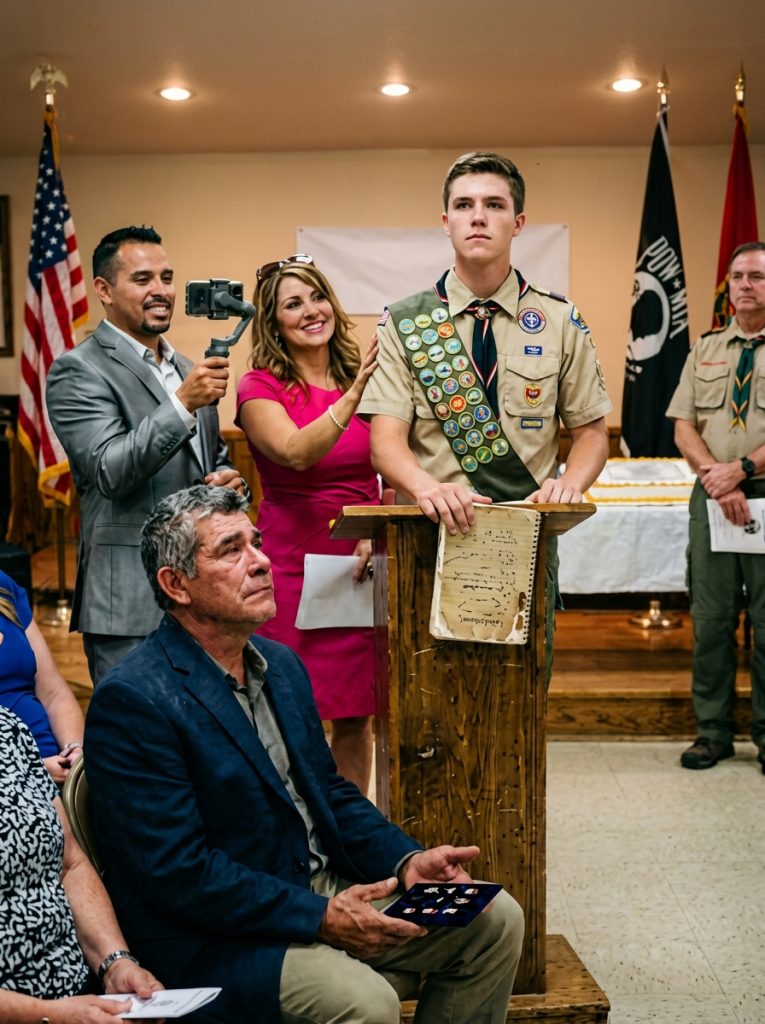
Eli opened the logbook to a page he’d marked, and the microphone picked up the small dry sound of the paper.
“This is my camp log,” he told the room. “Every Scout keeps one. Mine’s nine years thick. I’m not going to read all of it. Just the parts nobody saw.”
Rick still had the phone up on its little stick, but his grin had gone uncertain, the way a grin does when a man realizes the story might not be about him.
“October, year one,” Eli read. “Rain the whole weekend. My ride bailed. A man I’d known for six weeks drove four hours round trip so I wouldn’t miss it. He sat in the truck the whole time because he didn’t have rain gear. Didn’t tell me that part. I found out from another dad.”
He turned a page.
“Year three. Couldn’t afford the camp fee. The logbook says ‘fee waived — anonymous.’ It wasn’t anonymous. It was him. I checked the troop records last week.”
He turned another.
“Year six. The week of the regional jamboree, our truck disappeared and a worse one showed up, and he told me he’d been ‘meaning to upgrade.’ I was sixteen. I believed him because I wanted to.” Eli’s voice caught, then steadied. “I know now he sold it to pay my way. I’ve known for two years. I just never said it out loud until tonight.”
He turned to the last marked page.
“Year nine. Two weeks ago. The night before my project inspection I panicked and called him at one in the morning. He didn’t tell me to go back to sleep. He drove over, sat on my floor, and quizzed me on knots until the sun came up. He had work at seven. He went anyway.” Eli looked up. “There’s no merit badge for that. There should be.”
The hall had gone so quiet you could hear the flags move in the heat off the radiators.
I sat there in my too-big blazer with my hands clamped over the pins in my pocket, and I prayed the boy would stop, because I could not take much more of being seen like that.
He didn’t stop.
“Some people here came tonight to be in a video,” Eli said, and he did not look at Rick when he said it, which was somehow worse than if he had. “They want the pin and the photo and the part where they get to call me their son on camera. And I thought a long time about how to handle that, because the man who raised me taught me you don’t humiliate people, even people who’ve earned it. You just tell the truth and let the truth do the work.”
Rick lowered the phone.
Sharon had stopped dabbing at her eyes. The performance had nowhere left to go.
“So here’s the truth,” Eli said. “A parent isn’t who’s on your birth certificate. It’s who’s in the logbook. It’s who showed up. Every campout. Every fever. Every rainstorm. Two hundred miles round trip in a truck older than me.”
He looked out past the lights and found me in the second row.
“Frank Delgado has been my dad since I was nine. He’s just never made me say it because he never needed the credit. Tonight he’s getting it anyway.”
He held out his hand toward me. “Dad. Come up here.”
I don’t remember standing. June Alder would say my legs decided before I did. I remember the walk, the longest twenty feet of my life, the velvet card shaking in my fingers.
Eagle Scouts give their parents pins. That’s the tradition. The new Eagle takes a tiny pin and fixes it to the people who raised him, a thank-you you can wear over your heart.
Eli took the card from my hands. He took out the little pin. And instead of letting me pin him, he pinned me — fixed it right to the lapel of that ridiculous oversized blazer — and then he wrapped me in a hug in front of the whole hall, and into my shoulder, where the microphone couldn’t reach, he said, “Thanks for staying.”
Nine years of keeping my face still so the boy wouldn’t see me cry.
I gave up on that right there at the podium.
Scoutmaster Whitman stepped to the mic, cleared his throat hard, and said, “In thirty years I have never seen a Court of Honor like this one. Frank, on behalf of this troop — thank you for the Scout you raised.”
And the room stood up.
All of them. The other parents, the little brothers and sisters, the old veterans from the Legion in the back. They stood up and they clapped for a diesel mechanic in a blazer that didn’t fit, and I had to hold the podium to stay upright.
Rick and Sharon did not stand.
There’s no dramatic way to tell this part, because it wasn’t dramatic. It was just small. They stood off to the side for a minute, waiting for a moment that was never coming back to them. Then Rick muttered something about beating the parking, and the two of them walked out the side door into the dark, the gimbal hanging at his side, recording nothing anyone would ever watch.
Nobody followed them. Nobody booed. The truth had already done the work, exactly like I taught him.
I should tell you why I took him in at all, since that’s the part people always want.
My wife, Carmen, and I never could have children. We’d made our peace with it, mostly, the way you make peace with a door that won’t open. Then Carmen passed — fifty-three, her heart, no warning — and the house got so quiet I could hear the refrigerator think. A year of that. A man rattling around a silent house.
The caseworker’s call came on a Tuesday. A boy, nine, needed a place for the weekend. I said yes mostly so I’d have a reason to cook a real dinner.
He was so small and so guarded and so braced for me to send him back. I kept thinking, just get him through the weekend. Then it was just get him through the school year. Then I stopped counting, because you don’t count the years with your own kid.
Carmen would have loved him to pieces. I tell him that. He says he knows.
Here’s the part I hadn’t told the room, the reason my hands had been shaking since I walked in.
Three days later, we had a hearing.
When Eli turned eighteen, he’d filed to legally change his name. Not to erase anyone — he kept Carter as a middle name, “for where I started,” he said. But he wanted Delgado on the end. He wanted us to match on paper the way we’d matched in every way that counted for nine years.
The birth parents had been served notice of the petition. That, I understood later, was the real reason they’d shown up at the ceremony with a camera — to perform being parents, to build themselves a little evidence, in case they decided to fight it.
They didn’t fight it.
I don’t know if it was the room standing up, or the logbook, or just the cold math of realizing the followers don’t care about a kid they have to actually show up for. But they signed off. No contest.
The judge was a soft-spoken woman who read the file, looked over her glasses at the two of us, and asked Eli why he wanted the change.
Eli said, “Because I want my kids someday to have his name. He earned it. I just want to give it back.”
She signed without another question.
Elijah Carter Delgado.
We went for pie after. He let me pay, which felt like its own kind of gift.
That blazer still hangs in my closet, the little parent pin still on the lapel. It still doesn’t fit. I don’t care. I’ve decided I’ll be buried in it.
People ask me sometimes if it bothers me, the years his birth parents took, the credit they tried to grab on camera at the end.
It doesn’t. Not anymore.
Because somewhere out there is a video of a man trying to claim a son he never raised — and right next to it, in a logbook nine years thick, is the real record of who showed up.
I know which one is true. So does Eli.
And on the lapel of a blazer that doesn’t fit, I’ve got a pin the size of my thumbnail that says so for the rest of my life.