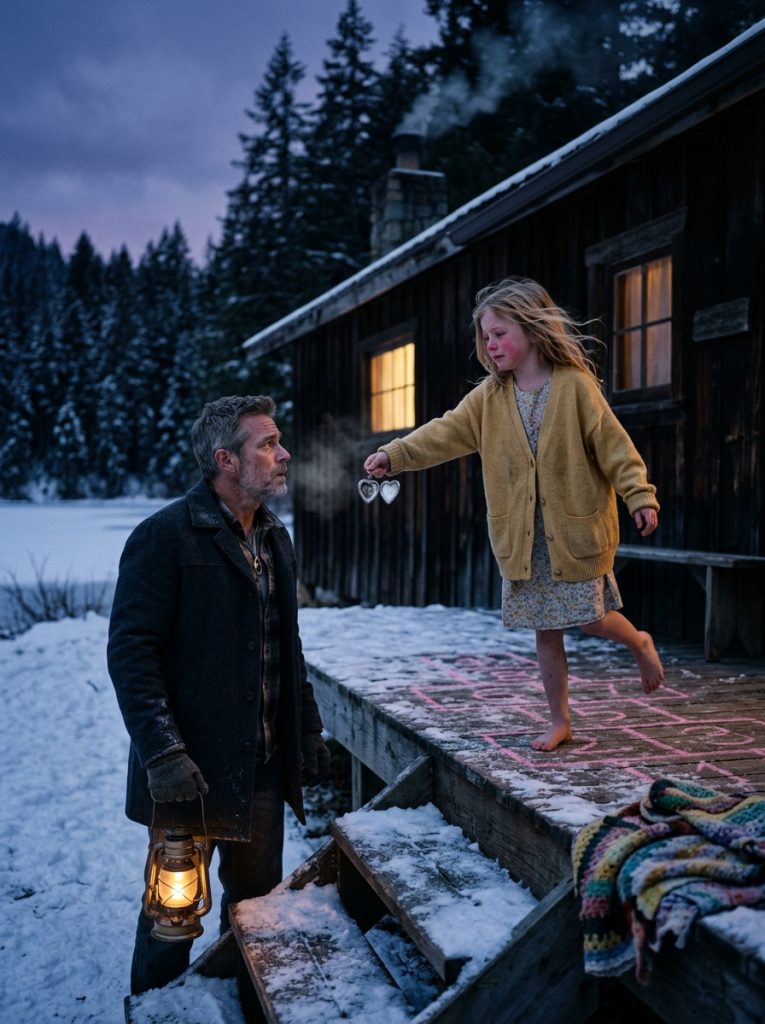
I got her inside before I got anything else.
That was the only clear thought in my head. Whatever was happening, whatever this was, the child was barefoot in the snow, and that came first.
I built up the fire in Rachel’s old woodstove. I found a pair of my wife’s wool socks still folded in a drawer, two winters untouched, and I rolled them three times over Maple’s tiny feet. I warmed milk I had no business finding in the cold pantry, until I understood that someone had stocked it. Recently.
Maple watched me the whole time over the rim of the mug, the locket resting against the blanket. Rachel’s quilt, I realized when she pulled it to her chin. The one she stitched the last winter she was well.
“You really are him,” Maple said. “The man in the picture. Mama said you’d be sad.”
“Did she,” I said, because my throat wouldn’t do more.
“She said sad people are just people who loved someone a lot.”
I had to put another log on a fire that didn’t need it.
She fell asleep in the chair before she could tell me much. I sat across from her all night, this stranger’s child in my dead wife’s quilt, and I did not sleep at all.
At first light, a truck I knew came grinding up the lake road.
June Alder. Sixty-eight, gray braid, our nearest neighbor for fifteen years, the only soul who’d kept an eye on the place after the funeral. She came in stamping snow off her boots, took one look at the sleeping girl, and her face folded.
“Oh, Daniel,” she breathed. “She found her way back.”
So I made coffee, and June told me the part Rachel never did.
There had been a girl. Three winters ago, the last good autumn Rachel had, before the diagnosis turned everything to hospitals. A young woman named Joelle, barely twenty, had turned up at the county gas station with a baby and a black eye and no plan past the next hour. Rachel found her there, the way Rachel found everyone who was lost.
She didn’t call anyone. She didn’t lecture. She just brought Joelle and the baby up to the cabin and let them stay.
“All that fall,” June said. “You were traveling for work, remember? Rachel never told you because she knew you’d worry, and because it wasn’t her secret to tell. That girl had run from something bad. Rachel fed them, got Joelle her papers sorted, drove her to a women’s program two counties over come spring. Set her up. Let her go.”
“And the locket?”
June’s eyes filled. “Rachel gave it to her at the bus. Told me about it after. She put a little photo of you in it — the lake picture — and she said, ‘Joelle, if the world ever takes everything again, you go to that cabin, and you find the man in this locket. He has the kindest heart I know. He’ll come.'”
I sat with that a long time. My coffee went cold.
My wife had promised a frightened stranger that I would show up.
She’d promised it without asking me, because she never doubted the answer. Even dying, she’d been arranging the world to be gentler than it is. Even dying, she’d believed in me more than I believed in myself.
“Where is Joelle now?” I asked.
June couldn’t say it. She just slid a folded letter across the table, one Maple had carried inside her cardigan, soft at the creases from being read by small hands.
It was Joelle’s handwriting. Tired. Careful.
She wrote that she’d built a life. Six good years. That she’d gotten sick that autumn — the fast kind, the kind that doesn’t wait for you to be ready — and that the program had no family to list for Maple, and the foster line frightened her more than dying did.
She wrote: “Rachel said you would come. I have no one else who ever kept a promise to me. I am sending my Maple to the one place a good thing ever happened to us. If you are reading this, I am already gone, and I am so sorry to ask. Please. Be the man in the locket.”
A neighbor of Joelle’s had driven Maple the last four hours and left her at the foot of the road, too afraid of the system to do more, with instructions to wait at the cabin with the chalk and the kettle until the man came.
She had waited two days. Drawing hopscotch every morning so the porch would look lived-in. So I would know somebody was home.
I went and stood on that porch in the cold for a while. I’m not ashamed to say I talked to Rachel out loud. I asked her what she’d done to me. I asked her how I was supposed to do this alone at fifty-one. I asked her why she always, always saw further than I could.
The lake didn’t answer. But the chalk squares did, in their own way. Seven of them. A child counting on a promise.
I’d driven up to that cabin to end something.
I understood, standing there, that Rachel had left me one last thing to begin.
It was not simple. I want to be honest about that, because grief and grace rarely arrive clean.
There were caseworkers. There were forms thicker than the snow. A kind, exhausted woman named Ms. Okafor from the county sat at my kitchen table and explained kinship and emergency placement and the long road of guardianship, and how unusual my situation was, a widower and a locket and a dead woman’s promise.
I told her I would walk every step of that road.
I got a lawyer. I got a home study. I got a child psychologist who taught me that you do not rush a six-year-old who has lost the only person she had — you just keep showing up, the same way every day, until being there stops being a surprise.
So I showed up.
I learned to braid hair badly. I learned which stuffed rabbit could not be washed without a three-day grieving period. I learned that Maple talks to her mother at night, and that the kindest thing I can do is leave the door cracked and let her.
The guardianship came through in the fall. We celebrated with lemon cake, because it turned out Joelle used to make lemon cake, and Maple wanted it, and now it is ours too.
I did not reopen the cabin to sell it.
We live there now. Part of the year, anyway. The realtor’s number is long deleted from my phone.
We painted the porch boards, but before we did, we traced the hopscotch squares in permanent paint so they’d never wash away — seven of them, leading to the door. Maple insisted. “So Mama can always find it,” she said. “And so could you.”
People ask me, sometimes, if it’s hard. Raising another woman’s child in the shadow of the wife I lost.
It is. Some nights the house is full of two ghosts, and I am the only grown man in it, and I feel every year of my age.
But then a barefoot girl in too-big socks pads out to the kitchen and asks me to check the locket is still working, by which she means she wants to see Rachel’s face and her mama’s promise in the same little brass heart.
And I open it, and there’s the lake, and there’s the woman who loved the whole world more than it deserved.
Rachel didn’t get to meet Maple. Joelle didn’t get to grow old. I will carry both of those losses to my own grave, and I won’t pretend a happy ending erases them.
But the kettle is warm now because I keep it warm. The window is lit because someone is home. And the man in the locket finally came, only a little too late, and just in time.