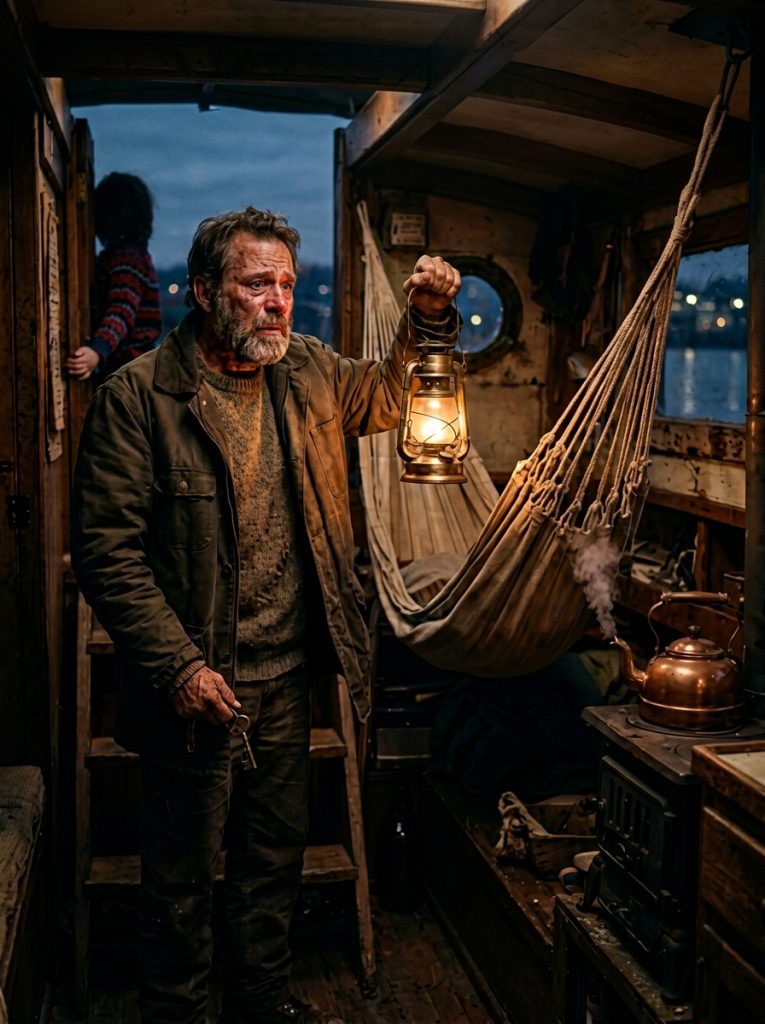
Tessa ate three bowls of the soup I found in the galley cupboard, and somewhere in the second bowl she started to talk.
Not all of it. Children who’ve learned to survive don’t hand you everything at once. But enough.
Her mother was gone — not dead, she was careful to say, just gone, somewhere Tessa didn’t have an address for. She’d been staying with a grandmother whose health had finally failed her, and when the grandmother went into the hospital, a situation Tessa wouldn’t name had moved into the house, and Tessa had done the math a nine-year-old shouldn’t have to do and decided the river was safer.
Nine days on the Wandering Marin. Boiling river water on Marin’s kettle. Sleeping in a hammock she’d found rolled in a locker. Surviving, the way my wife once told her the river people do.
“You can’t tell anyone,” she said, when the soup was gone and the fear came back. “If you call someone, they put me somewhere. I’ve been somewhere. I’d rather be on the boat.”
And there it was. The choice I had until morning to make.
The easy thing was to feed her, look away, and let her slip back into the dark when I left — to tell myself she’d chosen the river, that it wasn’t mine to fix.
The right thing was going to cost both of us something, and it wasn’t going to be simple, and it might make this frightened kid hate me.
I sat in the lantern light on my dead wife’s boat and I asked myself what Marin would do.
I already knew. Marin never once chose the easy thing. It’s why she gave a cold child her gloves at a food pantry and told her the river would always help.
“I’m not going to make you disappear into anything,” I told her. “But I’m also not going to leave a nine-year-old to boil river water alone. Those are both true. So we’re going to find the version where you’re safe and you’re not just handed to strangers. I’ll be in the room the whole time. I won’t leave you. That’s a promise, and I don’t make promises to break them.”
She didn’t believe me. Why would she? Adults had been making her promises her whole life.
But she was tired, and warm for the first time in nine days, and she fell asleep in the hammock while I sat awake on the step, keeping watch the way I hadn’t kept watch over anyone since Marin got sick.
In the morning I walked up to the marina office and found June Hollis, who keeps the docks and misses nothing.
“You knew someone was on my boat,” I said.
June had the decency to look guilty. “I knew a kid was coming and going. Figured it was a runaway. I left out food a couple times.” She sighed. “I should’ve called somebody. I just — I know how the system can chew them up. I kept hoping someone better than me would come along.”
“Someone did,” I said. “Now help me do it right.”
June knew a social worker named Pam — not a faceless agency, a person, someone who’d spent twenty years actually fighting for kids instead of just processing them. I called Pam from the marina office with Tessa sitting beside me, my hand never leaving the table where she could see it, so she’d know I wasn’t doing anything behind her back.
It was a long, hard day. There were questions Tessa didn’t want to answer and some she couldn’t. There were moments she looked at me like I’d betrayed her, and those were the worst moments of all.
But Pam was gentle, and honest, and she didn’t lie to Tessa about what came next, and slowly the rigid terror in that little body eased by a single degree.
I won’t pretend it wrapped up like a story.
Tessa’s grandmother was still in the hospital, and then in a rehabilitation facility, and the situation that had driven Tessa to the river had to be dealt with by people whose job that is. There was a temporary placement — an emergency foster home across town — and Tessa cried when Pam’s car pulled away from the marina, and so did I, standing on the dock of a boat named for my dead wife, watching another person I cared about disappear down a road.
For about a week I thought that was the end of my part. A man who’d done the right hard thing and would now go back to being alone.
Then Pam called.
“She won’t settle,” Pam said. “She keeps asking about the man from the boat. The one who kept his hand on the table.” A pause. “Sam, kids like Tessa don’t ask for people. When they do, you listen. Would you be willing to be a steady presence? Properly. Background check, training, supervised visits to start. It’s not a small thing. But she picked you.”
She picked you.
I’m fifty-eight. I’d driven four hours to say goodbye to a boat and to a marriage and, if I’m honest, to the part of myself that still had anything to give.
I said yes before Pam finished the sentence.
It took months. The classes, the paperwork, the slow patient work of earning a frightened child’s trust an inch at a time. Tessa’s grandmother, when she recovered enough, became part of it too — we are, the three of us and Pam, building something that doesn’t have a tidy name. Not a replacement family. A net. Enough people who won’t let her hit the ground again.
The first supervised visit, Tessa barely spoke. She sat across a county-office table and tested me the way hurt kids test you — waiting for me to get bored, get angry, get gone. I just kept showing up. Same time. Same chair. Every week. It turns out that’s most of what love is, when you strip the rest away: being the person who keeps showing up after everyone else has stopped.
By the sixth week she saved me the chair next to her.
Some weekends now, Tessa comes to the river.
We fixed up the Wandering Marin together — scrubbed the deck, patched the hammock, got the old stove humming. She likes to boil water in Marin’s copper kettle and make us tea on the deck at dusk, exactly where my wife used to sit.
I told her, once, about Marin. About the gloves at the food pantry. About “the river people will always help, because nobody out here owns anything, so everybody shares.”
Tessa was quiet a long time. Then she said, “She was right. The boat helped me. And then you did.”
I had to look out at the water for a while after that.
Here’s the truth I most needed to tell, the one I drove four hours and three years to learn:
Grief told me I’d come to that boat to end something. That the kindest version of my life was over the morning Marin died, and all that was left was to tie off the loose ends and drift.
Grief was wrong.
Marin’s last act of kindness was waiting on that boat for three years, in the body of a freezing child who remembered a stranger’s gloves. My wife reached past her own death to put a little girl exactly where I would find her, on the one night I was broken enough to go looking.
I didn’t get Marin back. I want to be honest about that. There’s no version of this where the kettle whistles and she walks up from the galley. I still set one cup out of habit and have to put it away. The loss is permanent, and some nights it still takes the wind out of me.
But the boat isn’t a grave anymore.
It’s a place where an old man and a young girl boil river water and watch the dark come down soft over the Tennessee, two people the river caught instead of letting fall — and somewhere in the lantern light, I swear, my wife is finally, finally at rest.