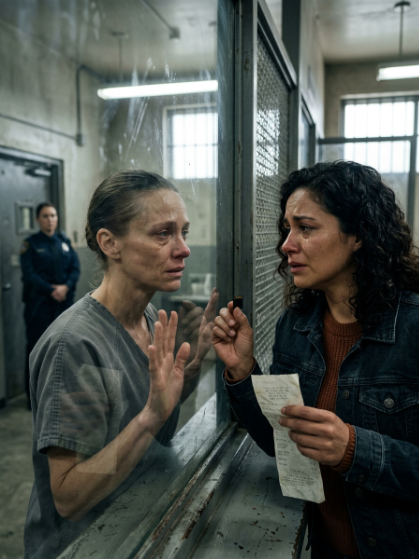
Marisol came back every week after that.
She didn’t have to. We were strangers who shared half a father and nothing else. But she came, and each time she brought another piece.
The gas-station receipt was time-stamped 9:42 p.m. on the night of the robbery, from a Shell station outside a town two hundred and four miles from my family’s shop. The robbery happened at 9:15.
I could not have been in two places.
But a receipt alone hadn’t been enough at my trial. Paper can be forged, the prosecutor had said. People share cards.
The memory card was different.
It was from a cheap dashcam our father kept in his truck — the truck Marisol inherited, the truck that had been sitting under a tarp in a storage unit for eleven years because no one knew it mattered.
On the night of the robbery, our father had lent me that truck.
That detail had never come out, because by the time of my trial, my father and I weren’t speaking, and he was a man who took his guilt to the grave rather than admit he’d raised two daughters he kept apart.
The dashcam ran the whole drive.
It showed my face at the wheel. It showed the Shell station. It showed the date and the clock, burned into the corner of every frame, two hundred miles from the crime they sent me away for.
Marisol took it to the Mid-State Innocence Project.
I want to tell you it moved quickly. It didn’t. Nothing about being wrongfully convicted moves quickly. There were forensic reviews, authentication hearings, a state lab confirming the footage hadn’t been altered, motions my exhausted public defender should have filed a decade earlier.
It took fourteen months.
But the truth, once it has a date stamp, is very hard to argue with.
And there was one more thing on that dashcam — something Marisol almost missed.
The morning after the robbery, before our father knew anything was wrong, the camera had still been running when he made a phone call from the truck on speaker.
The other voice was Victor’s. My husband.
“It’s done,” Victor said. “Just don’t let Rennie use the truck again this week. I told them she had it that night.”
Our father had said, “What did you do?”
And Victor had hung up.
My father knew.
He knew, and he said nothing, because Victor was the son-in-law he liked and I was the daughter who’d married against his wishes, and admitting the truth meant admitting he’d let his pride sit on top of my innocence for eleven years.
He kept the truck. He kept the camera. He never erased it.
I think, in the end, that was the closest my father could come to a confession — leaving the proof where someone braver might one day find it.
Marisol was braver.
The State’s Attorney reopened the case. Victor’s alibi — me — collapsed, and with it, his version of that night. The robbery had been his. The money had covered debts I never knew we had. He’d handed the police a wife to convict and walked out of the courtroom a free man eleven years ago, and now the same machine that crushed me turned, slowly, to face him.
My conviction was vacated on a Tuesday in October.
They opened the gate, and this time someone was waiting.
Marisol stood in the parking lot in her denim jacket, holding a paper sign she’d made by hand because she didn’t know what else to do with her hands, and it just said my name. RENNIE. Like she was afraid I wouldn’t know it was for me.
I walked out with everything I owned in a clear plastic bag.
She hugged me before I reached her, and I felt her shaking, and I realized she’d been carrying her own kind of sentence — a father who’d hidden her, a sister he’d hidden from her, a family that had cost both of us years in different cells.
“I’m sorry it took so long,” she whispered.
“You’re the only one who came at all,” I said.
Here is the part I have to be honest about.
I am free. But I am thirty-nine, and I went in at twenty-eight, and there is no court in the country that can give me back the decade in between.
My twenties are gone. My father is gone, and we never got the conversation I both dreaded and needed. The friends I had before don’t quite know how to look at me. I flinch at locked doors. I wake at the times they used to count us.
Freedom isn’t a clean ending. It’s a beginning you have to learn from scratch, with hands that forgot how.
But I didn’t get nothing back.
I got a sister.
Marisol and I rent a small place now with a yard. She’s teaching me to drive again on back roads, in a used car that is emphatically not a truck. We argue about the radio. We discover, constantly, the small inherited things — we both hate cilantro, we both hum when we cook, we both have our father’s stubborn chin, the one detail of him I can stand to love.
The State settled. Victor is awaiting trial.
People ask if I’m bitter about the eleven years.
Some days, yes. I won’t lie to you.
But then I look across the kitchen at a woman I didn’t know existed two years ago, who unpacked a dead man’s storage unit and found my whole life folded inside a memory card, and chose — a total stranger — to fight for it.
I lost eleven years.
I gained the only family that ever came when the gate opened.
I’m still deciding, most mornings, whether that’s a tragedy or a mercy.
Lately, watching her burn the eggs and laugh about it, I think it might be both.