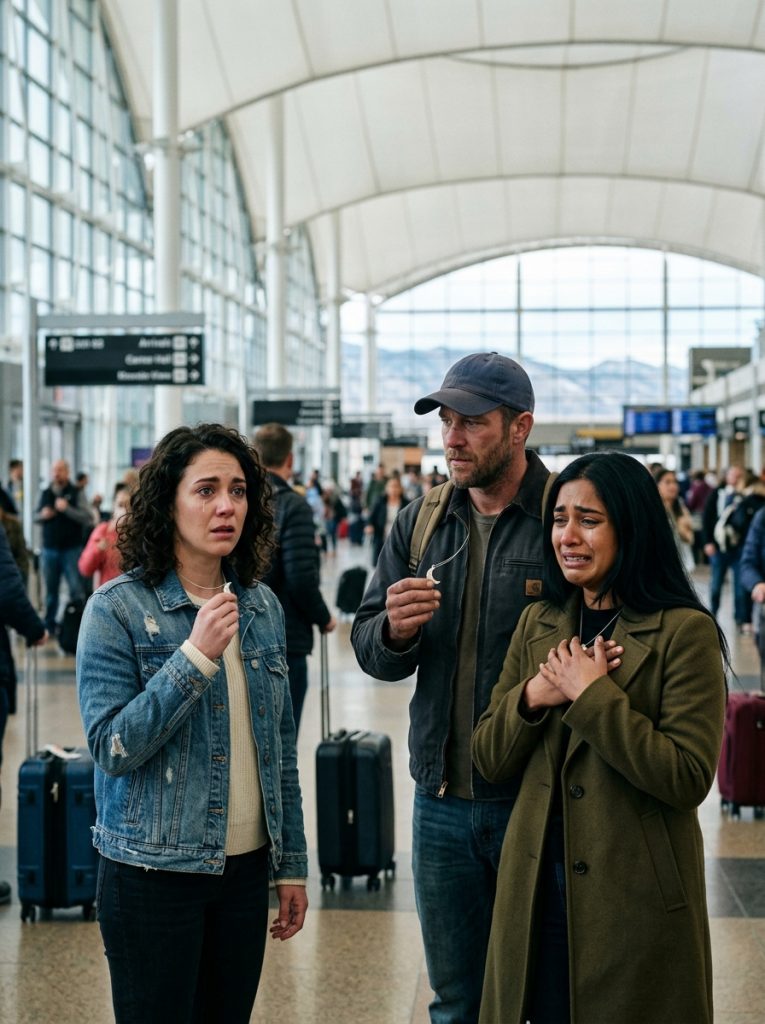
“Della Marsh,” the old woman said again, softer. “Your mother’s name was Della Marsh. And I’ve spent eleven years trying to find the courage to tell you what I did to the three of you.”
We turned as one.
She was small and silver-haired, in a pale blue cardigan, clutching a manila envelope to her chest like a shield. She’d been sitting two gates down, she told us later, every day for a week, because she’d seen the same reunion notice we’d posted and she’d finally booked a flight to Denver to meet the children she’d helped erase.
Her name was Margaret Aldous. For thirty years she’d been a placement clerk at the agency that handled all three of our adoptions.
“There’s a quiet room past security,” Daniel said, in the steady voice he uses when something is too big to feel yet. “Let’s not do this in a hallway.”
So the four of us sat in a beige airport conference room, and Margaret Aldous opened her envelope and gave us back our beginning.
Our mother was nineteen when she had us.
Della was a housekeeper’s daughter who’d fallen for the son of the family her mother worked for — the Ashfords, who owned half a county in Georgia and a U.S. Senate seat they treated as a heirloom. When Della got pregnant, the young man’s father did the math on a scandal in an election year and decided the problem would simply disappear.
He paid Della’s family to send her away to have us quietly.
And when she had not one baby but three, the old man panicked. Triplets are memorable. Triplets get talked about. So he made a colder arrangement: the three of us would be placed separately, in three different states, through three different sets of paperwork, with our births staggered on record so no one would ever connect us.
Della was told all three of her babies had been adopted by one loving family out west, together. A lie to keep her quiet. A lie so she’d stop asking.
“I typed the placement orders,” Margaret said, her hands shaking. “I was twenty-six and afraid for my job and I told myself the family must know best. I split you up. Oregon. Texas. Georgia.” She looked at each of us. “It was the worst thing I ever did, and I’ve prayed about it every day since.”
Priya was crying openly. Daniel’s jaw was working.
“The coin,” I said. “The pendants.”
Margaret almost smiled. “Della did that. The morning they took you, she had an old silver dollar — her own father’s — and she begged a jeweler to cut it into three and put one on each of your blankets. The Ashfords never noticed. It was the one piece of her that traveled with you. The one thing she got to keep on you.”
Three half-moons. One coin. One mother, choosing the only inheritance she was allowed to give.
There was one question left, and Daniel asked it for all of us.
“Is she alive?”
Margaret nodded slowly. “She is. She’s sixty-one. She never married, never had other children. She spent decades writing letters to an agency that threw them away.” She slid a second sheet across the table. “She’s in a memory-care residence outside Macon now. Early-onset Alzheimer’s. She has good days and bad days. I found her two months ago. It’s why I finally got on the plane. I was running out of time to do this while she could still understand it.”
The room went very quiet.
A mother who’d searched her whole life, losing the very memory she’d searched with.
We flew to Georgia together that weekend. The three of us. We didn’t discuss it; we just did it, the way you do things with people who are suddenly, undeniably yours.
The Ashford name still meant something in that part of the state. We learned the old senator was long dead, and the son — our biological father — was a careful, gray man who’d built a careful life and answered our certified letter through a careful attorney, offering money for our silence.
We didn’t take it.
Not because we’re saints. Because Priya said the thing that settled it: “He already paid once to make us disappear. I’m not taking a second check to finish the job.”
Instead we wrote him a single letter back, the three of us signing it together, telling him we’d found each other, we knew everything, and we wanted nothing from him but the truth on the record someday if he ever found the courage. We never heard back. That was answer enough.
The man who scattered us got to keep his careful life.
We got each other. I’ll take that trade every time.
The memory-care residence had a garden, and that’s where they brought her.
Della Marsh was small, like Margaret, with my curls gone silver and Daniel’s exact stubborn jaw and Priya’s restless hands folded in her lap. She watched the three of us walk across the grass and her face moved through confusion, then caution, then something I have no word for.
We’d been warned she might not understand. That on a bad day she might think we were staff, or ghosts, or no one.
It was a good day.
Priya knelt first and held up her pendant. Then Daniel. Then me.
Three half-moons in the Georgia sun.
Della’s hands flew to her mouth. She reached out and touched each pendant, one at a time, counting under her breath — one, two, three — and then she said a word the nurses had never heard her say.
“All?”
“All three, Mama,” Priya whispered. “We’re all here. We found each other. We found you.”
She didn’t have the whole story. The Alzheimer’s had taken most of the words. But she knew the coin. Some things live deeper than memory — in the hands, in the body, in whatever part of a mother keeps counting her children for forty years.
She held us, one at a time, and then all at once, in a garden in Macon, and she kept whispering “three, three, three,” like a woman who’d finally finished a sum she’d been carrying her whole life.
We go back every month now. Daniel drives the farthest, twelve hours from Amarillo, and never misses. Priya brings paintings to hang in Della’s room. I bring my nurse’s training and a list of questions for her doctors.
Some visits she knows us. Some visits she doesn’t. We’ve made our peace with that. We didn’t come this far to need her to remember — we came so she’d never be alone again, the way she made sure, with one cut coin, that we’d never be entirely alone either.
Margaret Aldous visits too. We forgave her. It surprised me, how easy it was, once we understood she was the only person in the whole machine who ever came back to say she was sorry.
Our adoptive parents have met now — all of them, one big awkward, loving Thanksgiving in Denver, the neutral ground where we first stood as strangers. My mother in Bend cried and held Priya’s mother’s hand. Daniel’s foster-turned-adoptive dad grilled enough brisket for forty.
Three families who each thought they’d raised an only child, sitting at one long table, because three babies someone tried to scatter grew up and refused to stay scattered.
I used to feel like a room I walked into should have had more people in it.
It does now. It’s loud, and it’s full, and every single person at the table is wearing, or holding, or keeping safe a piece of the same silver coin.