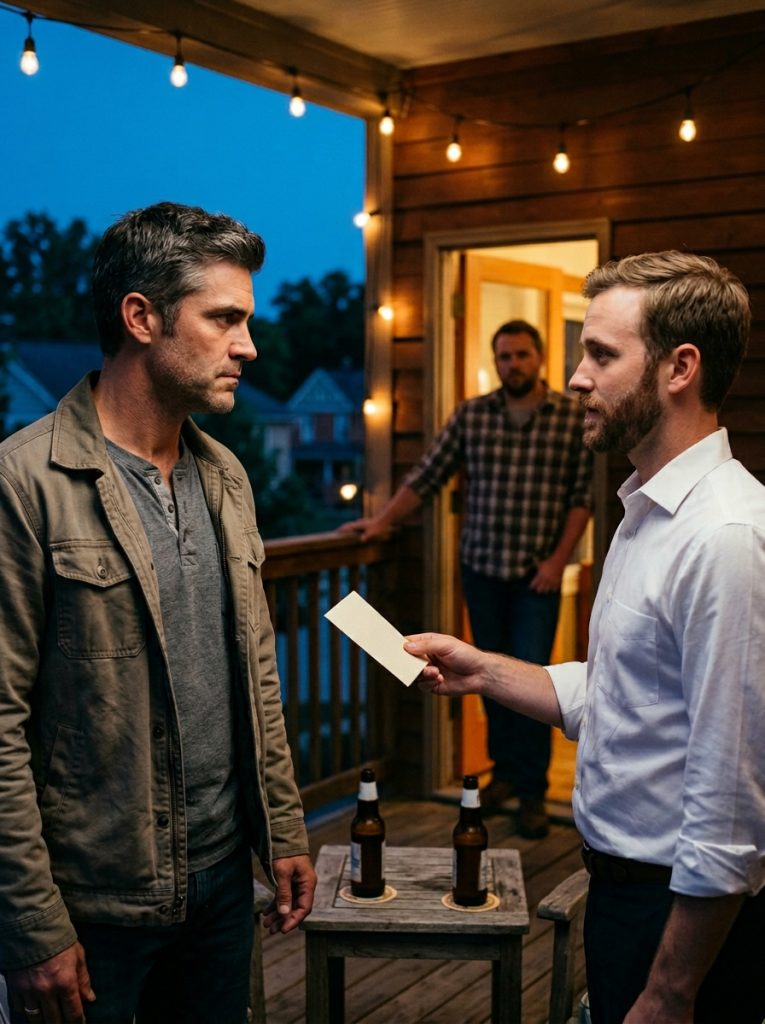
What my brother said, two days before his wedding, was: “Prove it.”
Not “I’m sorry.” Not “I believe you.” Just “Prove it” — in a voice that was already half-broken, because some part of him wanted me to.
So I did.
I drove him to my apartment that night, Tobias trailing in his own car like a man following an ambulance, and I pulled out the accordion folder I’d carried through three moves and never opened in front of anyone.
Six years of receipts.
The second mortgage our father took out the year the big-box hardware store opened across the highway. The medical bills from the eight months before hospice, the ones the insurance fought. The promissory notes to a man named Calloway who lent Dad money at the kind of interest you only agree to when you’re drowning.
And the sales. My truck. Mom’s ring. The store’s table saws and inventory and finally the building itself, sold to clear it all so the lender couldn’t touch the house Eli grew up in.
Eli sat on my floor and read every page.
He read for an hour without speaking.
When he got to the letter — the one our father dictated to me from his hospital bed, the one I’d never shown anyone — he stopped being able to pretend.
Marcus, the letter said, in my shaky handwriting taking down his words. Let your brother believe what he needs to believe. He’s almost done with school. If he finds out how bad it got, he’ll quit and try to fix it, and I will not have both my boys buried in my mistakes. Carry it. I’m sorry to ask. You were always the strong one. — Dad.
Eli put the letter down very carefully, like it might shatter.
“Six years,” he whispered. “You let me hate you for six years.”
“He asked me to.”
“You should have told me anyway.”
“Maybe,” I said. “But you’d have done exactly what he was afraid of. You’d have dropped out. You’d have spent your twenties paying off a debt that wasn’t yours, instead of becoming the man Sara’s marrying on Saturday.” My voice cracked. “I could lose the store, Eli. I couldn’t lose that too.”
That was when my brother — thirty years old, two days from his wedding — put his face in his hands and cried the way he hadn’t let himself cry at the funeral.
I’d carried this alone for so long that I’d forgotten it could be set down.
Tobias quietly let himself out. Some moments aren’t for witnesses.
We talked until almost four in the morning.
Eli told me what he’d been told — that Uncle Ray, Dad’s brother, had whispered at the funeral that I’d “cleaned out the accounts and run.” Ray, who’d never lent Dad a dime when it mattered, needed someone to blame so the family wouldn’t look too hard at him. I made an easy villain. I was already gone.
“I’m going to have a conversation with Ray,” Eli said grimly.
“Don’t,” I said. “Not this week. This week is yours and Sara’s. Ray doesn’t get to be in it.”
The next day — one day before the wedding — Eli called the family lawyer and the bank himself.
He didn’t have to. I think he needed to, the way you press on a bruise to be sure it’s real. Every number matched. The lawyer, an old friend of Dad’s, got quiet on the phone and finally said, “Your brother never wanted you to know, son. He made me promise too.”
By that afternoon, Eli had stopped looking at me like a stranger.
He’d started looking at me like a brother who’d just come back from a long, unfair war.
Saturday came clear and warm.
I stood beside him at the front in the tux I’d let them fit me for, the one I’d told myself I’d never wear. Sara was radiant. My brother’s hands shook again, but for the right reason this time.
When the officiant asked who stood with the groom, Eli answered before anyone could.
“My brother does,” he said. “He always did. I just didn’t know it.”
Half the room had no idea what that meant.
I did. It was the apology and the thank-you and the six years, all folded into five words.
At the reception, Eli tapped his glass and made a best-man’s speech about his best man, which is not how it’s supposed to go.
He told them our father had been a good man who got buried in debt and too much pride to share it. He told them his brother had quietly paid that debt and taken the blame to protect a kid finishing college. He left out the cruel parts — Uncle Ray, the whispers — because Eli, it turns out, learned the same lesson I did, just slower: you protect the people you love by deciding which truths build them up.
Then he raised his glass to me.
“To Marcus,” he said. “The strong one. I’m done making him carry things alone.”
The whole room drank to a story they only half understood, and I sat there with my throat tight, finally a brother again in public, not a rumor people lowered their voices around.
Later, during the dancing, Sara found me by the bar.
She took both my hands. “He cried in the car on the way to the rehearsal,” she said. “Happy crying. The kind he hasn’t done since his dad. Whatever you gave back to him this week — thank you. He’s been carrying a hole shaped exactly like you for six years.”
“He carried a lie,” I said. “I just carried the truth.”
“Same weight,” she said. “You both put it down at the same time. That’s the only way it ever works.”
I danced with my new sister-in-law, and across the floor my brother was laughing, and for one whole song nothing in me ached.
I thought that was the end of it. The clean, warm end.
But there was still the matter of the ring.
I’d sold our mother’s ring six years ago to a pawnshop in Galena, and it had haunted me more than the truck or the store ever did. The week before the wedding, on a hunch, I’d gone back. The owner, a patient woman named Dolores, had kept it in her personal case the whole time. “Knew somebody’d come for it someday,” she said. “They always do, the good ones.”
I bought it back with money from the welding shop — the business I’d built from nothing in the six years everyone thought I’d run off with a fortune.
I gave it to Eli the morning after the wedding, over breakfast, while Sara was still asleep.
“For when you and Sara are ready,” I said. “It’s hers now. Mom would’ve wanted it going forward, not sitting in my drawer.”
My brother held our mother’s ring and couldn’t speak.
Uncle Ray we dealt with a month later, together, at a diner of our choosing. We didn’t shout. We didn’t need to. Eli laid the lawyer’s letter and the bank records on the table between the coffee cups and watched Ray’s face do the same thing Marcus Vane’s would have done, if I’d known then what I know now about men who lie to make themselves smaller targets.
“You let me believe my brother robbed our dying father,” Eli said quietly, “so nobody would ask why you never visited him once.”
Ray didn’t come to Thanksgiving. Nobody missed him.
These days, Eli brings Sara by the welding shop on Sundays. He’s learning to run a bead of weld, badly, laughing the whole time, and I let him ruin perfectly good steel because the sound of my brother laughing in my shop is worth more than the metal.
We talk about Dad now. Out loud. The good and the buried.
Some debts you pay with money. The hardest ones you pay with years, and silence, and a folder you carry through three moves hoping someone will finally ask the right question.
My brother asked. Six years late, five days before his wedding.
It was right on time.
Last Sunday he hung the old Hale’s Hardware sign — the one I’d saved from the building before it sold — up on the wall of my shop, where the light from the bay door hits it every morning.
Two brothers under our father’s name again, finally telling each other the truth.