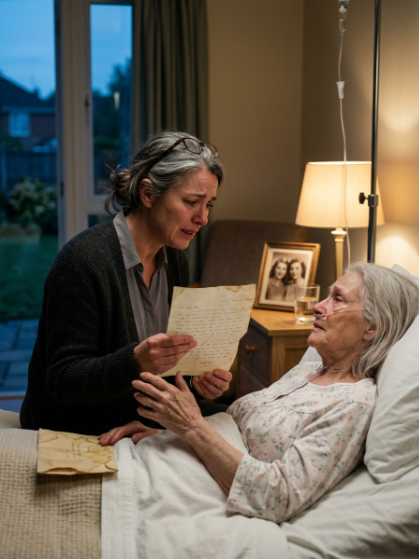
So I read her the rest.
I pulled the chair close, took her cold hand in mine, and I read my dead aunt’s letter to my dying mother in the blue light of that hospice room.
“I didn’t leave because of what they told you I did,” Vivian had written. “I left because of what I did to keep it from touching you.”
Mom’s eyes were open now. Fixed on me. Listening with everything she had left.
The story came out of that yellowed page line by line.
In 1986, my mother was newly married to my father, a young man with a small name and a smaller bank account, both of them clinging to a future that could tip over with one bad winter.
And Vivian — younger, wilder, the sister my mother adored — had made a mistake.
She’d co-signed a loan for a man who vanished. Thousands of dollars. A debt with my family’s name on it, and a scandal attached: the man had been running a fraud, and the bank was naming everyone connected to him.
If it landed on Rose, the letter said, it would have sunk her marriage before it began. My father’s family would have walked. The shame, in that town, in that year, would have followed her for life.
“So I took all of it,” Vivian wrote. “I told them it was mine alone. I told them you knew nothing, because you didn’t. I let them believe I was the reckless one, the thief, the disgrace — because I was the one who could survive being those things, and you weren’t.”
Then she left town.
Not to abandon my mother.
To carry the wreckage somewhere it couldn’t splash back on her.
“Mama told me to stay away from you,” the letter said. “She said your marriage would never hold if my name kept turning up. So I stayed away. I want you to know it was the hardest thing I have ever done, and I have regretted the silence every single day.”
My mother made a sound I had never heard her make.
I kept reading.
“I am writing this the night before I go for good. By the time it reaches you, maybe years from now, maybe you’ll be old, maybe you’ll have a family of your own who never knew you had a sister. I hope you do. I hope your life got big and safe and happy. That was the whole point of mine getting smaller.
Forgive me for the leaving, Rosie. I never once stopped being your sister. I just had to be her quietly.
All my love, always — Viv.”
The letter ended there.
For thirty-nine years, my mother believed her sister had thrown the family away.
The truth was the exact opposite.
Vivian had thrown herself away to save it.
I set the page down on the blanket.
My mother’s lips were moving. I leaned in until my ear nearly touched them.
“Vivian,” she whispered. The name she hadn’t said in almost forty years. “My Viv.”
And then: “I forgive you. I forgive you. Tell her — “
She stopped. Her eyes searched mine, suddenly clear, suddenly here.
“She’s gone too, isn’t she,” Mom said. Not a question.
I nodded, even though she couldn’t really see me. “Eight years ago, Mama. But she mailed this before any of it. She got to say it. And you got to hear it.”
My mother smiled.
It was the first true smile I’d seen on her face in months — not the polite one she gave nurses, the real one, the one from the photograph on the nightstand where two girls in summer dresses leaned their heads together, before money and shame and a man with a stolen name ever came between them.
“We were so close once,” she said. “I let them tell me a story. I should have known my sister. I should have known.”
“You know now,” I said.
She held the letter against her chest with both frail hands.
She slept that way.
And sometime before morning, with the page still over her heart and the lamp still warm, my mother let go.
The nurse said it was peaceful. She said sometimes people are just waiting for permission to put something down.
I think my mother had been carrying a sister-shaped grief for thirty-nine years without ever knowing it was grief, because she’d dressed it up as anger to make it bearable.
The letter let her set it down.
I had that old photograph framed properly. Two sisters, heads together, summer of 1985.
It sits on my mantel now, where I see it every morning.
A letter took thirty-nine years to cross a town.
It arrived with hours to spare.
I used to think that was the cruelest part — all that time lost, the reunion that could only happen on paper, between a dying woman and a dead one.
I don’t think that anymore.
I think some words travel exactly as long as they need to.
And the right ones always arrive in time to be the last thing you hear.