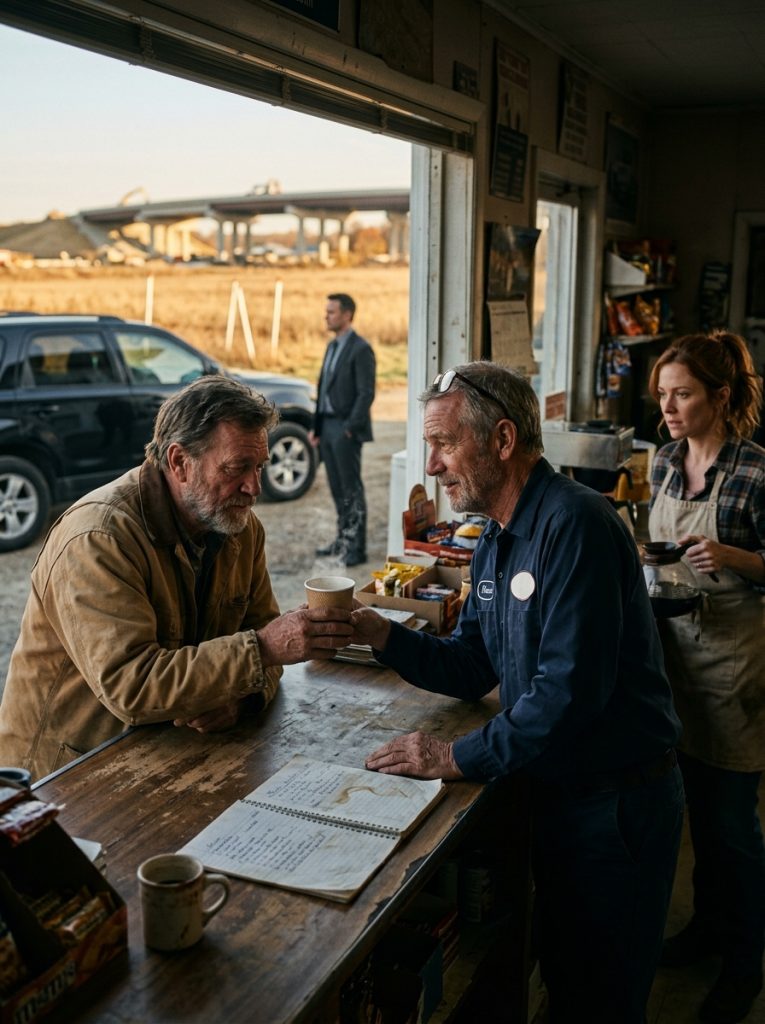
The thing Walt set on the counter, next to my father’s ledger of forgiven debts, was a state identification card and a brass commission seal.
Chairman, State Turnpike and Infrastructure Commission.
The name on it was Walter Brennan — the same Walt who’d been coming up a dollar short on his coffee for a month.
Marcus Vane made a sound like the air had been let out of him.
“You’re supposed to be in meetings in the capital,” he stammered. “Nobody said you’d be —”
“Out here? Walking the route?” Walt picked up his free coffee and took a slow sip. “Son, I’ve signed off on forty interchanges in this state. I learned a long time ago that the maps lie. They show you traffic counts and parcel lines. They don’t show you who a place belongs to. So I drive out, and I sit, and I watch.”
He looked around our little station like he was saying goodbye to it.
“I’ve been watching this one for five weeks.”
Vane recovered the way men like him always do — by reaching for the script. “Chairman, with respect, this parcel is critical to the interchange design. The engineering is final. Every other owner has signed. If Mr. Mercer holds out, he’s holding the whole project hostage, and the taxpayers —”
“The taxpayers,” Walt repeated. “Funny. Let’s talk about the taxpayers.”
He set down his cup.
“Three weeks ago,” Walt said, “Mr. Mercer got a zoning notice claiming his fuel tanks were out of compliance. I pulled the file. The tanks passed inspection eight months ago. The notice came from a county office that your firm donated to last spring.”
Vane’s jaw tightened.
“Two weeks ago, his bank called the loan they’d carried without a hiccup for a decade. The bank’s commercial lending is underwritten by a holding company. Your holding company. And last week, somebody floated the words ’eminent domain’ to a sixty-four-year-old man to scare him into signing.” Walt’s voice never rose. That was the frightening part. “None of that is in the engineering, Mr. Vane. But it’s all in my notes.”
I stood frozen behind the register. My father hadn’t moved.
“You squeezed every owner on this road,” Walt went on. “I talked to all of them. The Hendersons cried in their driveway. Ruth took the check because she was too tired to fight. You call that ‘everyone signed.’ I call it what it is.”
“That’s a serious accusation,” Vane said.
“It’s an observation. The accusation comes later, in writing, with the attorney general’s office cc’d.” Walt finally smiled, and it wasn’t a kind smile. “I already sent the first letter this morning.”
Vane looked at the door like he was measuring the distance.
“Here’s what’s going to happen,” Walt said. “The interchange is getting built. The state needs it. But there’s a second alignment my engineers flagged eighteen months ago — it curves forty yards east, uses the old quarry access, and costs about the same. The only reason it got shelved is that your firm’s parcels were cheaper if the road came through here.” He tapped the counter. “Through this.”
“Chairman —”
“The forty-yard alignment is back on the table as of this afternoon. Which means Mr. Mercer’s station doesn’t get bulldozed. It sits right at the mouth of the new exit.” Walt turned to my father for the first time. “If that’s all right with you, Hank.”
My father found his voice. “You’d reroute a highway. For a gas station.”
“No,” Walt said. “I’d reroute a highway away from a man who gives coffee to strangers who can’t pay, and writes it down so he won’t forget to forgive it. I’ve read a lot of impact studies, Hank. That ledger of yours told me more about the value of this corner than any of them.”
I started crying. I’m not ashamed to say it.
Vane tried one last time. “My firm has invested heavily based on the original alignment. There will be consequences. Legal —”
“Yes,” Walt agreed pleasantly. “There will. For the inspection that got falsified, the loan that got weaponized, and the eminent-domain threat that was never authorized by any public body. I’d start talking to your own lawyers, son, not ours.”
Marcus Vane left without another word. The little bell over our door rang behind him, the same way it had rung for thirty-one years.
What happened next wasn’t Walt’s doing. It was the town’s.
I don’t know how word got out — Dana’s best guess is that June at the marina diner has never kept a secret in her life — but by the next morning, people started showing up.
Not to buy gas. To stand.
Old Mr. Petrak, who’d sold his lot and regretted it, came and pumped a full tank he didn’t need. The high school booster club painted a banner and hung it on our fence. The Tran family, the ones from the blizzard of 2019, brought a folding table of food and set it up by the air hose like it was a tailgate. Pastor Reyes organized a sign-up sheet so somebody was always “just stopping in” during business hours.
A reporter asked one of them why a whole town would rally over two gas pumps.
A woman I’d known my whole life — Carol, who buys one scratch ticket every Friday — answered for all of them.
“Because Hank Mercer carried half this town on that ledger when times were hard,” she said. “You don’t let them bulldoze the man who never let you go hungry. You just don’t.”
Walt watched the whole thing from the window stool, sipping a coffee he still hadn’t paid for, and I saw him write something in a little notebook of his own.
“What are you writing?” I asked.
“Evidence,” he said, “that I made the right call.”
The next ninety days were not quiet.
The state reopened the eastern alignment. The attorney general’s office did open an inquiry into the development firm’s parcel-assembly tactics, and a reporter from the county paper started calling. The falsified zoning notice was withdrawn with an apology buried in legal language. The bank, suddenly very friendly, restructured our loan and stopped mentioning the holding company that owned them.
Marcus Vane was reassigned. We heard the firm settled with the Hendersons. Ruth, in Florida, sent a postcard that just said, “Give ’em hell, Hank,” which made my father laugh until he had to sit down.
But the part I’ll never forget came in October, the morning they unveiled the sign for the new exit.
State Route 9 — Cedar Hollow. Historic Waypoint.
Walt — Chairman Brennan — drove out for it in the same dented truck and the same barn coat. He’d been entitled to a town car. He brought the truck.
“You knew the whole time,” I told him. “Who you were. While Dad was giving you free coffee.”
“I knew who I was,” he said. “I wanted to find out who you were.” He nodded toward the counter, where the ledger sat in a new place of honor by the register. “Turns out your family’s been running a community impact study for thirty-one years. You just called it coffee.”
He pulled out his wallet to pay. Same as always.
My father waved him off. Same as always.
“On the house, Walt.”
The station is still there. Two pumps. One wheezing air hose. A ledger that’s a little fuller every month, because my father never learned how to stop, and now I understand that I never want him to.
The highway curves east now, the way it always should have, and every car that takes the Cedar Hollow exit passes a small lit window where an old man is pouring coffee for someone who can’t quite pay.