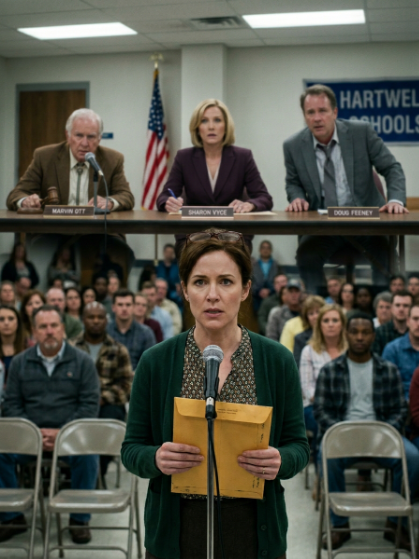
I read the date first.
“April ninth,” I said into the little microphone. “Three weeks before final grades were due.”
Then I read the email under it. Out loud. Slowly — because in a room that small, slow is its own kind of loud.
It was Sharon Vyce, writing to Principal Doug Feeney, asking him to “revisit” her son Brandon’s chemistry grade, because a failing mark would “create problems with his scholarship offer.” I read the principal’s reply, declining, politely, citing twelve missing labs. I read her next message, less polite. Then I read the last one. The three-line one.
“‘If you won’t correct this, Doug, I’ll handle the teacher myself when her contract comes up for review. I sit on that board for a reason.'”
I set the page down.
You could have heard a pin drop in the next county.
I turned to the dais. “I’d like to ask the member from District Two why she didn’t recuse herself from tonight’s vote. Or I can keep reading. There are six more emails.”
Sharon found her voice then, the way cornered people do. “Those are taken out of context. A mother advocates for her child. That is not a crime.” She tried a small laugh. “This is exactly the kind of dramatics that make her unfit for a classroom.”
“What context turns ‘I’ll handle the teacher’ into advocacy?” I asked. “I’ll wait.”
She didn’t have one.
The board chair, Marvin Ott — a man I’ve known since he coached my little brother’s baseball team — leaned slowly into his microphone.
“Doug,” he said, not looking at Sharon, looking at the principal. “Are these real?”
Doug Feeney had been sweating through his gray suit for an hour. He stood, and to his credit, he didn’t hide behind anyone.
“They’re real,” he said. “I kept them because I had a feeling that someday somebody was going to need them. Sharon’s been after Lainey’s job since the day Brandon failed. Tonight’s complaint about ‘unprofessional conduct’ — there’s no incident behind it. No report. No student, no parent, no write-up. I looked. There’s nothing there. Because there never was anything. There was a grade, and a grudge, and a board seat.”
The room came apart in a low roar — the sound a small town makes when it realizes it’s been used.
A voice cut through it from the third row. Hal Brennan, who’s delivered the mail on Sharon’s street for thirty years, stood up with his cap in his hand.
“My granddaughter had Ms. Brooks,” he said. “First teacher who ever made that girl believe she could do science. And you people were about to fire her over a report card.” He sat back down. “Somebody ought to be ashamed.”
Marvin brought the gavel down twice.
“The chair is recognizing a point of order,” he said. “Mrs. Vyce, you voted on a personnel matter involving the teacher who failed your son, and you did not disclose the conflict. That vote is void.” He looked down the length of the dais. “I’m calling a new vote, on a different motion. All in favor of rescinding tonight’s dismissal of Ms. Brooks, and referring member Vyce to the county ethics board — say aye.”
It wasn’t close. Even the two members who’d voted against me an hour earlier said it loud, the way people do when they want the room to forget where they’d been standing.
Sharon Vyce stood before they finished counting. She gathered her statement necklace and her little name placard as if she could carry her dignity home in her purse, and she walked out the side door while the whole town watched her go.
She resigned her seat two days later, in a letter she asked them not to read aloud.
They read it aloud. That’s how Hartwell works.
The ethics board took six weeks and found what everyone in that room already knew. Brandon, for what it’s worth, isn’t a bad kid. He came to my classroom the following week, on his own, ears bright red, and asked whether he could retake the labs over the summer and fix his grade honestly. I said yes before he finished the question. That’s the whole job. That’s all I ever wanted it to be.
They gave me my classroom back, with back pay and a letter for my file that called the dismissal “improper.” There was no apology from the board as a body — boards don’t apologize, they “move forward” — but Marvin shook my hand at the door and held it a second too long.
The next morning I unlocked Room 114 before the buses came. I wrote the day’s equation on the board. I lined up twenty-two pairs of safety goggles in a neat row.
Then I propped my door open, the way I have for sixteen years, and waited for the kids to come in.