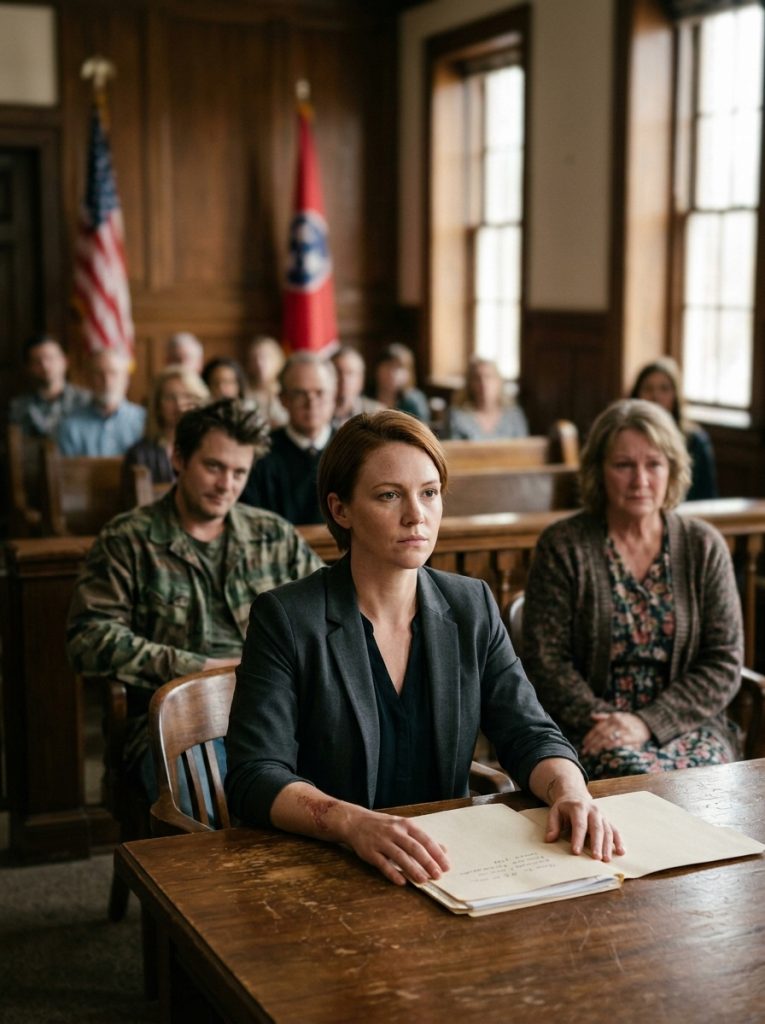
I waited, and people who are lying cannot stand a patient silence. They rush to fill it.
My mother filled it.
Given the floor, she built her story taller, the way the desperate always do. She told the court I’d “never left the county.” That my uniform was a costume from a surplus store — she gestured at Dylan’s camo jacket as if to prove the family owned several. That the scar I supposedly had was from a kitchen accident. That my grandfather was “confused” when he left me the farm, manipulated by a daughter pretending to be a war hero.
Dylan took the stand and swore to it. Swore he’d “never once” seen me in service. Swore he’d visited me at an apartment in Ohio during the years I claimed to be deployed.
Under oath. On the record. Exactly where I needed them.
When my attorney finally rose, Judge Pruitt looked almost relieved.
We started with the folder.
“Your Honor, defense enters the respondent’s DD-214 — her certificate of discharge.” He laid it down. “Her deployment orders. Two tours. Her unit assignments, dated, stamped, verifiable with a phone call to the Department of Defense.”
The dates on those orders covered the exact months my brother had just sworn I was eating dinner with him in Ohio.
“For the record,” my attorney said, “the respondent could not have cashed checks in Ohio on these dates. She was in Kandahar Province. The United States Army can confirm her coordinates better than her brother can.”
Dylan stopped rustling his jacket.
Then my attorney asked the court’s permission for me to show the scar.
I’d kept it covered for thirty-three years of my life and every minute of that trial. I stood, and I turned back the cuff of my charcoal blazer, and I showed the room the burn that runs the length of my left forearm — the morning an aid station took a blast and I kept working on a kid named Ramirez with my own sleeve on fire.
The gallery went silent. My mother’s performed tears dried up all at once, which is how you know they were never real.
“A kitchen accident,” my attorney said quietly. “From a woman who claims her daughter was never near a war.”
Then the doors opened.
Sergeant First Class Eloy Vega walked in, in his dress uniform, ribbons and all. He was not on my mother’s witness list. He was not on mine, either — I hadn’t dared ask. My old unit had heard, the way units always hear, and they’d sent him.
He testified for nine minutes. He’d been there when I earned the scar. He’d been there when I earned the things in the folder I hadn’t even needed to open. He looked at my mother the way you look at something you scrape off a boot.
And last, my attorney played the recording.
Months earlier, at a family dinner, my mother had bragged — phone on the table, recording app running, because by then I’d learned that my family’s words had a way of evaporating. She’d laughed about how she was going to “say whatever it takes” to get the farm, how “nobody’s going to side with a woman over a sweet old grandpa’s confusion,” how the lawsuit was “ninety percent theater.”
Ninety percent theater. In her own voice. Admissible. Tennessee is a one-party consent state, and I was the one party.
Judge Pruitt took the recording, the records, and the sworn testimony that now openly contradicted them, and he did not need long.
He ruled for me. The farm stays mine — my grandfather’s forty acres, his barn, the only house that ever felt safe. My mother was ordered to pay my legal fees in full.
Then he held her in contempt for the conduct in his courtroom, and he referred both her and Dylan to the district attorney for perjury, on the record, with the recording and the contradicted testimony attached.
Dylan’s camo jacket — the costume he wore to mock a uniform he never had the spine to earn — became Exhibit, in the worst way, of who was really pretending.
My mother tried to talk to me in the hallway. She started with “Adeline, you have to understand—”
I adjusted my blazer over the scar and I walked past her. I’d already said everything I had to say, and I’d done it by saying almost nothing at all.
My grandfather left me a letter, it turned out, with his attorney, to be opened only if it ever came to this. He’d written that he always knew I served, that he was prouder of me than of anything else his name ever touched, and that he left me the farm precisely because he knew the others would come for it and he knew I’d hold.
I read it on the porch of the house he gave me, the night the verdict came down.
Dylan reached out once, months later, an apology by text. I haven’t answered. Maybe someday. The DA has his case; that conversation can wait its turn.
People ask why I didn’t just shout the truth from the first minute.
Because the Army taught me that the strongest position in any fight is to let the other side commit, fully, on the record, to a hill that isn’t there.
I sat still. I let them swear to a lie in a room built for the truth.
And then I opened a folder, rolled up one sleeve, and let eight years I’d never bragged about speak in a voice no courtroom could pretend not to hear.