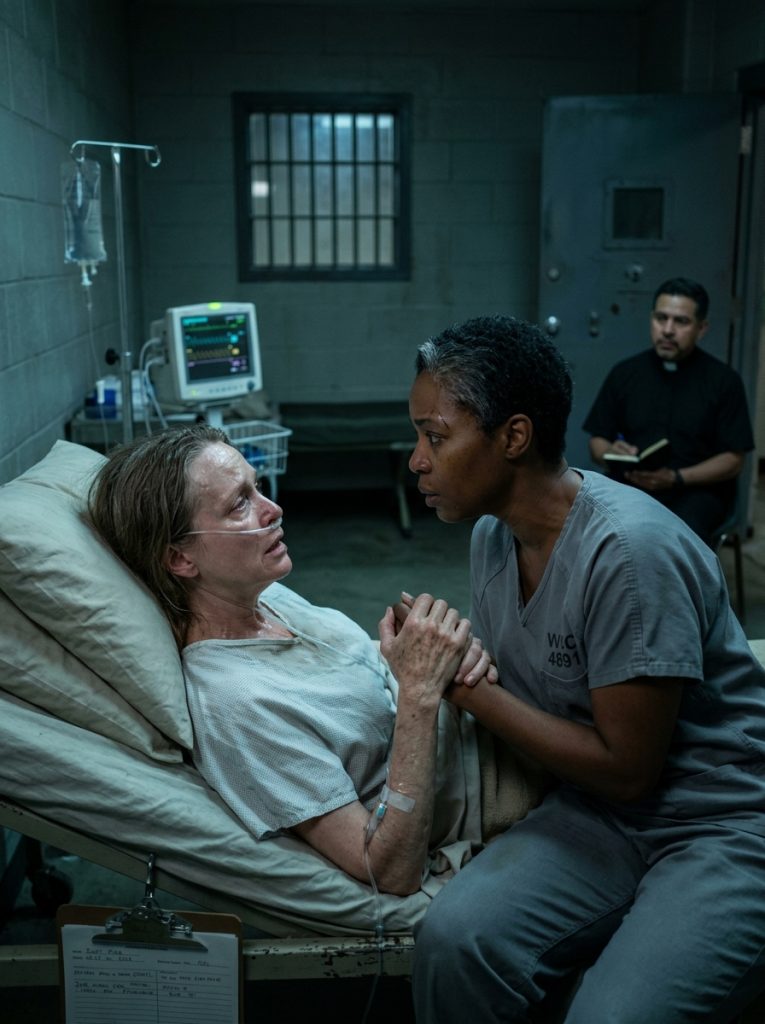
Dot’s grip tightened, and the words came out of her in pieces, between the beeps, like she was spending the last of herself on them.
“Chaplain,” she rasped. “Get it down. All of it. I’ll sign.”
Chaplain Ruiz was already pulling his chair to the cot, notebook open, pen moving.
And Dot told it.
She told how, eight years back, before she ever knew me, a man approached her through a go-between. A clean-cut man with money. He needed a woman with a record and a key to a particular car. He needed something found in that car on a particular night.
Fifty thousand dollars. Half up front. She’d been desperate, and desperate is a country with its own laws.
“I didn’t know your name then,” she whispered. “Didn’t know I’d end up sharing a cell with the woman I helped bury. When they put you in with me and I heard your case, I knew. God help me, I knew, and I said nothing for years.”
“Why now,” I said. My voice didn’t shake. I’d used up shaking a long time ago.
“Because I’m about to meet somebody,” she said, “and I’d rather not do it with this on me.”
She named him.
My husband. My ex now, on paper, though he divorced me while I was inside and married the woman he’d been seeing the whole time — the woman, it turned out, who’d benefited from the life insurance policy and the house and the savings the day I was convicted.
Dot gave details no innocent person could invent. The make of the go-between’s car. The diner where she got the second envelope. The fact that the cash came in bank-strapped bundles, which meant a withdrawal, which meant a record.
Ruiz wrote it all. A night nurse came in and witnessed it. Dot signed at the bottom in a hand that barely held the pen, and the chaplain and the nurse signed beneath her, and the time and date went on it.
Dot died four days later.
A dying woman’s confession, witnessed and documented, is not a thing the law can wave away. The chaplain wouldn’t have let it be ignored even if anyone tried.
I’d stopped writing to the Innocence Project two years before. They get thousands of letters. I figured mine was just one more.
Ruiz called them himself. A chaplain saying “I have a signed deathbed declaration naming the real party” moves differently than a sixth letter from an inmate.
A lawyer named Priya drove out within the week.
After that it went faster than six years had any right to let it.
They subpoenaed the bank records. The fifty-thousand-dollar withdrawal was there, in two pieces, dated to the weeks around my arrest, from an account my husband controlled. The “found” evidence in my car was re-examined with techniques that didn’t exist at my trial; it had been handled, placed, never truly tied to me.
The go-between, facing his own exposure, took a deal and confirmed every word Dot had said.
My husband had built a whole clean life on the six years he stole from me. The settlement he’d taken. The house. The new wife. The story that he was the wronged man whose criminal ex got what she deserved.
It came down like a wet paper wall.
He’s charged now — conspiracy, fabricating evidence, perjury, fraud. The trial’s still ahead. His lawyer says a lot of confident things. I’ve heard confident lawyers before. From the other chair.
They overturned my conviction on a Thursday.
I walked out the gate on a Friday morning with a state-issued check that doesn’t begin to cover it and a cardboard box of letters, most of them from Dot, who turned out to be the only person in six years who ever told me the truth.
My daughter was at the gate.
She’s fifteen now. She was nine when they took me. She’d stopped writing because someone told her I was guilty and she was old enough to read the headlines and too young to read the lies under them.
She’d seen the news. She came on her own. A neighbor drove her.
She didn’t run to me like a little kid. We’re past little-kid running. She just stood there, taller than I dreamed, and said, “Mom?” like she wasn’t sure she was allowed.
I said, “It’s me. I never stopped being me.”
We don’t get the six years back. Nobody hands those over with the check. She has a whole childhood I wasn’t in, and some nights that’s a grief so big I can’t see around it.
But she’s relearning me, and I’m relearning her, one awkward, holy, ordinary day at a time.
I think about Dot every single day.
A hard woman who did a terrible thing for money, and who, at the very end, with nothing left to gain, decided the truth was worth more than her own comfort.
She gave me back my name.
I stopped defending myself six years ago because no one would listen.
The day someone finally did, it was a dying woman in a prison cot, holding my wrist so I couldn’t look away — and that one held hand undid everything they’d built to keep me buried.