The first thing out of my mouth wasn’t anger.
It was, “You’re alive.”
Twenty years of rehearsed speeches, and that’s what fell out. Not a curse. Not a question. Just the plain stupid relief of it, because some part of me had buried him a long time ago and here he was in the doorway, breathing.
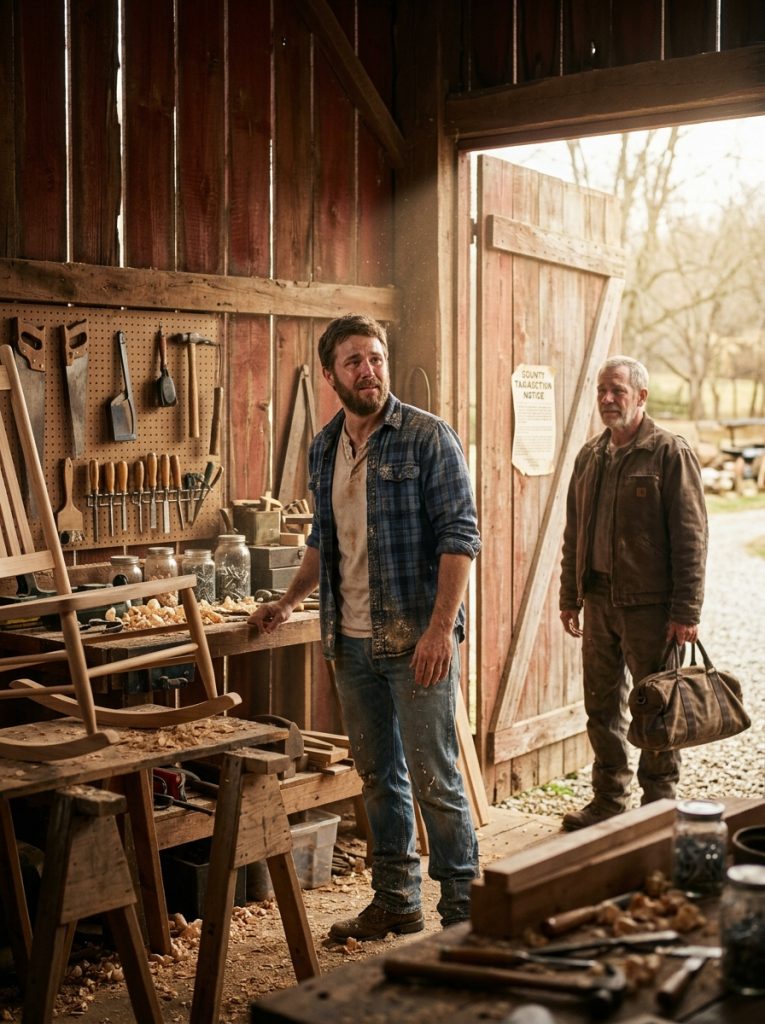
Ray set the duffel down. He looked at the half-finished rocking chair, the leather apron on its hook, the tools in their painted outlines, all of it exactly where he’d left it, and his face came apart.
“You kept it,” he said again. “Twenty years. Caleb.”
“I couldn’t take it down,” I said. “I tried. My hands wouldn’t do it.”
Then I saw him notice the paper on the door. The auction notice. The county seal. Noon tomorrow.
“What is this,” he said. Not really a question.
So I told him. The back taxes. The penalties. A mechanic’s wage against a number with too many zeros. A year of fighting and losing. That I’d driven out here tonight to say goodbye to a building.
He sat down hard on the workbench stool, and then he told me the thing nobody ever told me.
He didn’t walk out on us.
Twenty years ago, Ray was a millwright at the plant off Route 7. There was an accident — a line that should have been locked out wasn’t. It crushed his hand and his hip. He spent four months in a bed and came out owing money none of us knew existed: the part the insurance fought, the surgeries, the lawyer he’d hired to fight the plant and lost to.
The debt was the kind that follows a name and eats everything attached to it. Our house. The barn. The little college fund with my name on it.
“I did the math,” he said, and his voice was the flat, worn voice of a man who’d done a terrible arithmetic and then lived with the answer for twenty years. “If I stayed, they’d take it from all of us. If I left — if I disappeared, if the debt couldn’t find a household — they could only come after me. Just me.”
So he left. He let everyone believe he’d run, because the lie that he was a coward was cheaper than the truth that we were drowning.
“I sent money,” he said. “Cash. Money orders, no name, to your mother. Every month I could. Did she—”
I felt the floor tilt.
There’d been envelopes. For years. Cash, no return address. Mom called it our guardian angel. She cried over them. She never knew. She went to her grave thinking a stranger had been kind to us, and the stranger was the husband she thought had abandoned her.
I told him that. I watched it land on a man who’d given up his whole life to protect us and never once got to know if it worked.
He put his ruined hand over his face and he wept, and I crossed that workshop and I put my arms around my father for the first time in twenty years, and we cried in the sawdust until the light through the plank walls went from gold to gray.
We didn’t have until noon to fix it. We had until morning.
But here’s the thing about a man who disappears to pay a debt: he eventually pays it. Ray had spent twenty years as a ghost, working under the table, living small, and somewhere in a credit union three states away there was an account with the slow, stubborn savings of a man with nothing left to spend it on.
It wasn’t a fortune. It was, almost exactly, the size of a county tax bill.
We were at the courthouse when it opened. He paid it in full, in person, and signed his real name for the first time in two decades on a piece of paper that said the workshop was staying in the family.
The clerk asked if they were related, me and the old man counting out a cashier’s check.
“That’s my dad,” I said.
It still surprises me every time.
He lives in the house now. The debt’s long dead — it died years ago; he just never came home because he didn’t think he’d be welcome. He was wrong about that. He’s wrong about a lot of things, and we have time, now, to argue about all of them.
We finished the rocking chair last month. Took it down off the bench where it had waited twenty years, and the two of us sanded it and oiled it and set it on the porch.
He sits in it most evenings.
I keep the workshop the way it always was. Only now there’s a man in it.