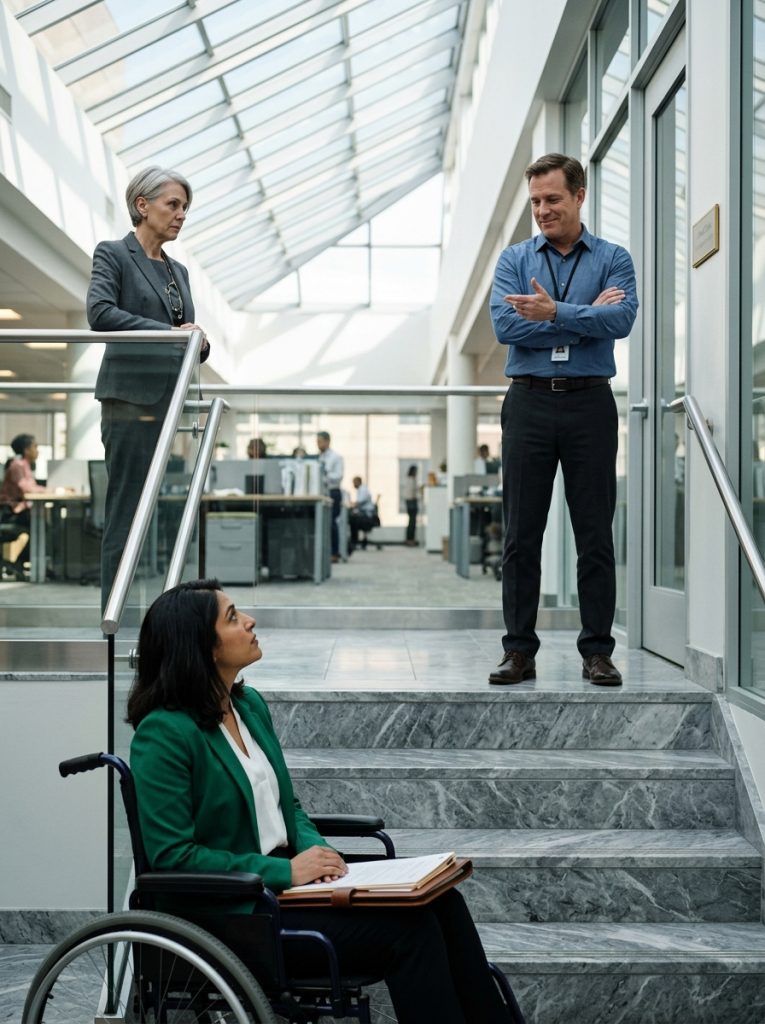
“Before we begin,” Derek said, smiling at the board director, “Priya has a few words. We’re really proud of the inclusion work happening here.”
He thought I was going to thank him.
I opened the folder on my lap and I started to read.
“Report on accessibility and hiring at Halcyon Systems,” I said. “Prepared by the Director of Inclusion. Page one. The office assigned to this position is reached by three stairs and has no ramp, no lift, and no alternative entrance. The director cannot enter her own office.”
The room went very still.
Derek’s smile flickered. “Priya, maybe this isn’t the—”
“Page two,” I continued, calm, even. “In six years, this company has hired one hundred and forty engineers. Zero use a wheelchair. Two disclosed any disability. Both left within a year. I interviewed them. I’ll read their exit notes if the board would like.”
Eleanor Grant set down her pen.
“Page four,” I said. “The building has eleven code deficiencies under the accessibility standards this company is legally required to meet. I’ve listed each one, with the section number, and the date it was last flagged and ignored.” I looked up. “The oldest is from before I was hired.”
Derek tried once more. “This is being handled internally—”
“It’s being handled right now,” Eleanor said. She didn’t raise her voice. She didn’t have to. She turned to me. “Keep going. All of it.”
So I did.
I read the policy I’d written — forty-one pages. A real accommodations process, with a budget and a name attached to approve it. Accessible-by-default facilities, not “we’ll figure it out later.” A hiring pipeline that partnered with organizations Derek had never bothered to call. A rule that no role could be created without first confirming the person hired into it could physically occupy it.
That last one I read slowly, looking right at Derek.
When I finished, the room was silent in a way that meant something had shifted.
Eleanor was the one who broke it. “Who approved giving a director a title with no budget, no team, and an office she can’t get into?”
Nobody answered. Which was its own answer.
One of those two engineers who’d left — the ones whose exit notes I’d offered to read — had written a single line I couldn’t stop thinking about. “I was good at the job,” it said. “I just got tired of being a problem to be solved.” I’d put that line on page three of the report. I’d watched Eleanor’s eyes stop on it and stay there.
She asked for the folder. I handed it up the three steps I couldn’t climb, and watched her read the cover page again.
“This isn’t a thank-you speech,” she said, to the room, not to me. “This is the most useful thing anyone has put in front of this board in two years.”
They didn’t adopt it that day. Boards don’t move that fast. But they adopted it by the end of the month — all forty-one pages, with a budget line that had real numbers on it, and my name on the approvals.
The “Director of Inclusion” office at the top of the three steps got reassigned to a supply room. They built a ramp into the atrium that summer, and they gave me a new office on the ground floor, the one with the wide door, the one I could actually use.
Derek was “reassigned” too. He moved to a different floor, a smaller title. Last I heard he tells people he “championed accessibility.” I let him. The ramp doesn’t care who claims it.
Here’s the part I think about most.
Six months later, we hired an engineer named Tomas. Brilliant. Uses a power chair. On his first day he rolled straight up the new ramp, through the wide door, to a desk that had been set at the right height before he ever arrived, because the policy required it.
He didn’t notice any of it. That was the whole point. Nothing about his first day required gratitude or apology. It just worked, the way it should have worked all along.
He found me at lunch and said, a little puzzled, “Everyone keeps telling me this place is really accessible. It just seems… normal?”
I smiled.
“That’s the goal,” I told him. “Normal. They gave me a title to look good. So I used it to make ‘normal’ the rule.”
Then I rolled back to my ground-floor office, through the door I’d been told I’d have to wait for, and got back to work.