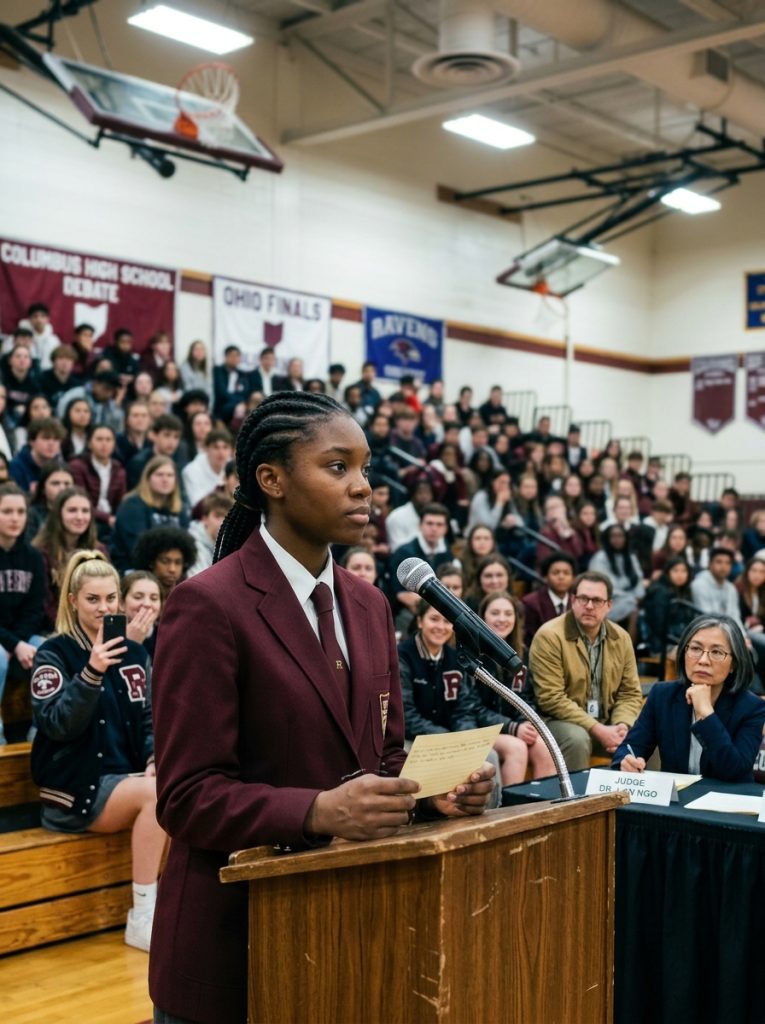
“You want to know what it costs,” I said into the microphone, and my accented voice filled a gym that had been laughing ten seconds earlier. “I will tell you what it costs.”
I told them about the first language I lost. The one I dreamed in, before the dreams had to learn new words.
I told them about the second language, the one of the camp, picked up fast because fast was how you got fed, how you got seen, how you kept your little brother close in a crowd.
And I told them about this one. English. The third. The one I was standing in front of them speaking, knowing every vowel came out with an edge that made a girl in the front row think I was a joke worth filming.
“You laugh at the way I say the words,” I said. “You have never had to count them. I count every word before it leaves my mouth. I am tired in a way you have never been tired. And I am still here, at this podium, in your language, saying something true. Ask yourself which of us is actually brave.”
The gym was so quiet I could hear the banners moving in the air from the vents.
I won’t pretend I remember the rest of my argument. I’d thrown away the cards. I just told the truth until I ran out of it, and then I said thank you, and I sat down, and my hands were shaking so hard I sat on them.
The head judge, the small woman in the navy suit, took a long moment before she picked up the microphone.
“Before I announce the result,” she said, “I want to say something the rules don’t require.”
She took off her silver glasses.
“My name is Dr. Lan Ngo. I sit on the state appellate court. Many of you were told that an important judge would be evaluating this final, and you assumed she would be impressed by polish. By smooth delivery. By cards held in steady hands.”
She looked, very deliberately, at the front row. At Brooke, whose phone had drifted down into her lap.
“Forty-six years ago,” Dr. Ngo said, “I came to this country on a boat, and then in the back of a truck, and then into a classroom in a town much like this one, where the other children did an impression of my accent every time I raised my hand. English is my third language too. I have argued cases in front of the highest court in this state in a voice that still, on the hard words, carries the shape of the place I was born.”
You could have heard a pin drop in that gym. You could have heard a feather.
“I was not sent here to find the most polished speaker,” she said. “I was sent here to find the best argument. The most polished speaker is not always the bravest one in the room. Today, she was not even close.”
She put her glasses back on.
“The winner of the final, unanimously, is Amara Okeke.”
I don’t remember standing up. I remember Mr. Delaney in the front row with both hands over his face, the man who’d stayed late all year, who’d told me a hundred times that my accent was not a flaw but a passport, a record of everywhere I’d survived. He was crying and not hiding it.
Here is the part the cinematic version would leave out, but I won’t.
Brooke didn’t get struck by lightning. Nothing dramatic happened to her. She just sat there, small, while the gym she’d expected to laugh with her stood up to clap for me instead. The video she’d been filming to mock me — she never posted it. A friend of hers told me later that Brooke watched it back that night and deleted it, because in it you could hear the whole gym turn, and you could hear, very clearly, who she had been in that moment.
I think that was worse for her than any punishment. I think she had to watch herself.
Dr. Ngo found me afterward. She didn’t give me a speech. She wrote something on the back of her judge’s placard and pressed it into my hand.
It said: “The accent is the proof you made it here. Never sand it down. — L.N.”
I keep it in my blazer pocket. I’m going to law school. I already know it.
And when I argue my first case, in my third language, with the edges still on every word, I am going to remember a quiet woman taking off her glasses in a high-school gym, and I am going to let them hear exactly where I came from.