The name on the beneficiary line was Tara Lynn Pierce.
I didn’t know her. Not then. But Dale did. He’d known her for almost a year before the fire — long enough to put her name on a one-hundred-thousand-dollar life insurance policy he took out on me, his wife, three weeks before our house burned down.
A policy I never signed. A policy I’d never heard of until a lawyer from the Innocence Project slid it across a scratched metal table in a visiting room and asked me, gently, if I’d ever met a woman named Tara.
Here’s what the jury was never told, because the prosecution never went looking.
Dale set the fire. He’d been planning to leave me for Tara, but Dale didn’t believe in leaving empty-handed. He wanted the house insurance and he wanted the life insurance and he wanted a clean exit with no alimony and no split. So he engineered a story: a struggling wife, a convenient fire, an arson-for-profit scheme. He forged my signature on the homeowner’s claim. He told the investigators about my “money troubles.” He shook his head sadly in that courtroom until twelve tired people decided his sadness was evidence.
What he forgot — what arrogant men always forget — is that they leave a paper trail when they plan too far ahead.
The life-insurance policy on me, dated three weeks before the fire, with his girlfriend as the beneficiary, was the thread. Because you don’t insure the life of a wife you’re about to frame for arson unless you’re hedging every possible way she might stop being your problem. It established the relationship. It established the timeline. It established intent. And once the investigators had Tara’s name, they had Tara.
She’d married him, by then. And a guilty conscience is a patient thing. When two investigators showed up at her door with the policy and the dates and the words “accessory to arson,” Tara folded like a paper crane. She’d known. Maybe not every detail, but enough. She testified to all of it.
Six years, two months, and eleven days after they took me away, a judge vacated my conviction.
I’d like to tell you that the moment was triumphant. That I walked out into sunlight and a brass band.
It wasn’t like that.
Because here is what exoneration doesn’t give back.
It doesn’t give back my mother, who died in the second year I was inside, holding a folder of evidence she’d gathered herself with shaking hands, still telling the nurses her daughter was innocent. I wasn’t allowed to go to the funeral.
It doesn’t give back the years my daughter Becca grew up calling another woman’s rules home, raised in part by the man who put me in a cell. It doesn’t give back her eleventh birthday, or her first day of high school, or the thousand ordinary nights a mother is supposed to be down the hall.
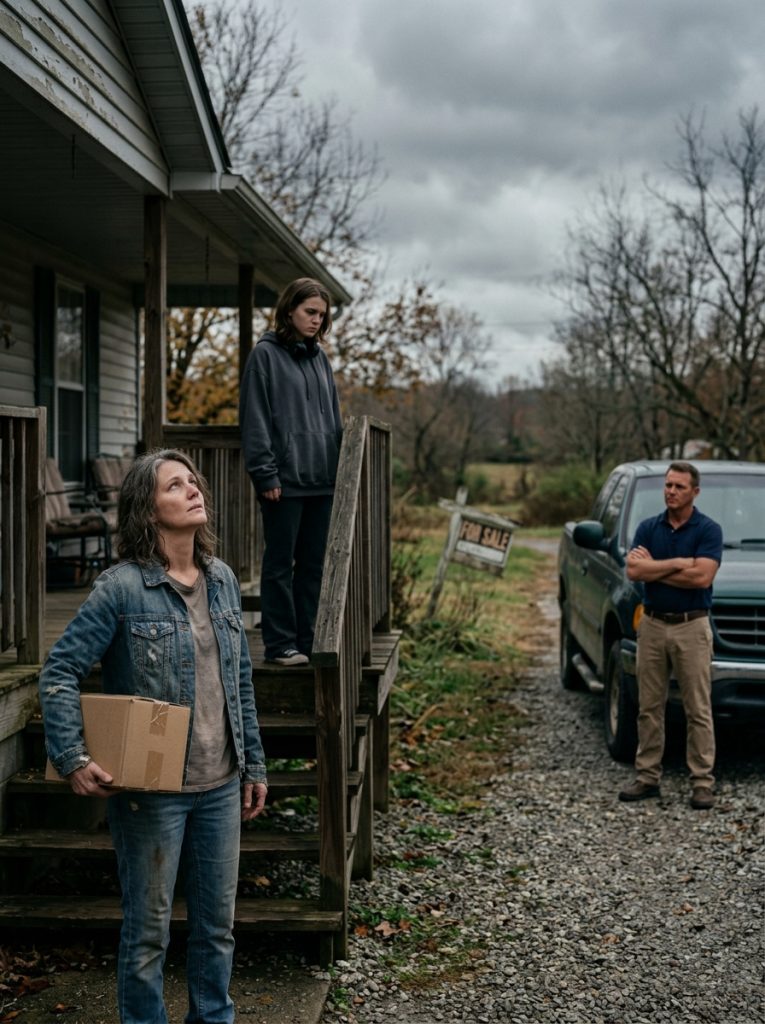
When I came home, she stood on that porch in her hoodie and looked at me like I was a rumor. Six years is most of what she could remember. To her, “Mom” was a story with a bad ending that the adults kept changing.
So I didn’t rush her.
I rented a room in town. I got a job at the diner on Route 9. And every Sunday I showed up at that porch, and most Sundays she didn’t come out, and I sat on the bottom step anyway so she’d know through the window that showing up was something I could do now, freely, for as long as it took.
It took four months for her to sit on the step beside me.
It took a year for her to call me Mom and mean it.
Dale is awaiting trial now. Tara testifies against him. The house is being sold, and I don’t want a dime of it. I told the lawyers to put whatever comes to me into an account for Becca, for college, for a life I wasn’t there to build the foundation of.
People ask if I’m angry. I was. For six years, anger was the engine that kept me upright.
But anger is heavy, and I’ve carried enough heavy things. What I want now is small and ordinary. I want to learn who my daughter became while I was gone. I want to sit on a porch step in the open air whenever I please. I want a Tuesday that nobody can take.
The truth came too late to give me back the years.
But it came.
And on the good Sundays now, Becca comes down the steps without my asking, and she sits, and she leans her head on my shoulder like she did when she was small — like some old muscle in her remembered me before the rest of her could.
I’ll take it. After everything, I’ll take every single Sunday I can get.