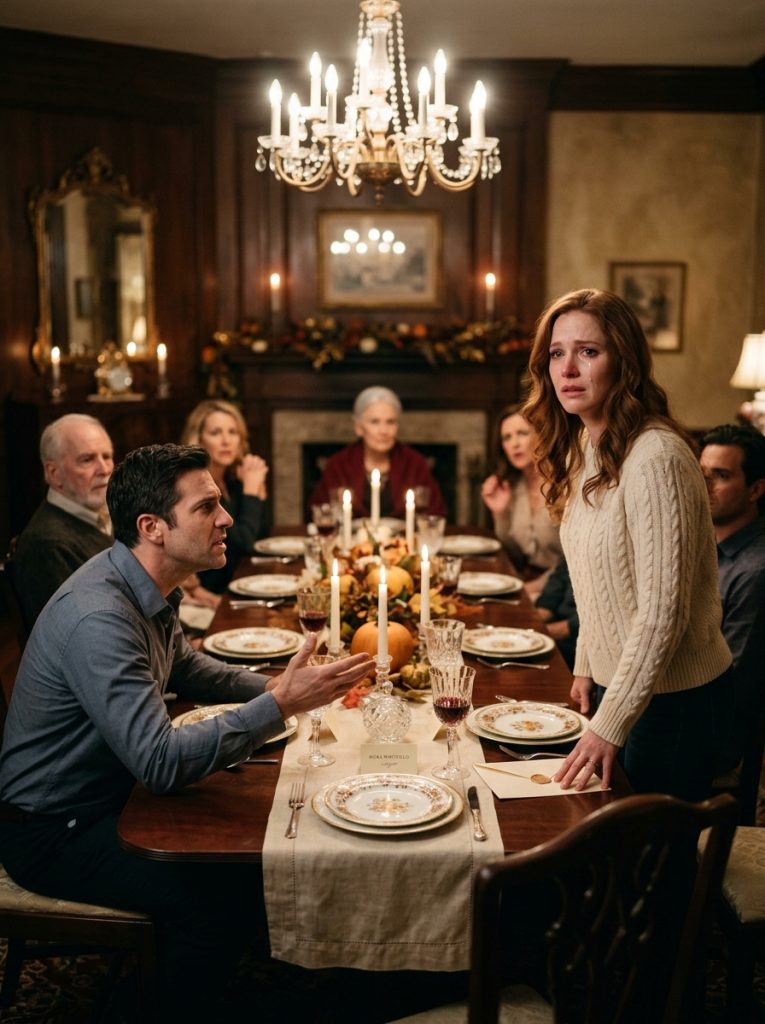
I sat down at the head of the table because my grandmother told me to, and because my legs wouldn’t hold me anyway.
Paul stayed standing. “Grandma, this is not the time—”
“Sit, Paul.” Vivian’s voice could still flatten a room. “You’ve controlled the time in this family for six years. Tonight it’s mine.”
He sat.
Vivian nodded at the envelope under my plate. “Open it, Nora. Out loud. Your father wrote it for exactly this dinner.”
My hands were shaking so hard I tore the flap crooked. Inside was a single page in my father’s careful hand, and a smaller folded document behind it.
I read it aloud because she asked me to.
Nora — if Vivian is giving you this, then I’m gone and the truth has waited too long. You did not steal from this family. You did not abandon me. You left because you were told to, and I was too sick and too proud to stop it. I’m sorry. The house was always meant to be yours. Make them honor it. — Dad
The room had gone so quiet I could hear the candles.
“That’s a forgery,” Paul said, but his voice had no floor under it.
“It isn’t,” Vivian said. “I watched him write it. I notarized the page behind it myself.”
I unfolded the second document. It was a deed of trust. The family home — this house, this table, the chair I was sitting in — placed in trust for me, dated three weeks before my father died.
Signed. Witnessed. Sealed.
“I don’t understand,” I said, though I was starting to. “Paul told everyone I took money from Dad’s accounts. That I left because I got caught. That’s why—” My voice cracked. “That’s why none of you returned my calls.”
“Because your brother needed a villain,” Vivian said, “and you were younger, and softer, and easier to cast.”
I finally looked at Paul.
And the whole rotten architecture of the last six years rearranged itself in front of me.
It had been Paul handling Dad’s money when Dad got too sick to manage it. Paul who “discovered” the missing funds. Paul who told the family, tearfully, that he hadn’t wanted to believe it of his own sister.
There were no missing funds. There had been a transfer Paul made to himself, and a story he built to cover it, and a sister conveniently positioned to take the fall.
“You let me think Dad died believing I robbed him,” I said. The words came out steady, which surprised me. “You let me grieve him alone in a one-room apartment eight hours away, thinking he hated me at the end.”
“You don’t know what it was like,” Paul started. “Managing everything, the house, his care—”
“I begged to help with his care!” The candles jumped. “You told me he didn’t want to see me. You told me that on the phone while he was dying.”
Paul had no answer. The silence answered for him.
Vivian folded her hands. “After your father passed, I started asking questions. Quiet ones. I’m old, not stupid. I found the transfer. I found the second account. And I found the letter your father left me to give you, when I could prove enough that you’d be believed instead of doubted.” She looked around the table at the rest of the family — aunts, cousins, the ones who’d gone cold on me. “I wanted every one of you in this room when it came out. So none of you could pretend later that you didn’t hear it.”
One of my aunts put her hand over her mouth. My cousin Daniel said, softly, “Oh, Nora,” and it was the first kind thing anyone in that family had said to me in six years.
Paul tried one last time to stand on the story. “The estate’s already settled. The house is in my name now. Whatever that paper says—”
“That paper,” Vivian said, “is a trust that predates your settlement, and my attorney has the original. The house was never yours to put in your name. Which raises some very interesting questions about how you did.”
That landed. Paul went gray.
Here’s how it ended.
The trust held. The house was mine — had been mine, legally, the whole time I’d been grieving in exile. My grandmother’s attorney unwound Paul’s “settlement” thread by thread, and what he’d taken came back into the estate, where my father had wanted it.
The family didn’t all come around at once. Some of them had been too comfortable believing the easy story. But the aunt who covered her mouth started calling me. Then my cousin. The thaw was slow, and real, and I let it be slow.
Paul and I don’t speak. I didn’t press charges, though Vivian wanted me to. He left the dinner that night and hasn’t been back to the house. I told him the truth costing him this family was a sentence I didn’t need to add to.
I host Thanksgiving now.
The first year, I almost didn’t change the place cards. Then I did. I wrote every name myself, in my father’s careful style, and I put my grandmother at the head of the table where she belongs.
She protested. I told her the cards stay exactly where they are.
She laughed for the first time in years.
And under her plate, where my father’s letter once sat under mine, I tucked a small note of my own: Thank you for being the one who kept asking questions.
Some families bury the truth with the people who knew it.
Mine had one stubborn woman in a red shawl who refused to let it stay buried — and a seat at the head of the table that finally found its way back to the right hands.