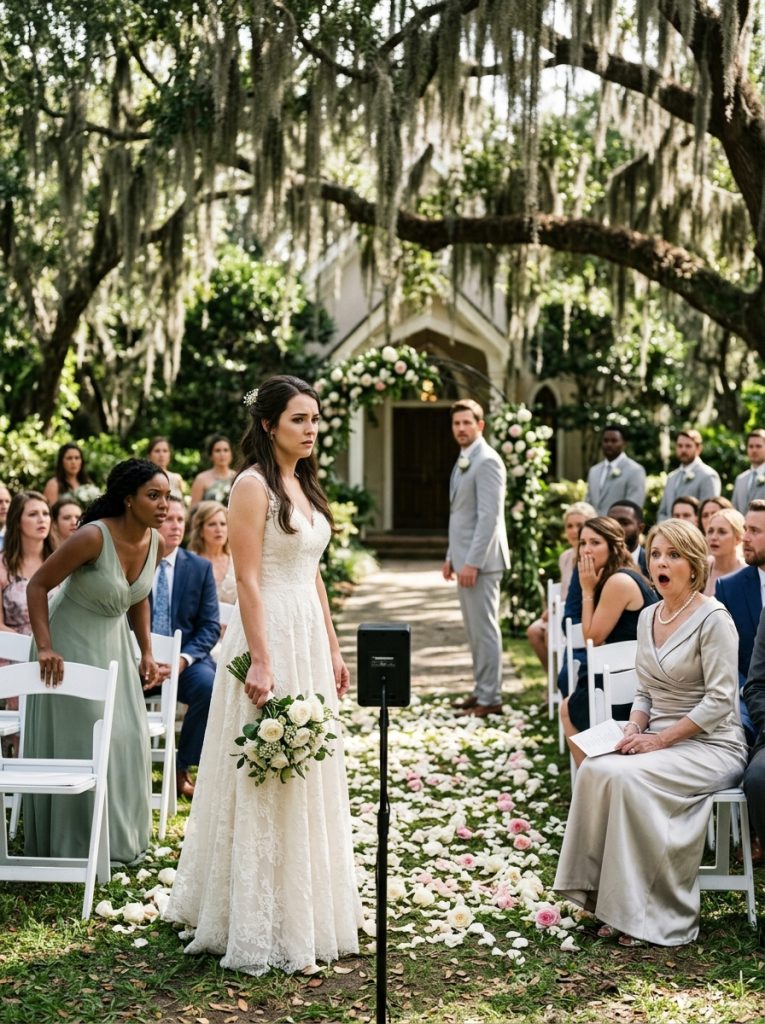
I walked all the way to the front, past two hundred turned heads, and stopped at the altar where Cole stood waiting with that practiced smile cracking around the edges.
He reached for my hands. “Babe, the sound guy is an idiot, that was taken completely out of—”
I stepped past him.
To the microphone the officiant had been about to use.
“Everybody heard that, right?” I said into it. My voice came back over the speakers, steady — the same speakers that had just betrayed his family. “I want to be sure I’m not the only one. For a second there I thought I’d imagined it.”
Nervous laughter. Diane Whitfield had gone the color of her champagne dress.
“Three weeks ago,” I said, “I found a prenuptial agreement in Cole’s desk. I wasn’t snooping. I was looking for a stamp. It had my name on it, terms I had never discussed, and a signature line dated for today.”
I looked at Cole.
“I almost talked myself out of believing it. Told myself the man I loved couldn’t possibly be planning my exit before he’d even married me.” I gestured at the speakers. “Thank you, by the way. For clearing that up.”
Here is what the recording didn’t capture — the part I had spent three weeks quietly confirming.
The prenup wasn’t just lopsided. It was a machine.
A clause that assigned me the household debts in any divorce. A clause that valued my contribution to the marriage at zero, no matter how long it lasted. And a signature page in a handwriting that wasn’t quite mine, as if they intended to slot it in whether I signed or not.
I’d taken it to a lawyer. A real one. She read two pages, looked up, and said, “Honey, this isn’t a prenup. It’s a trap with a wedding built around it.”
So I did three things in three weeks.
I made copies.
I moved my savings somewhere safe.
And I decided to let them walk all the way to the edge of this before I stopped it — because some lessons only land in front of an audience.
“Mrs. Whitfield,” I said to Diane, who was on her feet now, “you called me a temporary problem. You were almost right. I am temporary. I’m leaving in about ninety seconds.”
“But I’m not a problem,” I said. “A problem is something you have to solve. I’m just a woman who reads what she signs.”
Cole found his voice. “Lauren, you’re embarrassing yourself—”
“No,” I said. “I’m embarrassing you. There’s a difference. And the recording already did most of the heavy lifting.”
I set the copies of the prenup on the altar, right where the marriage license was supposed to go.
“For anyone curious how this man plans to love you forever,” I said, “it’s all in there. Page four is my favorite.”
Then I slid off the ring, set it on top of the stack, and picked my bouquet back up from the table by the door on my way out — because they were my grandmother’s roses, and I was not about to leave them for these people.
I walked out of that garden into the brightest sunlight I have ever felt.
My father caught up to me at the car. He didn’t say I told you so, though he had, gently, twice. He just took off his suit jacket, draped it over my shoulders, and said, “Where to, kid?”
We went and got cheeseburgers. In a wedding dress. Best meal of my life.
The fallout was its own slow weather.
Word travels in a town like ours. The recording traveled faster. By Monday, everyone had heard the toast and the altar both. The Whitfields quietly canceled their big anniversary party that fall. Nobody would have come.
Cole called eleven times the first week. Then he sent a lawyer’s letter about “defamation.” My lawyer sent one back about the forged signature page. His letters stopped.
I hear he’s engaged again. I hope she reads page four.
People assume the worst day of my life was the day my wedding fell apart on a microphone in front of two hundred people.
It wasn’t.
The worst day would have been the second anniversary. The one Diane was already counting down to. The one where I’d have signed away everything and never seen it coming.
I got to skip that day.
I have my grandmother’s roses pressed in a frame on my wall now.
Not as a wound.
As a receipt — proof of the morning I heard exactly who they were, and believed them the very first time.