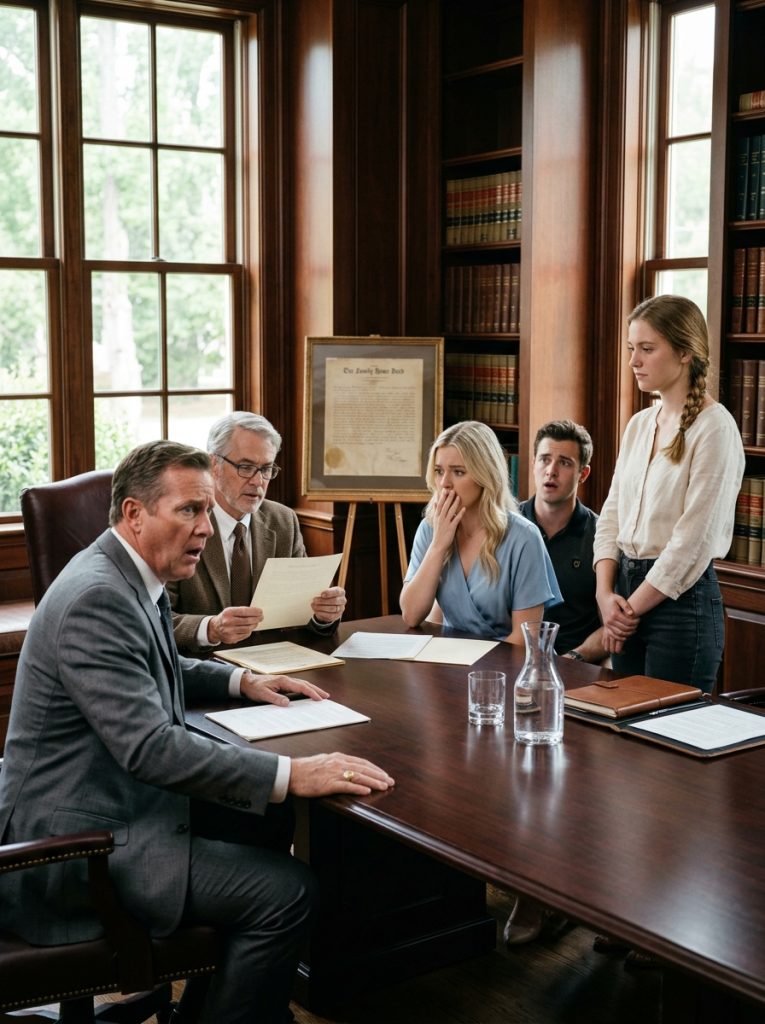
Mr. Greaves turned to a page near the back of the will, the one with the wax seal Roland had assumed was just decoration.
“‘To my wife, Diane, I leave the use and comfort of my home and a monthly provision, for her lifetime or until remarriage,'” he read.
Roland’s chin lifted. He liked the sound of that.
Then Mr. Greaves kept going.
“‘Upon her remarriage, all provisions to her shall cease.'”
The room shifted.
Diane had remarried Roland fourteen months after my father’s funeral.
“‘The entirety of my estate — the house, the accounts, and Marsh Contracting — is held in trust for my daughter, Ivy, and passes to her in full upon her twenty-first birthday.'”
Mr. Greaves looked up over his glasses.
“Ivy turned twenty-one last Tuesday,” he said.
The silence had a texture to it. You could have leaned against it.
Roland stood so fast his chair scraped the floor.
“That’s not — let me see that. He was sick when he wrote it. She manipulated him. She was a child—”
“I was fifteen,” I said. The first words I’d spoken in an hour. “I didn’t manipulate anybody. My dad just didn’t trust you. Turns out he was right.”
Mr. Greaves slid a second folder across the table. This one wasn’t a will.
“There’s a related matter,” he said, and now he was looking only at Roland. “Over the past four years, Mr. Pierce, you took out two lines of credit secured against this house and against Marsh Contracting’s equipment. Property you represented to the bank as your own.”
He let that sit.
“It was never yours to borrow against. It was held in trust for Ms. Marsh. That makes those loans fraudulent — and it makes the debt yours. Personally. Not the estate’s. Not Ivy’s. Yours.”
Roland’s face did something I’d waited six years to see.
It fell.
I want to tell you I felt triumphant. The truth is more complicated.
For six years I had told myself a story where the day the truth came out, I would finally feel whole. Like winning would fill the hole my father left behind.
It didn’t. Winning just stopped the bleeding. There’s a difference.
What I felt, sitting in that office, was tired. And under the tired, something quieter — my father’s voice, the way he used to say, “I’ve got you handled, Ivy-bug. Always.”
He’d been gone six years.
And he still had me handled.
Here is what happened to everyone.
Roland moved out of my father’s house within the month — not to the garage, I want to note. I let him take his clothes and the car that was actually his. The debt followed him out the door. Last I heard, he was selling the watch.
Brett, who laughed in the lawyer’s office, called me twice. Once to apologize, which I didn’t believe, and once to ask for a loan, which told me the first call had been a lie.
Diane I felt for, a little. She had married a man who married her for a house that was never hers to give. She moved in with her sister. I send her a small provision anyway — not because the will requires it, but because my father would have. He married her. That still means something to me, even if it never did to her.
And Chelsea.
Chelsea was the one who used to leave half her lunch on the steps of the garage apartment without a word. Who never laughed when the others did. Who once, when I was sixteen and crying, slid a note under my door that just said, This isn’t forever.
She was right. It wasn’t.
Chelsea lives with me now. We run Marsh Contracting together — she keeps the books, I run the sites, the way my dad taught me before he got sick. The crew calls us “the Marsh girls,” and Chelsea never corrects them, even though her last name is Pierce.
I sleep in my father’s house again. My old room. The big one this time.
I never moved into the master. It still feels like his.
But I took one thing out of the garage apartment and carried it down to the kitchen, where everyone can see it.
A framed photo of a man in a contractor’s cap, grinning, a little girl up on his shoulders so she can see over the fence.
I’ve got you handled, Ivy-bug.
You did, Dad.
You always did.