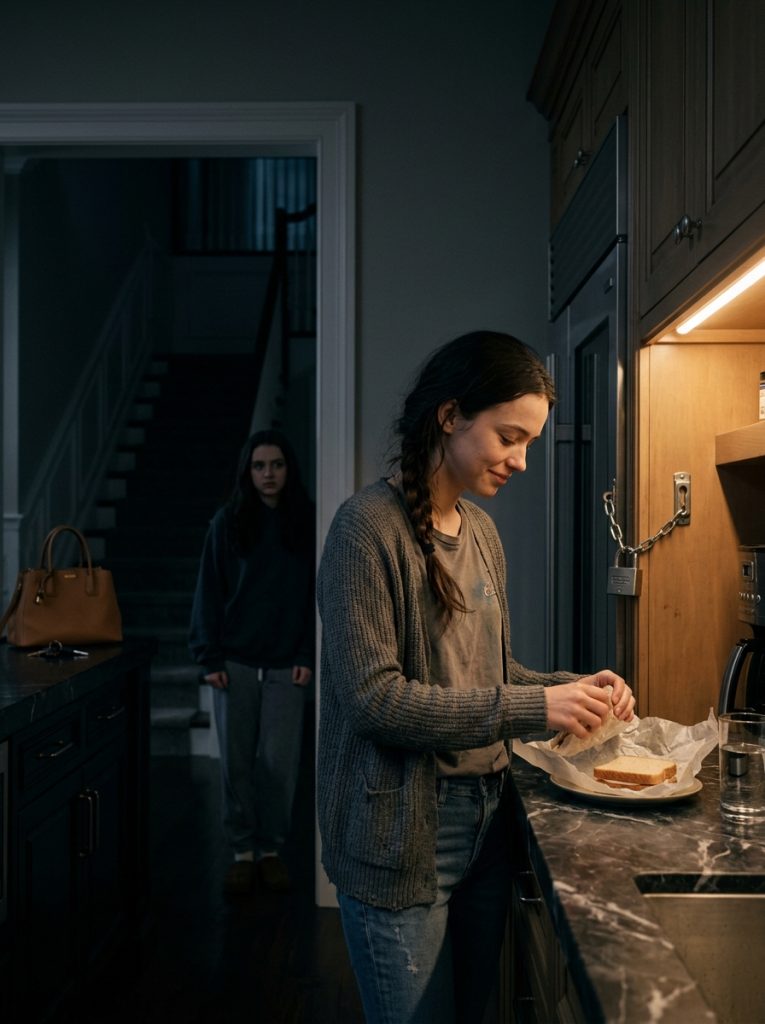
The man in the suit said his name was Mr. Adler, and that he had been my father’s attorney for twenty years.
I had never heard the name in my life.
That should have been my first clue. But I was nineteen and exhausted and holding half a sandwich, so I just stood there in the doorway in my gray cardigan while he asked, a second time, if I was June Hartley.
“That’s me,” I said.
“Miss Hartley, I’ve been trying to reach you for almost three years,” he said. “Every letter came back. Every call went unreturned. I finally decided to simply drive to the house.” He glanced past me into the dark hall. “May I come in? What I have to tell you is significant. And I’d prefer your stepmother heard it too.”
That woke the house up fast.
Karen came down the stairs in her robe, sharp and suspicious. Tiffany trailed behind her, scrolling, annoyed at being awake. And Brooke — Brooke hung back in the hallway shadows, the way she always did, watching me with worried eyes.
Mr. Adler sat at our kitchen table, opened his leather folder, and changed my entire life in about ten minutes.
My father, it turned out, had not left everything to Karen.
He had left almost everything to me.
The house. His investment accounts. The proceeds from the sale of his company, which had been sitting in a trust for three years. He’d named Mr. Adler as the trustee — not Karen — to manage all of it until I turned nineteen.
Which I had. Eleven days ago.
“Your father was very specific,” Mr. Adler said, sliding the documents toward me. “Mrs. Vance was granted the right to live in the home while she cared for you and saw you safely to adulthood. That was the condition. Caretaking. The estate itself was always yours, Miss Hartley. It has been since the day he died.”
The kitchen was dead silent.
I looked at Karen.
She had gone the color of old paper.
“You told me he left everything to you,” I said. My voice didn’t even shake, which surprised me. “You told me I was lucky you kept me. You put a padlock on the pantry. In my own house.”
“June—” she started.
“You intercepted my mail.” I turned to Mr. Adler. “She did, didn’t she. Three years of letters.”
His jaw tightened. “Tampering with mail addressed to an heir is something we will be discussing at length. With others present.”
Tiffany had finally put her phone down.
I should tell you that I didn’t scream. I didn’t flip the table. Three years up in that attic teaches you that the loudest person in the room is usually the one with the least.
I just stood up, walked to the pantry, and looked at the padlock.
“Do you have the key?” I asked Karen.
She didn’t answer.
So I went and got the bolt cutters from the garage — my father’s bolt cutters, in my father’s garage, in my house — and I cut it off myself.
There was one more thing.
That night, after Mr. Adler had gone and Karen had locked herself in her room making frantic phone calls, I climbed up to the attic. My attic. And I pried up the loose floorboard I’d found my first month up there, the one where I’d hidden a flashlight and a few dollars like a kid.
I don’t know what made me dig deeper that night. But I pulled the board all the way up.
There was a metal box underneath. Not mine. Older. Coated in dust.
Inside was the original deed to the house. And a letter, in my father’s handwriting, sealed, with my name on the front.
He’d hidden it up there. In the one room he must have known no one else would ever bother to go.
My June, it read. If you’ve found this, then either you’re snooping like you used to, or something has gone wrong and you’ve ended up in this attic — which was never, ever where I meant for you to be. If it’s the second one, I am so sorry. I tried to make it impossible for anyone to cheat you. Trust Mr. Adler. The house is yours. You were always the best thing I ever made, and everything else I built was only ever scaffolding around you.
I sat on the attic floor and cried for a long time.
Then I went and knocked on one door.
Not Karen’s. Not Tiffany’s.
Brooke’s.
She opened it an inch, frightened, certain she was about to be thrown out with the rest of them.
“I know it was you,” I said. “The sandwiches. Three years. Through the vents. I know it was you.”
Her eyes filled. “I couldn’t do more,” she whispered. “I’m sorry I didn’t do more. I was so scared of her.”
“You did enough,” I said. “You did the one thing nobody else in this house did. You made sure I was never hungry and alone on the same day. Do you have any idea what that’s worth?”
Here’s how it all shook out.
Karen and Tiffany were out within the month. The mail tampering, and the three years of “caretaking” she’d spent quietly draining whatever she could reach, turned into a legal matter that did not go well for her. Mr. Adler, it turned out, had been waiting a very long time to open that folder.
I kept the house. My father’s house.
And I kept Brooke.
She was seventeen, and her mother frankly didn’t fight very hard to keep her, which tells you everything. I petitioned for guardianship the day she turned eighteen, so that staying would be her own choice. It was.
She has a real bedroom now. Not the attic. And the pantry doesn’t lock anymore — there’s nothing on it to lock.
People ask me how I can stand to live in the house where I was treated like that.
But it was never their house. It was my father’s. And he hid a letter for me in the one room they banished me to, because somehow he knew — that even the attic, in the end, was mine.
And the sister who shared her lunch with me when she had nothing else to give?
She’s the only family from those years that I kept.
We still split sandwiches sometimes. At the kitchen counter. Both halves, right out in the open, where anyone in the world can see.