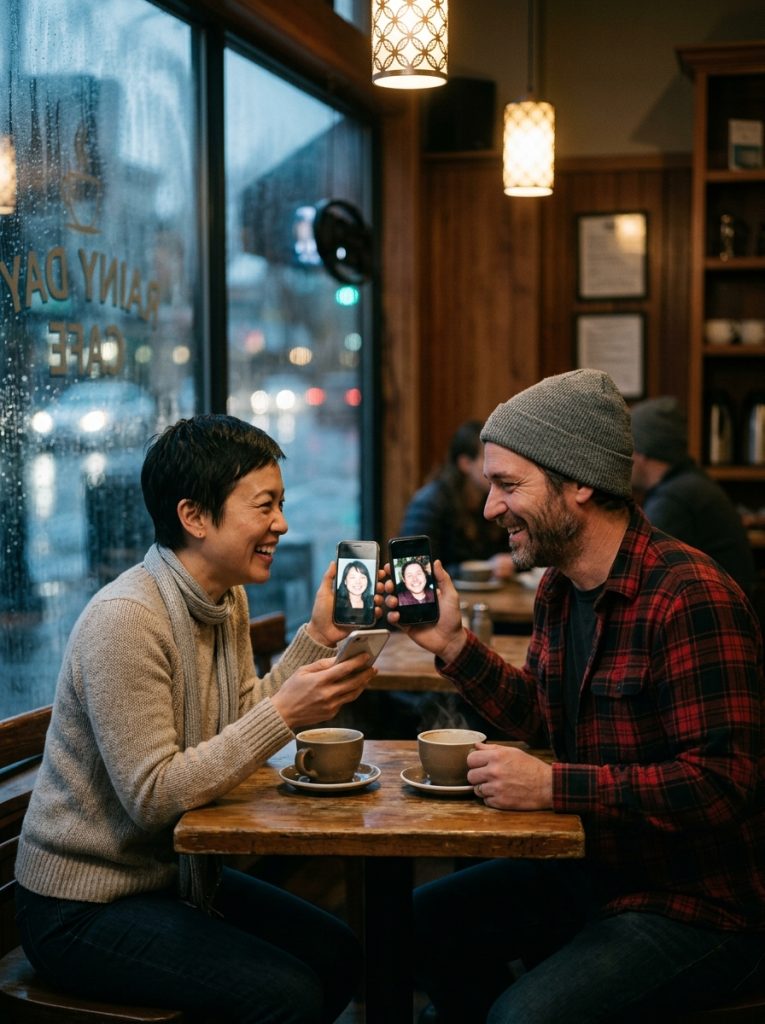
For a while we just sat there, two phones face-up on the table, laughing the way you laugh when laughing is the only thing keeping you from crying.
Then Daniel turned his phone over and slid it back into his pocket, and he went quiet.
“Okay,” he said. “I’ll go first. Since I lied first.”
“You didn’t lie,” I said. “An old photo isn’t a lie. It’s a… hope.”
He smiled at that. “Yeah. A hope.”
He wrapped both hands around his coffee like he needed something to hold onto.
“Two years ago I got diagnosed,” he said. “Lymphoma. Stage three. The photo on my profile is from the week before I found out. It’s the last picture of me where I still looked like — me. Before the chemo. Before I lost the hair, the weight, the whole year.” He shrugged, trying to keep it light and not quite managing. “When I made the profile last month, I almost used a new one. But I couldn’t do it. I wasn’t ready to be a guy whose pictures all start at ‘after.'”
The whole room seemed to go still around me.
“I’m in remission,” he added quickly. “Six months clear. The beanie’s just because the hair’s growing back in weird and I’m vain about exactly one thing now.”
I started to laugh, and then I wasn’t laughing anymore.
“My turn,” I said.
He waited. He was good at waiting. I’d noticed that across three weeks of messages.
“Breast cancer,” I said. “Eighteen months ago. The photo’s from my sister’s wedding, right before everything. Long hair. I loved that hair.” I touched the soft, uneven fuzz growing back at my temple. “I kept the scarf because some days I still don’t recognize the woman in the mirror, and the scarf is the one thing about how I look that I chose. Does that make any sense?”
“More than you know,” he said.
And then he tilted his head, and something shifted in his face. A question forming.
“Where were you treated?” he asked.
“Providence. The infusion center on the third floor.”
He went completely still.
“The one with the bad watercolor paintings,” he said slowly. “And the window that looks out over the parking garage.”
“And the nurse named Gloria who used to smuggle in real coffee,” I whispered.
We stared at each other across the cold cups.
“Tuesdays,” he said. “I had my infusions on Tuesday mornings. There was a woman who always sat in the corner chair by the window, reading paperbacks, who gave the new patients her own good blanket because the center’s blankets were so thin.”
My cup nearly slipped out of my hand.
“That was me,” I said. “Daniel, that was me. The corner chair. The good blanket.”
“You gave me your blanket,” he said, and his voice cracked right down the middle. “My very first round. I was so scared I couldn’t stop shaking, and a woman in the corner — she didn’t say anything, she just walked over, put a blanket across my lap, and went back to her book like it was nothing at all.”
I remembered. God, I remembered. A young guy, terrified, completely alone, no one in the chair beside him. I remembered thinking somebody should be here with him, and nobody was.
“I looked for you the next Tuesday,” he said. “To say thank you. But our schedules must have shifted. I never saw you again.” He laughed, wet and disbelieving. “Two years. And a dating app sat us down at the same table with the same little lie, told for the exact same reason.”
Neither of us touched the coffee again. It went stone cold between us.
We talked until the cafe closed. About the ugly watercolors and Gloria’s smuggled coffee and the specific terror of a beeping IV pump at two in the morning. About the friends who vanished and the ones who showed up. About how strange it is to survive something and then have to figure out how to actually live afterward — which nobody ever warns you is the harder part.
When they flipped the sign on the door, Daniel walked me to my car in the rain.
“I have to tell you something,” he said. “And it’s going to sound insane.”
“We’ve already established it’s that kind of night.”
“I almost didn’t make that profile. I almost decided the whole photo thing was too complicated — that nobody would want to start at ‘after’ with a stranger.” He looked at me. “I’m so glad I used the old picture. Because if I’d used a new one, you might have swiped right past, and I’d never have found out that the woman who gave me her blanket on the worst morning of my life was real.”
I didn’t have a clever answer for that.
So I took off the scarf.
Just took it off, right there in the rain — the first time I’d done that in front of anyone who wasn’t a doctor or my sister.
He didn’t flinch. He didn’t look away. He just smiled, like I’d handed him something precious.
That was eight months ago.
We don’t use the old photos anymore. We took new ones — terrible ones, both of us squinting and laughing, his hair sticking straight up, my fuzz catching the light. Those are the ones we use now.
Because here’s what the worst year of my life taught me, and what one good night undid:
The photo from “before” was never the real you. The real you is the one who’s still here. Scarf, beanie, bad new haircut and all.
And sometimes the person sitting across the table already knows that.
Sometimes they gave you their blanket two years ago, and they’ve just been finding their way back to you ever since.