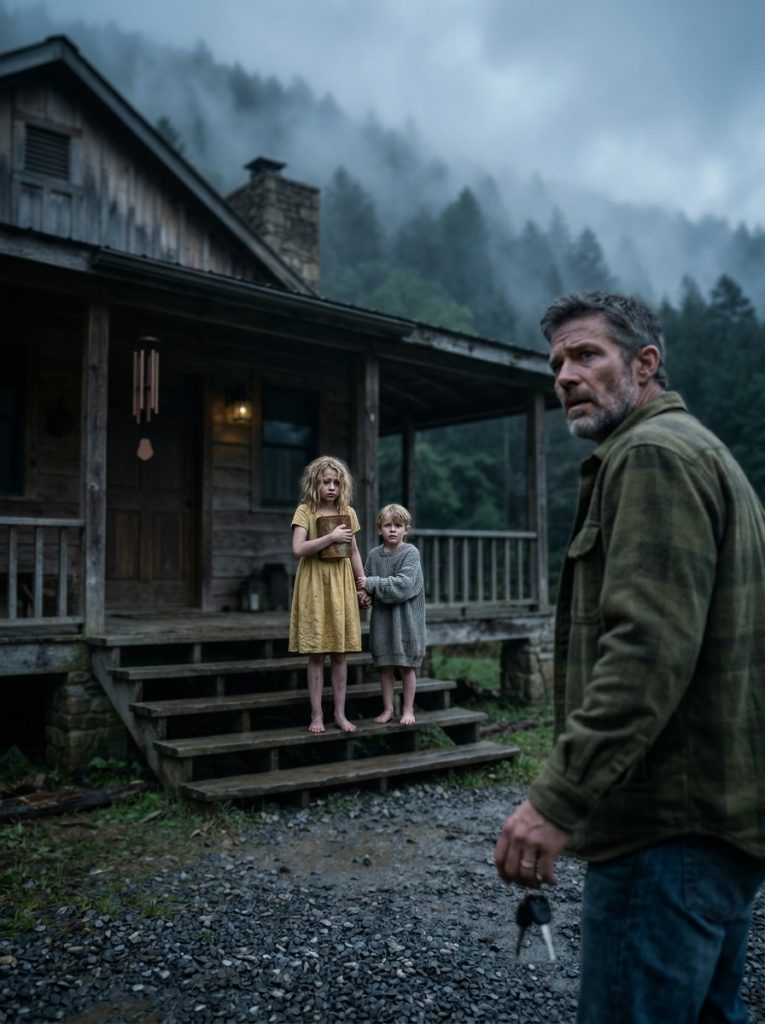
I didn’t go up the trail right away.
First I got those two kids inside, wrapped them in the quilts Grace had left folded at the end of the bed, and put the kettle on like my hands knew exactly what to do even when the rest of me didn’t.
The girl — Lucy, she finally told me — would not let go of that rusted tin.
“What’s in it?” I asked, crouching down to her level.
She opened it then, just a crack, like she was showing me something holy. Inside was a photograph. Soft, creased, water-stained at one corner.
It was me.
A younger me, maybe fifteen years back, standing on that very porch with my arm around Grace, both of us laughing at whoever was holding the camera.
“Mama said you were kind,” Lucy whispered. “She said if we ever needed help and she couldn’t give it, we should find the man in the picture. She said his name was Thomas, and his wife was named Grace, and Grace had the kindest eyes she ever saw.”
I had to sit down on the floor.
“Lucy,” I said carefully. “Where is your mama right now?”
Little Sam, barefoot in his too-big sweater, pointed at the dark window. At the trail.
“She got too tired to walk,” he said simply. “She told us to wait on the porch. She said you’d come on a Friday, because Grace told her you always closed the shop early on Fridays.”
I had. Fifteen years ago, I’d closed the hardware store early every Friday so Grace and I could drive up here before dark. Grace had told that to someone, once, in passing — and that someone had held onto it like scripture for fifteen years.
I grabbed the big flashlight and a wool blanket and I ran.
The trail was Grace’s. I could have walked it blind. Up past the split oak, along the spine of the ridge where she always stopped to breathe and tell me the fog looked like the whole world was being washed clean and started over.
I found her in the old lean-to we’d built our first summer together.
A woman, maybe thirty, thin as paper, curled under a coat that was nowhere near warm enough for the mountain at night. Her lips had gone blue. But her chest was still rising. Barely.
“Maggie?” I said. I don’t know how I knew her name. Maybe Lucy had said it. Maybe I just knew.
Her eyes opened, found my face, and something in them simply let go. Relief — like a breath she’d been holding for fifteen years finally allowed to leave her body.
“You came,” she breathed. “Grace said you would.”
“Don’t talk,” I told her, getting the blanket around her shoulders. “I’m taking you down. Hold onto me.”
She gripped my wrist with what little strength she had left.
“Grace found me on this mountain a long time ago,” she whispered. “I was running from someone. She hid me up here. She fed me. She gave me that photo and your shop hours, and she said — she said, ‘If I’m ever not here when you need me, you go to Thomas. He won’t ask you a single question. He’ll just help.'”
“I’m helping,” I said, and my voice broke on it. “We’re going. Right now.”
I carried her down that trail in the dark, slipping on roots, the flashlight swinging wild. I got her into the truck. I drove ninety miles an hour down the mountain with two children in the back seat clutching each other and a tin with a photograph inside.
She held on through the night.
She held on long enough for a nurse to lean down and tell her, gently, that her babies were warm and fed and asleep in the waiting room down the hall.
Maggie smiled when she heard that.
And then, just before dawn, she let go.
Too late. I keep circling back to those two words. If I’d driven up a day sooner. An hour. If I’d come to clear out the cabin that first awful year instead of avoiding the place for three. Maybe. Maybe.
But I make myself think about what Grace built, too. A promise so solid that a dying woman walked her two children up a freezing mountain on the strength of it, fifteen years after my wife first made it. You don’t earn that kind of faith by accident. Grace earned it one quiet kindness at a time, and never told me, because to her it wasn’t a story. It was just what you did.
Lucy and Sam live with me now.
It took a year of paperwork, a patient judge, and a lot of nights of bad dreams and small hands climbing into mine, but they’re mine now. Or I’m theirs. I’ve stopped trying to decide which way it runs.
We kept the cabin. Of course we did.
The copper wind chime still hangs by the front door. Lucy hung Maggie’s photograph right next to the one of Grace, inside the green-trimmed window, so the two women who saved her are always looking out toward the trail together.
Sometimes Sam asks me if Grace and his mama knew each other.
“They met once, a long time ago,” I tell him. “But I think they’d have been friends for life.”
He likes that answer.
I didn’t drive up that mountain to say goodbye to a cabin after all.
I drove up to keep a promise I never even knew my wife had made.
And somehow, three years after losing her, that’s the most like Grace I’ve felt since the day she died.