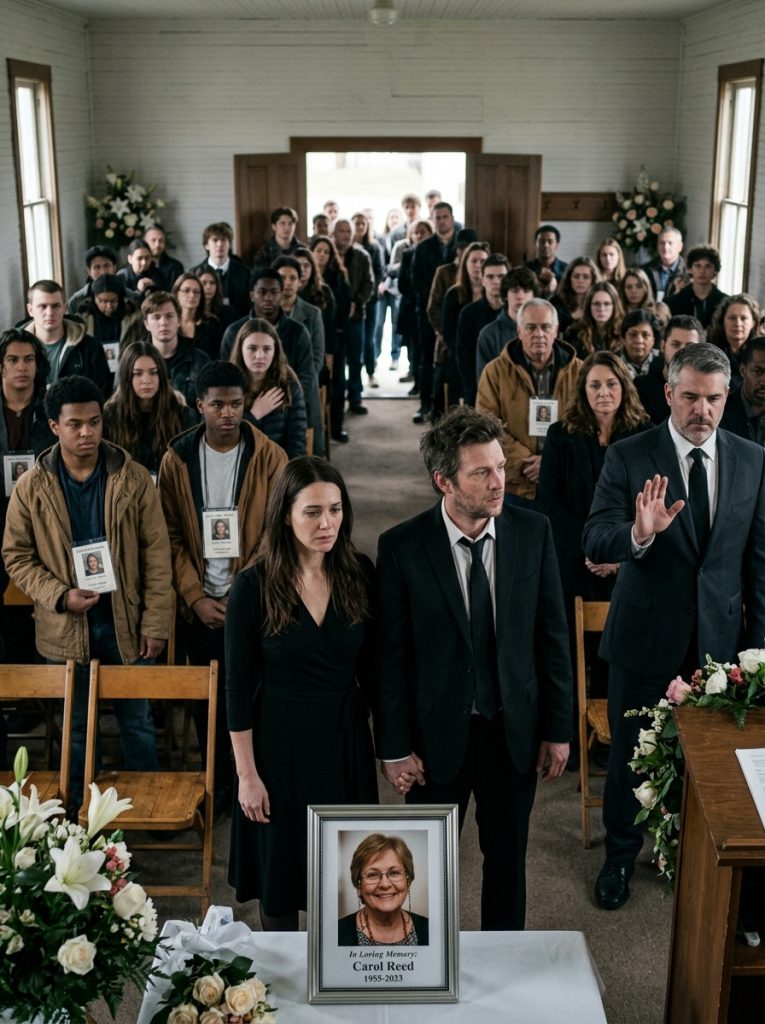
Marcus didn’t sit down.
He stayed at the front of that little chapel, one hand resting on the edge of my mother’s casket, and he looked out at the crowd like a man quietly counting his family.
“Some of you knew her as Carol,” he said. “Some of you knew her as Miss C. A few of you only ever called her ‘the lady with the green door.’ But every single person standing in this room knew her as the one who showed up.”
I gripped Brian’s hand so hard my knuckles went white.
“I was nine when I came to Carol,” Marcus went on. “Angry. I’d been through six homes in two years. I broke a window the first night, on purpose, just to see how fast she’d send me back.” He smiled at the memory. “She handed me a broom and a glass of milk and said, ‘You can be as angry as you want in this house. You just can’t be hungry and angry at the same time. Eat first.'”
The room laughed, wet and broken, like a single held breath let go.
“She kept me four years,” he said. “And when I aged out, she didn’t disappear the way the system does. She gave me a card. This card.”
He held it up. The same small laminated rectangle I had seen in forty pairs of hands.
“On it she wrote her phone number, and one sentence. ‘You will always have a place to come back to.’ She signed every one of them by hand. And she meant it. I called that number at two in the morning when I was twenty-six and about to do something stupid, and she picked up on the second ring like she’d been waiting up for years.”
My legs nearly went out from under me.
Because I finally understood what every person in that room was holding against their chest.
One by one, after Marcus finished, they came forward. Not to the casket. To Brian and me.
A nurse who said Carol sat with her through two miscarriages, in a hospital, holding her hand, because no one else came. A trucker who said Carol wired him three hundred dollars when his rig broke down outside Lincoln and never once let him pay it back. A woman my own age who said Carol drove six hours to her college graduation because no one in her family would.
“She sat in the third row,” the woman whispered to me, “and she cried like I was hers.”
I had been at a sleepover that weekend. I remembered being annoyed that Mom was “away for work again.”
Brian made a sound next to me I had never heard my brother make in thirty-six years.
After the service, when the chapel had slowly emptied, Marcus pulled the two of us aside. He was holding a cardboard box.
“She asked me to give you this,” he said. “If anything ever happened to her. She made me promise, ten years ago.”
Inside was a ledger. Decades of it. Names, dates, small sums of money, phone numbers, birthdays underlined. Hundreds of children. A second, secret budget our mother had run her entire life on a county clerk’s salary — in all those hours we thought she was filing paperwork at the office.
And underneath the ledger, two envelopes. One said Hannah. One said Brian.
I opened mine in the car with shaking hands while Brian sat very still beside me.
My Hannah, it read. If you’re reading this, then you’ve met them, and you’re angry with me, and you have every right to be. I missed things. I know I did. The recitals. The dinners. The school play where you were the only tree without a parent in the crowd. I have carried that every day of my life.
But I need you to understand something. Every child I kept was a child someone else had already given up on. I couldn’t give them back what they had lost. I could only promise them they would never be hungry and alone on the same night again.
You and Brian were my proof that love multiplies instead of dividing. You shared your mother your whole childhood and never knew you were doing it. That was the most selfish thing I have ever asked of two people, and it is the thing I am most proud of in this world.
The cards carry my promise. Now they’re yours to keep. Keep the green door open, my girl.
— Mom
I sat in that car for a long, long time.
I had spent thirty-four years believing my mother was distracted. A little distant. A little bit gone.
She was never gone. She was spread out across forty lives I had never once been allowed to see.
It has been a year now.
Brian and I kept the house. We kept the green door. We went through the ledger and found the last handful of open names — kids Mom was still quietly checking on the week she died — and we drove to every one of them ourselves and introduced ourselves and said, your person didn’t forget you, she just ran out of time.
We had the cards reprinted. The exact same ones. Her sentence. Her promise.
I sign every one by hand now. My handwriting is nothing like hers, but the kids don’t know that.
Sometimes one of them asks me who Carol was.
I tell them she was my mother.
And then I tell them the truth I learned far too late, standing in an overflowing chapel on the grayest afternoon of the year, holding a stranger’s hand:
She was everybody’s.