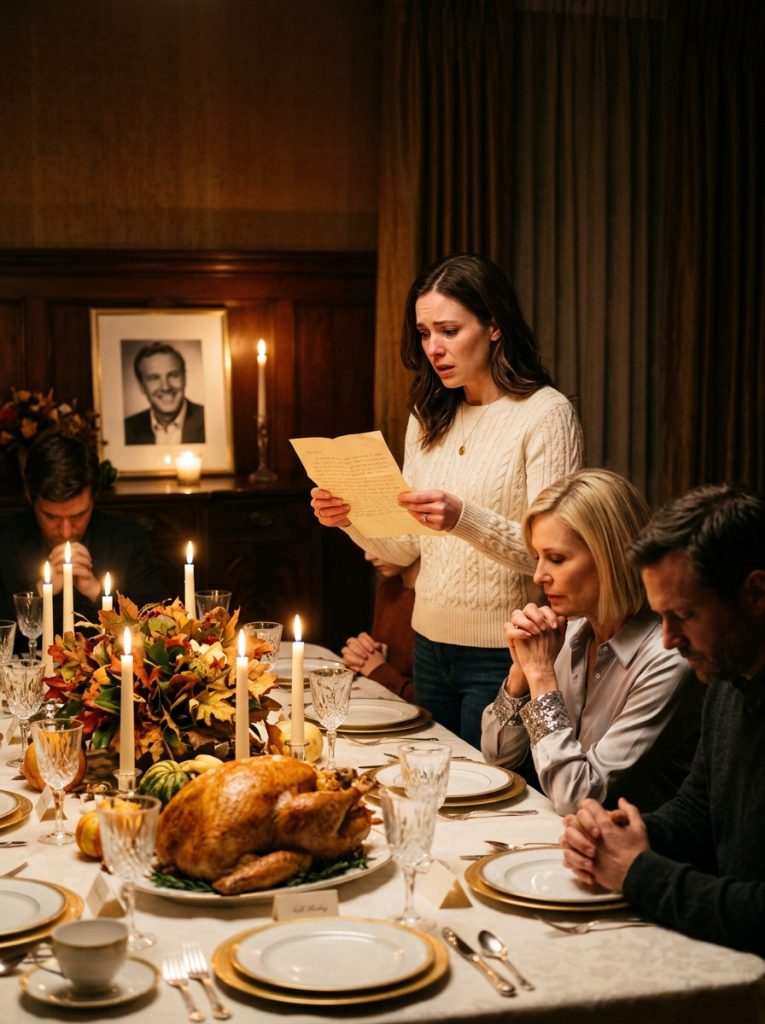
“‘If Nell is reading this,'” I read, “‘then I need all of you to put your forks down and listen to me very carefully.'”
Nobody moved. Diane’s polite smile had frozen into something closer to fear.
“‘I am writing this because I know my family,'” my father’s letter went on, in my voice now, but unmistakably his words. “‘I know what will happen the moment I’m gone. I have watched it begin already, from a hospital bed everyone was too busy to sit beside. Everyone except one.'”
I kept my eyes on the page. I didn’t trust myself to look up.
“‘Diane. I loved you. I want that on the record. But I was not blind. I saw the way Nell’s name came off the lease. I saw the locks get changed while I was still in rehab learning to walk again. I saw my daughter get edited out of her own family, politely, one Sunday at a time, and I let it happen far too long because I was tired and I was sick and I was afraid of being alone.'”
A fork clinked against a plate. Someone — my cousin, I think — had set theirs down.
“‘So let me correct the record now, while you’re all together, with the turkey getting cold.'”
I read the next part slowly, because it deserved to be slow.
“‘In the last fourteen months of my life, I kept a small notebook by the bed. Not out of bitterness. Out of curiosity, I suppose, about who would actually come. Grant, you came twice, both times to ask about the boat and the lake house. Diane, you came when the nurses called you. The rest of the family sent flowers and Facebook prayers.'”
Grant’s face had gone the color of the cranberry sauce.
“‘Nell came every Saturday. She drove three hours each way. She did my laundry and read me the sports page and argued with me about the Red Sox and never once, not one single time, mentioned the will. So I changed it.'”
The room had stopped pretending to be a dinner.
“‘The house in Mystic stays with Diane for her lifetime; I’m not a monster, and a promise is a promise. But the deed reverts to Nell after that — it was her mother’s family’s land before it was anyone’s, and it goes home. The lake house, Grant, that you’ve already measured for a dock you have no right to build — that is Nell’s now, outright, today. And there is an account at the credit union on Water Street that none of you knew about, in Nell’s name, that I have been quietly filling for nine years. Because I always knew which of my children I could trust to be kind when no one was making her.'”
I had to stop. My throat had closed.
Diane found her voice first, thin and shaking. “He wasn’t competent. At the end, he wasn’t—”
“He dictated it to his attorney in March,” I said. “Witnessed. There’s a video. He thought you might say that.”
There was one more line. I made myself read it.
“‘Nell. By now they’re angry, and you’re probably wishing I’d just let it lie. I couldn’t. A man doesn’t get to fix much from where I’m going. But I can make sure the last word at that table is the truth, spoken in your voice, so you’ll finally hear out loud what I should have said a hundred times while I could still say it myself: you were the one who stayed. Now eat something. You always forget to eat when you’re nervous. Love, Dad.'”
I folded the letter.
The silence was enormous.
I didn’t gloat. I didn’t have it in me. I just put the letter back in my bag, and I picked up my fork, because the last thing my father ever asked me to do was eat something.
The fallout took months. Diane’s lawyer looked at the video, the witnessed documents, the nine years of deposits, and advised her to accept it. Grant didn’t speak to me for half a year, and then, strangely, he did — a short, awkward call that started about the lake house keys and ended with him saying, quietly, “He wasn’t wrong, you know. About who showed up.” It wasn’t an apology. But it was honest, and from Grant, honest is rarer than sorry.
I have the lake house now. I go up most weekends. My mother’s family’s land, come home at last.
There’s a notebook in the nightstand drawer up there — Dad’s, the small one, that the attorney gave me after everything settled. I’ve never shown it to anyone.
On the last page, under fourteen months of dated little entries, he wrote one line that wasn’t meant for the table.
“Saturday. Nell again. I don’t deserve her, but I raised her, so maybe I did one thing right.”
Every Thanksgiving since, I set a place at the lake house for one more than will come.
And before anyone eats, I say grace.
Out loud. In my own voice. The way he taught me.